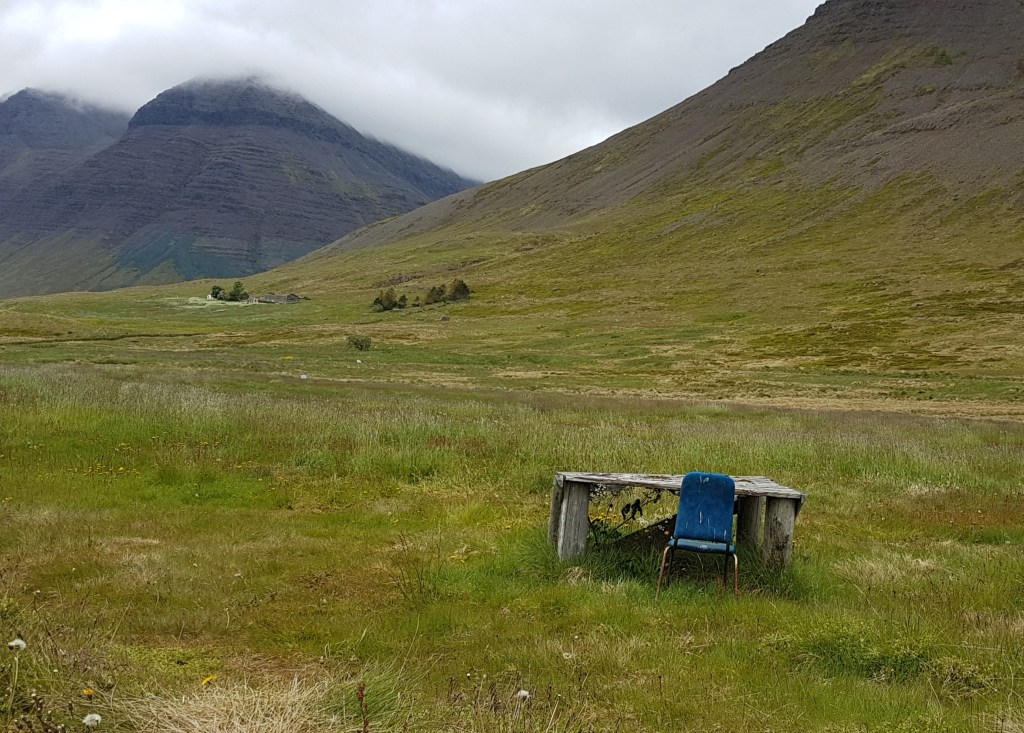
IN THE LAND OF UNSHEEPISH SHEEPLOVERS

“So he wants sheep,” said the man to himself. He shook his head…” (Independent People, p 210)

Don’t you sometimes feel like going to a place where volcanoes might blow up at any time? Well, my husband and I actually had no hankering for that kind of thing on our way to Iceland. A., in fact, was stuck on wildfowl and I on livestock. Because I was busy rereading ‘Independent People’, by Halldor Laxness. Never heard of it? Well, you’re missing out on a brutal and beguiling 20th century saga, worthy of the medieval ones that came out of the island lying atop two continental plates, the North American and the Eurasian, just below the Arctic Circle. All kinds of thermal activity there. Geyser is, in fact, an Icelandic word.  Saga too: long stories about people in a wondrous place almost unfit for human habitation.

I first picked up ‘People’ years ago only because of the stubborn-looking creatures on the cover. Then I rushed through page after page. I read about a man fiendishly obsessed with the animals that were going to make him free, on a bit of remote turf spurned by everyone else. Just like his Viking ancestors did, away from their kings and bishops.

Bjartur of Summerhouses only had one life to live and had no time to worry about the welfare of wives or children. Subsiding on meal after meal of porridge, or trash fish, all drowned in endless cups of coffee. Coffee! Hardly a drop of liquor! I finished the grim tale, and said, ‘Never again!’

But then I began leafing through the dusty volume once more just before my journey. The second time round there was sly humor, and poetry. And even love, tucked away here and there among the rocks, so to speak.   

Phalaropes, and green shanks wandered across the pages too.
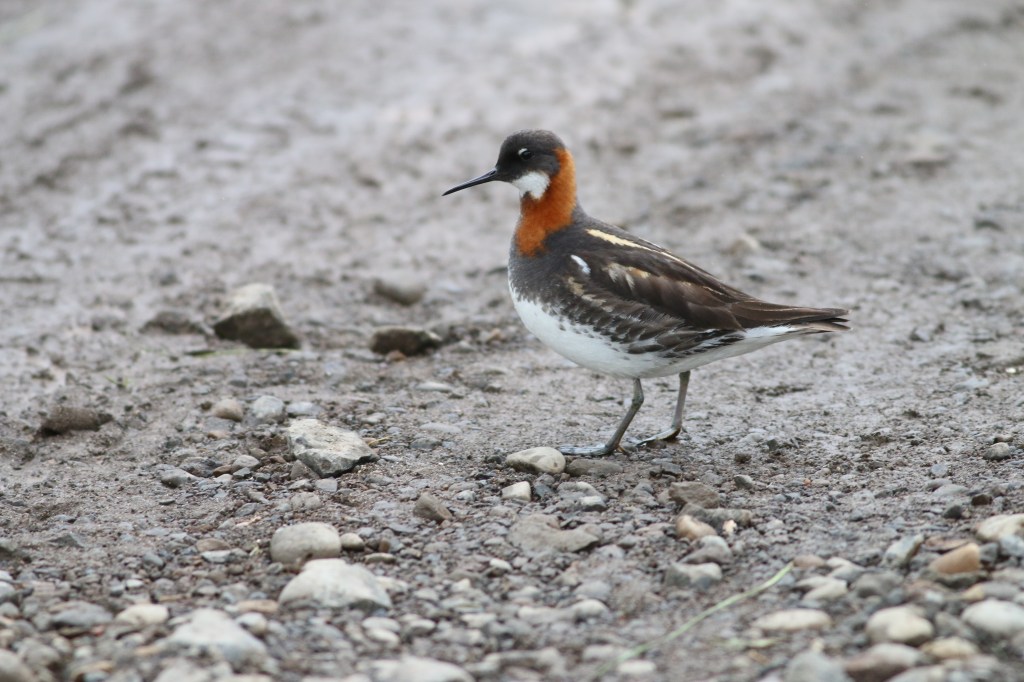
Red-necked Phalarope

I threw the paperback into my suitcase, along with a few summery things, on the 22nd of June, 2019.

An impatient teenager showed up at the Reykavik airport at 1 am to take us to his off-site car rental agency. Our eyes were half-closed, but he threw our bags into his jeep with energy and dashed off on a gravel road to a hill of granite overlooking the great ocean. The sun was just taking a cat nap below the horizon and its light was still hovering around. The solstice wasn’t over yet, by golly! We left our young dealer to celebrate this joyful event with his friends and the unopened cans of beer lining the floor of his little prefab office. Ah, that was a bit more like it.    

The, undeterred by the piece of paper on the dashboard of our basic car warning us about STRONG WINDS and reminding us to NEVER TAKE THIS TYPE OF VEHICLE ON ANY F-ROADS!, we made our way to the capital.  

F-roads, f-roads, I mused, as I dozed in the passenger seat. My oh my. What a rough land this must be.

The next morning, like someone worried about delirium tremens, I felt the need to stock up on books. I managed to find one on local history and another couple of novels by Laxness, not only a great but also prolific writer! This one was about an Icelander becoming a Mormon and moving briefly to Utah in the 1860s. Astonishing! The Latter-Day Saints were already evangelizing in such far-flung parts of the world in their early, unrepentant days? Now it’s true that the scenery in both places can be, let’s say, unexpected. The immigrant wouldn’t have felt like such a fish out of water. And maybe that’s where certain non-drinking habits were picked up, by some people, at least.   

Drowsy after driving for an hour in a northerly direction, we stopped in the town of Bogarnes to get some stimulants. We found some in The Settlement Center, a museum that was well worth whatever fee we paid. You really shouldn’t be too thrifty when sightseeing, not even in pricey climes. You can always save on food. Not every part of the world has a cuisine to write home about, in fact.

Well, we found out that the island looked rather different when the Norsemen showed up, in the late ninth century of our times. The new human arrivals found trees, by gosh. Some tall ones and many svelte birches, and grasslands, and winged creatures, and a few Irish monks, who then disappeared. The birds still flock to Iceland from far and wide, but the forests, alas, went the way of the monks. And the cows, the horses, and, last but not least, the sheep, were all brought over by the Norwegians along with the Celts they enslaved or married in Ireland and those other British Isles.  
  

The newcomers were called, appropriately enough, the ‘landtakers’. There was no heirarchy, no monarch, no government. Then the settlers founded their parliament, the Althingi, which sounds suspiciously like ‘all things’, and created an island community now referred to as Free State Iceland. This golden age of taking land and free statedom lasted from about 874 to 1264 CE.

The immigrants recorded the names of the first farms in a register called the Landnamabok. They recorded the names of their representatives at the Althingi. Icelanders are keen on documentation. A young man working at the museum told us that he knew for a fact that he was descended from one of the first pioneers. He had it all in his family tree. Ah, family trees. Another odd connection there. An image of my father working away in the basement of the Mormon archives in Salt Lake City flashed by in my mind.

The Thingi took place in the Thingvellir, meaning ‘parliament plain’. But it is also a continental rift! The Mid-Atlantic Ridge.

Laxness’ narrative was becoming less arcane. Its sometimes inscrutable, and many times callous hero, Bjartar, lived in the early part of the 20th century. An Icelandic everyman who was steeped in the history of his land, he was up against the elements, large landowners, and modern-day merchants. He couldn’t be encumbered by ‘feelings’. But he wrote verses. And though he didn’t send his children to school and barely fed them, he made them memorize the ancient tales of feuds and valor and romance.

We continued on our route, which included a ferry ride from the towns of Stykkisholmur to Brjanslaekur in order to skip a bay and a peninsula. You just can’t see every one, although I would never say, ‘seen one, seen them all’!  No, no, no. Every fjord has its distinct personality and deserves to be photographed, at the very least. But we were in a rush to get to the westernmost point of the fjords in the westernmost part of the country, the Vestfirdir. The least visited by people, the most visited by the avian population. And the most reminiscent of the kind of place where Bjartar staked his claim on an abandoned and possibly bewitched patch of soil.  

There is one main highway in Iceland, called route 1. It has two lanes, scarcely any shoulders and goes in a slow circle. The roads leading off of the ring road 1 are slower yet, and some are also denominated F. As noted earlier. Well, I could only imagine what it was like in Laxness’ youth, when Iceland was neither a tourist mecca nor independent.

We disembarked and drove like mad to the western edge of the western fjords, the cliffs of Latrabjarg. Maybe not what everyone would endeavor to see, but honestly how can you not feel elated when you are on top of one of the highest birdwatching spots in Europe? Really?

So much to fit in before the endless day ended! The air was downright chilly and the wind was strong. My imagination had failed me in terms of garments. I was shivering and the hood of my thin jacket kept blowing off my head as we wandered along the edge of a grassy field that suddenly turned into an eroding ledge. I could see waves breaking below, where the Denmark Strait meets the Atlantic Ocean. Greenland was the next stop over to the New World.

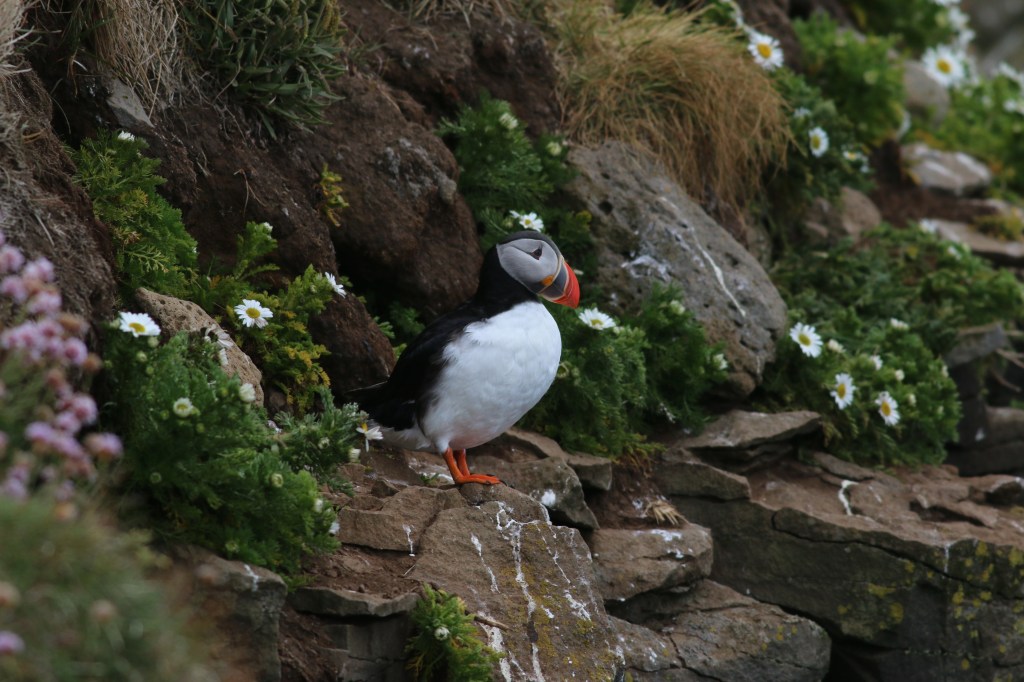
Puffins, guillemots, gannets and eagles were darting and soaring and feeding their young in a free state. At liberty to come and go.
We then hurried to the one hotel, very practically named the Labratarg, with a room available in the entire area. When we arrived at the lodge, only open in the summer months, the elderly owner told us that there was some food left for us. Good thing, he added, solemnly. It was 9 pm and the next eatery was hours away.  

Our international dinner was served to us by staff from Latin America. The owner explained that Iceland has such a small population that it has to look elsewhere for employees during the tourist season, especially in the more remote areas. We drank a little beer, without overdoing it, and then my husband and I went out for a walk along the main road. It was gravel and it was deserted. Except for some weird sounds. A ghostly thing was ricocheting from one side of the road to the other in the twilight. There was also talk of the supernatural in old Icelandic tales. Necromancers and elves and such. Then we finally managed to catch a flitting spectre in our binoculars.  A brave little snipe! The lesser snipe, to be exact, beating its wings back and forth so fast we’d have never been able to bring it down with, say, a gun.  

The Vesfirdir on a map resemble a sort of eight-fingered left hand with a small wrist and a huge thumb. A recipe for a meandering trek in a vehicle. Our next drive took us up and over one of the digits, from the Patreksfordur to the Sudurfirdir. The wind did buffet our vehicle, and as I gingerly cracked open the passenger door at the top of one climb, it almost got torn off its hinges. That warning was correct.

Long views of water, and barren mountains. The trees were cut down for fuel and to build small boats. The sheep could roam about and find food. Their wool was wonderful. But the sheep also ate all the edible highland plants, which didn’t grow back easily. There were volcanic eruptions as well. Only 1% of the forests still exist and nearly half of the grasslands are gone. No wonder not everyone was enthusiastic about the grazers.

We stopped to read a sign about a famous saga. Not a dwelling in sight in these denuded uplands, but some deeds were done here back in the heroic Middle Ages that Bjartur studied with fervor.

More driving on gravel roads, with wind and rain. Not many trails to detect. Markers but no actual paths. Some sturdy hikers with ponchos and long staffs were going up steep inclines willy-nilly, in the stark landscape.

Starkness, starkness. There was grass in the lush valleys at the head of the fjords, but not much greenery on any slopes closer to the sea. In fact, quite a bit of scree, with just patches of blue to give them some color. What extraordinary flowers, I thought, those purplish-blue things. Then I read that these Nootka lupine were introduced from Alaska after WWII. A pushy plant which creates controversy. It holds the land, and adds fertility. But it is not native and no one can stop its proliferation. An invader or a godsend?  

After Norway took over the country in the 13th century, Denmark then dominated Iceland from 1383 until 1944. By then the more powerful country was occupied by the Nazis. Iceland had invited the US to set up a base on their soil and the new nation was born with the blessing of the country then considered the leader and defender of the free world. 

So independence came once again for the Icelanders. Independence, after those early, heady days, so reminiscent of the ancient Greek polis, what philosophers enthused about. Some historians say that democracy took shape where it did in the Mediterrenean because of the mild climate. People could walk about, and socialize and exchange ideas at all times of the year. But maybe an inclement climate with little to offer the greedy could have the same result.

We started wandering around humpy green hillocks. There were sheep too, contented sheep. Like the ones belonging to Bjartur after things started going better.  When his family was no longer starving, during WWI. As the character says, slaughter on the continent, good business for the Icelanders. Bjartur the everyman was never worried about being genteel.

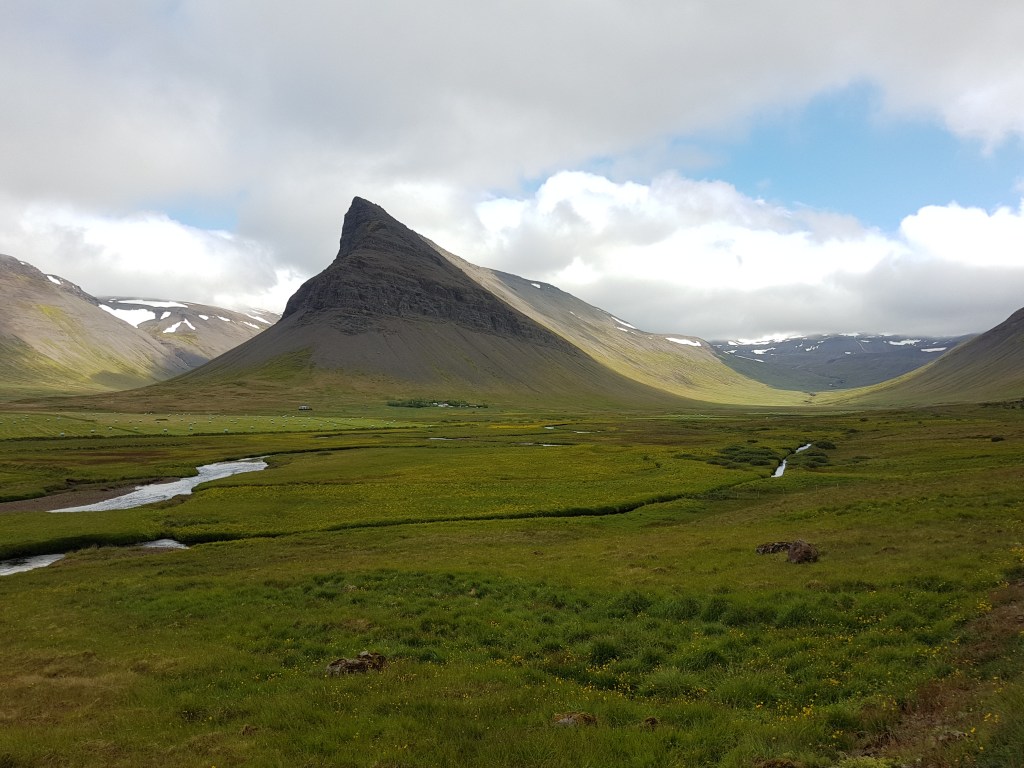
After a few nights in Sandfell, in an expensive hotel with school cafeteria-style food and tiny bathrooms and hard beds, we started on the long gracious slog from Isajordur over to Holmavik. A billboard for a campground advertising a natural hot pot caught our attention. A charming steamy basin in the ground. We paid a small sum of money to use the changing rooms to put on our swimsuits under our clothes and then walked across a field and over a stream to a windwhipped hillside with a hot spring filling a pool not much bigger than a bathtub in a luxury hotel.  I tested the water with one toe and then dropped in, to defend myself from the fresh air of summer in Iceland.

We then decided to have, yes, that black live-giving beverage, coffee, in the campground cafeteria. It was a large room where they also sold maps, souvenirs, and, finally, at last, thick homemade sweaters. Where had they been hiding the last few days? The unique seamless pieces were hanging on a rack near the cash register. I tried on all five and decided that only one would fit me or my daughters. 180 euros, under the table. ‘You see,’ the cashier explained, ‘they are just handknitted by local women in their spare time…’ There was, fortunately, a handy ATM in the facillity, where we could get the dough to purchase this truly national treasure.  

Feeling more at home, clad in the waterproof fabric of the commonwealth, I was now ready to explore other places. We spotted more greenshanks and redshanks and terns in the torquoise or agate colored water we passed as we munched on dried fish jerky I’d bought at a convenience store. The stringy, salty fish with its leathery skin still intact might have been something even Bjartor would have disdained. Or not. Land of tough people.

We were now leaving the western hand of the country. We had to go to other parts and check out some thundering waterfalls, and see other bird species. Suddenly, our dirt road became paved as we were coming down a steepish hill. The car jolted, unused to smoothness. We had come out of the wonderful wilds. Sigh.

There were big tour buses and many cars on the road east, following the undulating northern coast. We went to a bakery in a little port town and bought another sweater, cash down. This time there were four of them hanging on a rod next to the bread and cakes. The ATM was just across the road.

I saw a government-managed liquor store in the same shopping area. It looked identical to what you find in Utah. This was also astonishing. No advertising, a barely visible sign on a plain building. But yet, plenty of people were coming in and out, carrying large bags. That evening we went to a restaurant in the countryside to eat some lamb. My husband and I ordered beer, and then he ordered another one. The teenaged waitress glared at us. She was part of the Christian Women’s Temperance Union crowd, clearly. Bjartur might have agreed, although he wasn’t sure he was a Christian. Still had that heathen in him, able to survive among the hot pots and lava.

The responsible young woman certainly had a point. Who would want to navigate route 1 when tipsy? Or venture onto a diabolical road by mistake? There were plenty of brands of artisanal brews on the menu, though, and everyone seemed to be enjoying their amber drinks.  It was clear that Iceland was as divided about alcohol as it was about the purplish-blue flowers!

Our last night out on the road we stopped in the birthplace of the famous writer Snorri Sturluson, the man who wrote down all the Norse myths about Odin and Freya and so on, saving the fireside tales on parchment for eternity. We would, in fact, not know about Thor’s hammer if it hadn’t been for this energetic man of letters living on an island with geysers in the 13th century.

 I went up to the door of the neaby bed and breakfast place I’d booked. A woman came out to greet me enthusiastically in her local tongue. ‘I’m so sorry!’ I said apologetically, ’but I don’t speak your language…’ Our host was floored. ‘But your name looks Icelandic!’ she said in perfect English. ‘No, no, it’s actually Irish…’ ‘Oh, I’m also terribly sorry,‘  the good woman replied. ‘I don’t speak any Irish…’ ‘Me neither…,’ I replied. I smiled and shrugged to show there were no hard feelings. How could one explain to an Icelander, of all people, that not all idioms or cultures make it out of the great maelstrom of time?  

 I thought that was that, until the next morning, when she served us breakfast.

‘I’ve had a think,’ the dark-haired lady said. ‘You know, the Vikings brought Celts with them long ago. So we are related, after all.’ She patted my hand.

She was right, of course. We are all related and connected in some way, not just through Irish thralls dragged to Iceland over a thousand years ago. I thought about this as I wore my new sweater during the next, dread, winter of 2020, in Italy. I discovered during that first pandemic lockdown that I didn’t need to turn up the heat at home with all that thick yarn on me. It was a grand thing.

 I was also able to save money on fuel during the next winters, with prices going up every month. Invasions and that kind of thing. So my investment paid off and I also helped the rural economy of that not-so-faraway land. Laxness’ land.

I would go back someday, to the fantastical island. European, but not only. To see more birds, so cosmopolitan, and volcanoes, and trundle along mysterious thoroughfares. To frolic in the crisp summer wind, like a sheep. The grass-devouring, erosion-promoting animal so beloved by the free Icelanders.  

F for forbidding??

Recommended reads:

Independent People by Halldor Laxness

Viking Age Iceland by Jesse Byock
Biting off more than I can chew, in three countries, on a bike

Riding towards a pass we knew nothing about

One day at the end of April, my husband Annibale (Hannibal in English) and I decided to try out cycle touring. Good for our bodies, and everyone else. There would only be some sweat oozing out of us, but no other noxious emissions.   

The problem was, of course, where to go on our bikes: forests or towns with art galore? Climb slopes or stay on the flats? Ah, an embarrassment of riches where I am plunked down, in a flat town in Veneto between the mountains and the sea.

Why not simply put it all in the hands of an app? What could go wrong? So that’s what my significant other did last spring while I was away to comfort my old dad and say hello to our newborn granddaughter. The morning after I returned, via London, where I got drunk on beer at Heathrow for lack of anything better to do during my 7-hour layover, the alarm went off and I was dragged out of bed. ‘We have to get to Austria before dark!’

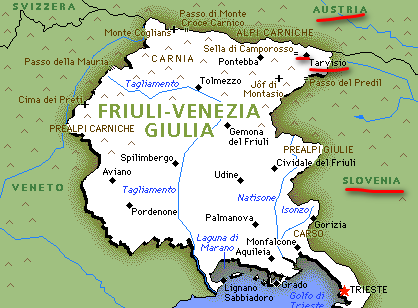
I dozed on the road to Friuli-Venezia Giulia, the region east of Veneto. Venezia Giulia is the southeastern coastal spur which includes the city of Trieste, and Friuli is the rest. By the way, if you haven’t heard a thing about the latter, don’t worry. It is one of the least known parts of Italy. The same goes for Molise, the ‘region that doesn’t exist’ that my husband happens to come from (next post).

We drove in our diesel-fueled automobile to a spot which would get us closer to our destination. It wasn’t right, it was going against the whole ethos of doing things off the grid (apart from all that airplane travel…), but Komoot, our trusty digital guide, had come up with an ambitious ride for the amount of time at our disposal. We couldn’t let it down, according to the human next to me who’d actually empowered the app.

But I was game. As game as a wreck suffering from jet lag who hadn’t been on any sort of bike in months could be.

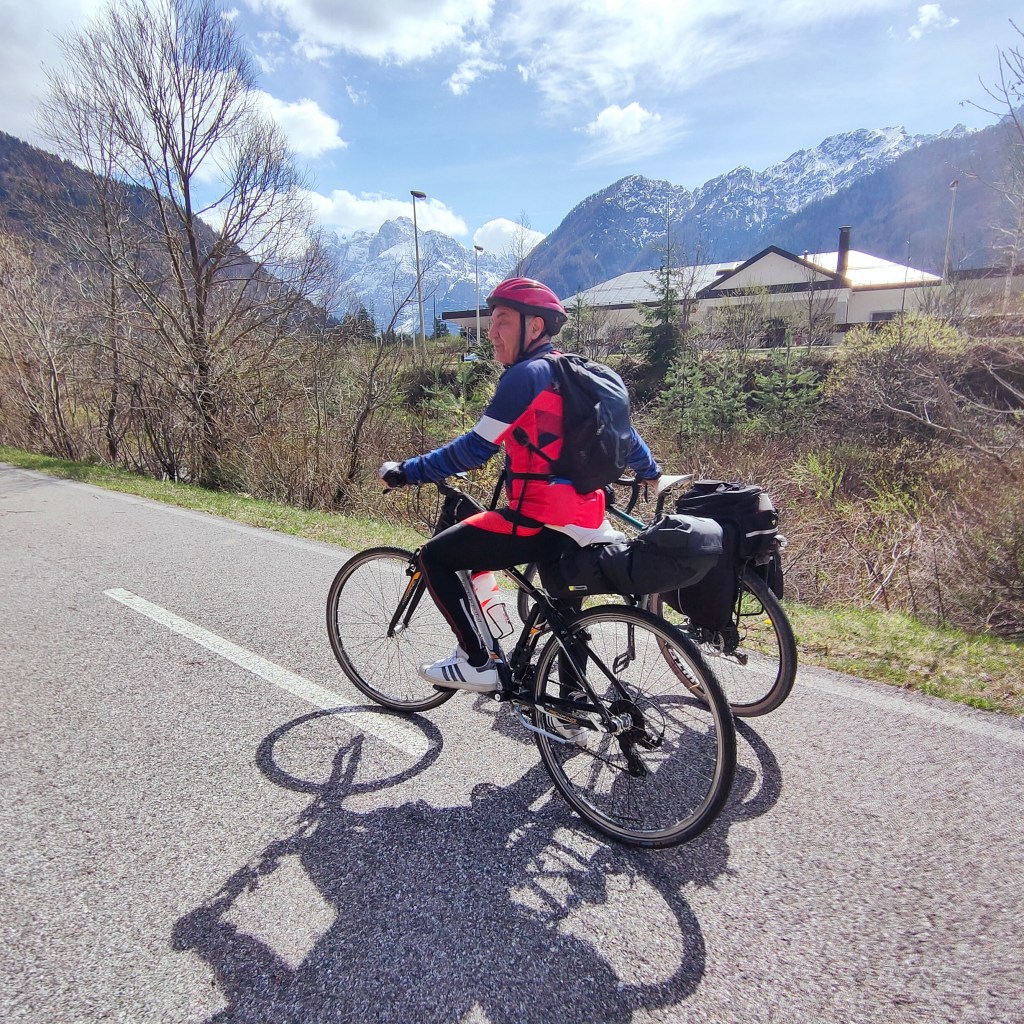
We parked in front of the Pontebba train station and headed north on a path that even my father could have handled with his walker.


Now, we were in a territory nestled between Austria and Slovenia, with some communities that still speak German and Slovenian. For this and other reasons, Friuli has a special autonomous status. That means that its local idiom, Friulano, more similar to Italian, has special status as well, and is called a language, as opposed to a lowly dialect.

Friuli produces wine, has mountains, and water flowing from the mountains, and a
vast plain, and beautiful towns which are not very large. Sparsely populated, one could say. A frontier land that is also prone to earthquakes, alas. It also saw quite a bit of fighting in WWI between the Kingdom of Italy, and the Austro-Hungarian Empire, and its German ally.

Hemingway’s A Farewell to Arms describes the chaotic Italian retreat of 1917 from Caporetto in present-day Slovenia. My husband’s grandfathers, young men who had
hardly ever left their little hamlets in the Appennines of southern Italy, were both
swooped up and conscripted to fight in the Alps of northeastern Italy during the Great
War. Despite having been wounded in Friuli, one grandpa always talked about going back
to visit that place in the wild blue yonder where he came of age, and didn’t die.

The ascent to Austria on the bike trail was so gentle that even my flabby legs didn’t feel it. And what a fine surface, set apart from the main road, with views of the river Fella below and the peaks of Carnia (northeastern Italy) and Carinthia (Karnten in southern Austria) and Carniola (Primorska and Gorenjska in northwestern Slovenia) standing in all their April splendor. You couldn’t ask for more, really.  

ascent on the forgiving Alps to Adriatic cycling path

We reached Tarvisio in no time. It lies in a land of three countries, a Dreilandereck, one of those handy German words that describe a whole situation in five or ten seconds. You can consult Mark Twain’s highly-esteemed essay The Awful German Language (https://faculty.georgetown.edu/jod/texts/twain.german.html) for more on that.

Tarvisio is famous for being in that little corner. And for having been wrested from Austro-Hungarian control during the devastating territorial war mentioned previously. Notice that the gracious sign below is written in four ways: Italian, Friuliano, German (the latter two identical here) and Slovenian.

Welcome to a border town

So far, so good. We ended up in a woody area near the extinct border between Italy and Austria, where we were following a scruffy-looking man in his late 60s with hefty panniers on both sides of his bike. He looked as if he hadn’t had the chance to take a shower lately. At a certain point a car shot out of a side road that had access to our path, forcing our cohort to make a sudden stop. ‘Asshole’, I heard the poor guy bellow. I sped up to talk to him, thinking he might be from my homeland. But no, he was a German from Bremen. Wow, I thought. Has ‘asshole’ entered the German tongue, the same way Americans say kindergarten and scheister lawyer?  Would have to ask my Teutonic colleagues about that. Full disclosure: I’ve been trying to improve my basic knowledge of the formidable German language on Duolingo as I think it’s good for my brain. No matter what Twain says. Anyway, the Bremener had cycled all the way from the North Sea to Venice and was now pedaling back. He deserved to tell the brutish automobilist off.

We were all heading for Villach, a small city in Karnten with a Slovenian name. Makes sense. The country we associate with The Blue Danube and Sissi and Sacher Torte was once part of a sprawling political entity with a whole slew of peoples and tongues. Many ethnic groups were eventually able to create their own nation-states, which didn’t necessarily include all the areas historically inhabited by them. Languages leave traces.

We crossed into Austria, where the bike path became less idyllic. We were inhaling car exhaust as we pedaled next to traffic-ridden thoroughfares in Villach, until we turned off the main route to go to an outlying village we’d chosen for a cheaper overnight stay. There we found the sort of Sound-of-Music type countryside we’d been expecting. Tidy green fields, and an understated church. And once we arrived at our modest hotel, I discovered that studying German can actually be useful, rather than simply entertaining or a way of staving off dementia. Just because English is the modern-day lingua franca doesn’t mean, of course, that everyone speaks it. Not everyone is into that kind of thing, in fact.

Back road in Austria

So I managed to understand the most crucial things, such as where the only restaurant in the entire area lay. Just a twenty-minute walk. What a relief, as our loaded gravel bikes needed a rest for the day.

I was also lucky enough to have studied, on my app, all about the love of German-speaking people for white asparagus. A goodly vegetable, full of nutrients. But what makes it so extraordinary? I reminisced about a corn-on-the-cob festival in Wisconsin I went to as child. There was a feature where you could pay five bucks for as many cobs as you could knaw on in 15 minutes. I’m sure swallowing small slices of pale slender stalks cooked in different ways is much more elegant. And therefore makes people go wild with delight, somehow.

White asparagus non-vegetarian specialty

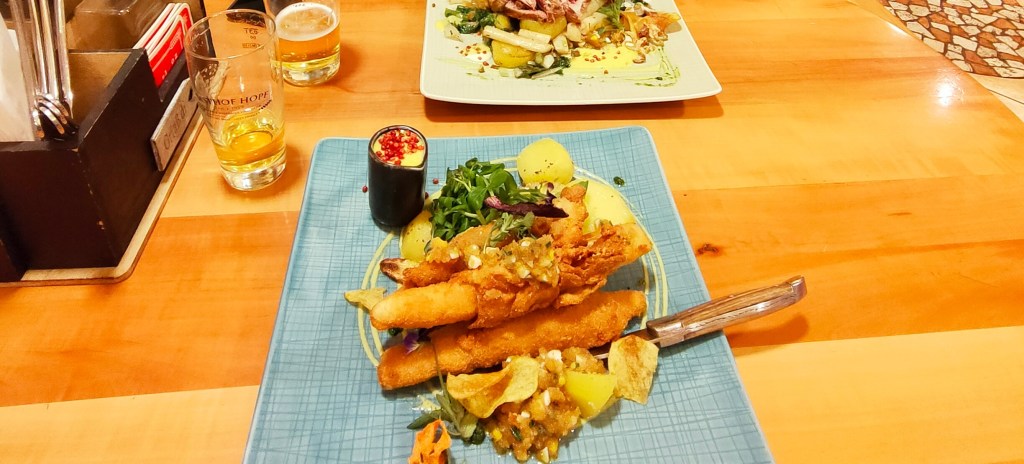
In any case, all the lessons about the famous Spargel turned out to have a purpose. They gave me a heads-up on why the local gasthof had an entire menu dedicated to this wondrous vegetable. Deep-fried asparagus wrapped in bacon may not be particularly healthy, but it did go down the hatch quite easily (along with some more beer).

Back in our room under my eiderdown, still suffering from jet-lag, I pulled out the reading material that I’d stuffed into my case. A slim paperback in lieu of an extra pair of socks. Wunschloses Ungluck, by the Nobel Prize winner Peter Handke. Difficult to swim through, but not because of its style or unbearable title (translated as A Sorrow beyond Dreams, although I would label it Dreamless Misery. But my German is execrable, so what do I know?). I was simply biting off more than I could chew. It’s a bad habit of mine which I still haven’t rid myself of. Now, I knew the ending was bad – the author’s mother was going to kill herself – but it was something a friend had once given me, it had been sitting on a shelf, neglected for twenty-some years, and it took place in Karnten. I opened it to the first page.

It turned out that Handke’s maternal grandfather was of Slovenian descent and was the first of his line to actually own property and thus be rich enough to marry. His forebears were farm laborers who procreated without the luxury of becoming husbands. I thought of my own great-great-grandfather in Sweden, who did marry, it’s true, but was also landless and so poor he had to live ‘on the parish’ – 19th century Scandinavian welfare. Some of his nine children, including my great-grandmother Nina, emigrated to America to escape that fate. I then nodded off before I could get much further than understanding that women living in rural Carinthia in the early 20th century weren’t supposed to expect much out of life. Their lot was to have a few laughs before the grim reality of marriage, children, cooking, and death.

We cycled eastward the next day. An easy ride along the Worthersee, a long lake surrounded by hills. Ah, I was in better condition than I thought. This was a bed of roses.

Calm, restful Worthersee

We passed through Klagenfurt, the busy capital of the region, had coffee, and turned north, just to put in a few more kilometres. All quite leisurely. And it turns out this is known as the sunniest part of Austria! Handke might disagree with that appellation, however. One of his sentences I actually understood without a dictionary focused on endless days of rain and fog.

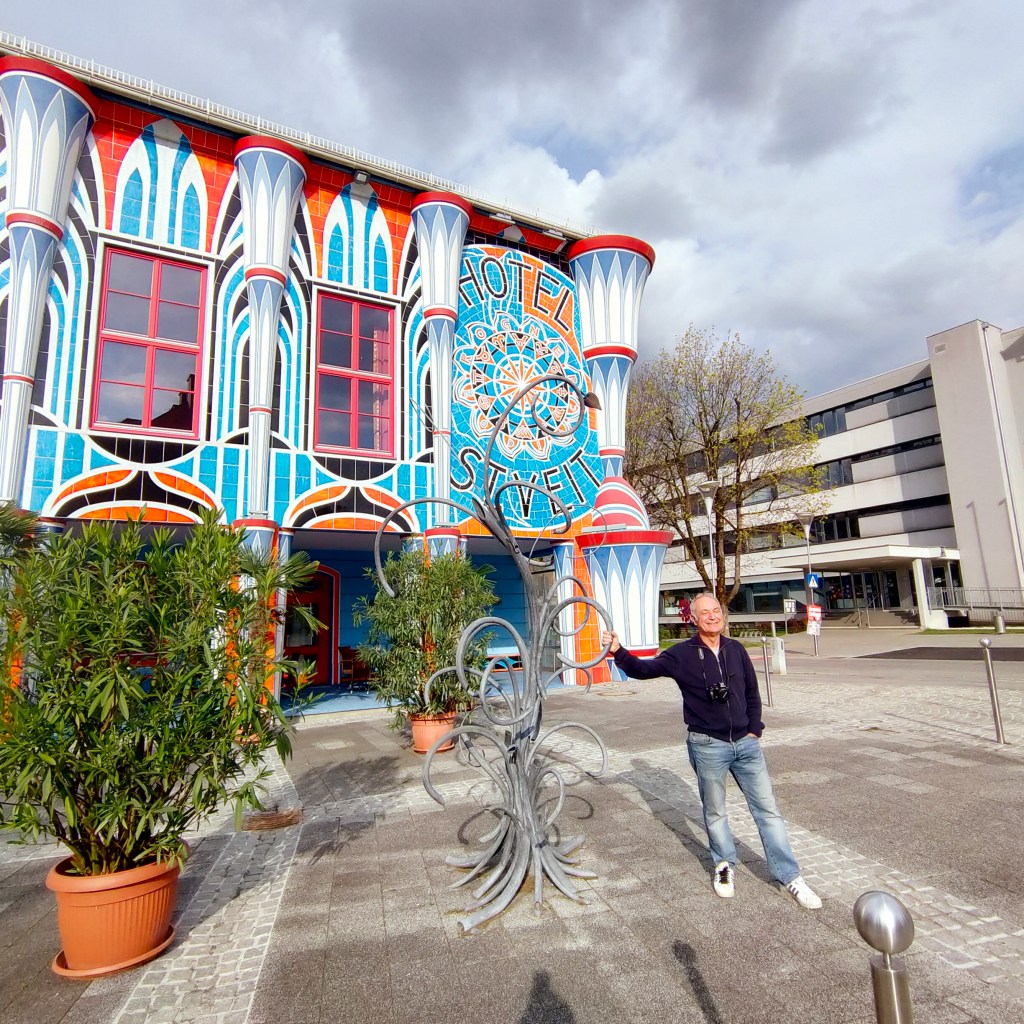
Only a little bit of grayness for us, though. We made our way up to Sankt Veit an der Glan and stayed in a fantastically decorated hotel. Austria is also known for art and design. Think of Schiele, Klimt and Hundertwasser.

Exuberant facade
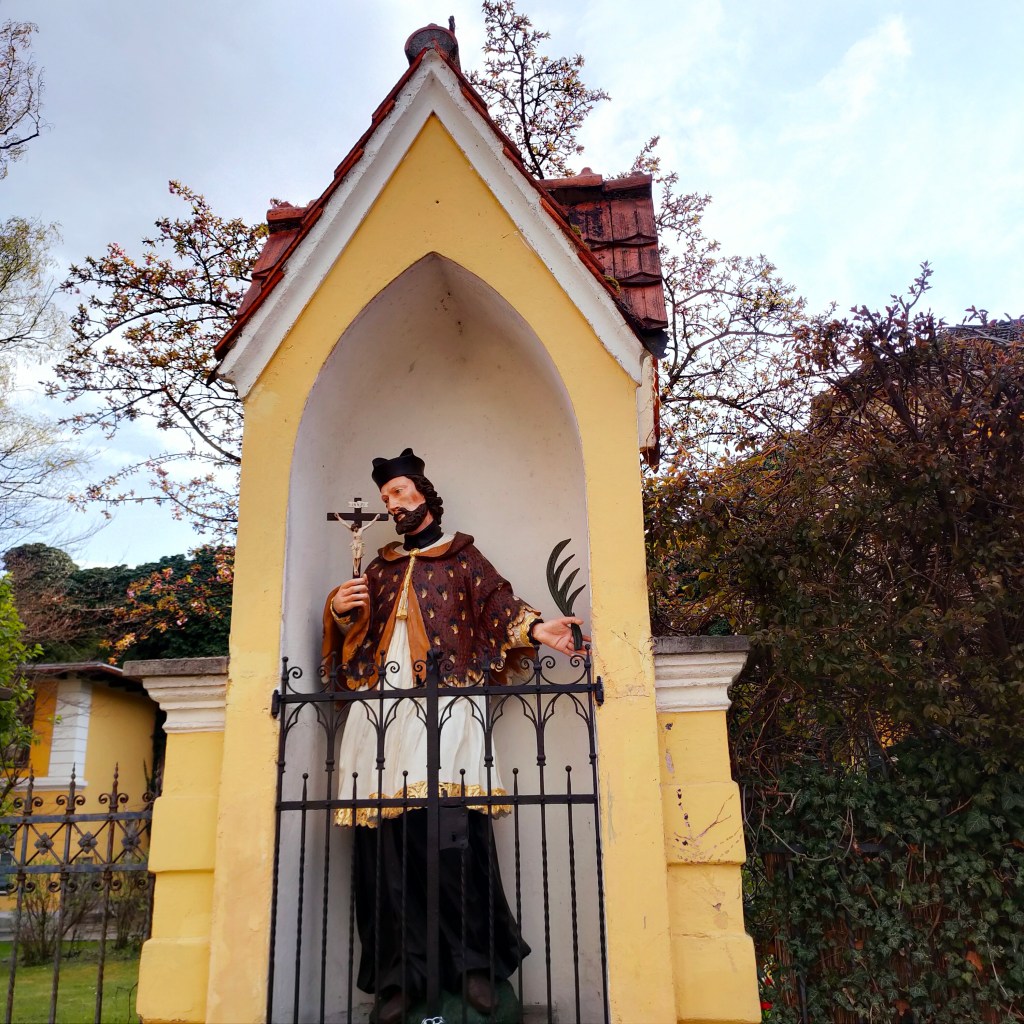
Sankt Veit himself, with his own exuberance

That night at dinner, over beer, my husband mumbled something about the road ahead. He was a little worried about the third day’s route, which would take us south over the Karawanks mountain chain into Slovenia. ‘It might be a bit steep,’ he said sheepishly, as he ate some more Spargel. Grilled this time, with sausage on the side. ‘Steep’? I was having trouble understanding him with all the noise from the other ecstatic spargel diners around us. ‘Yes, and it might rain too…it turns out…’. ‘Do we have any alternative?’ I shouted above the din.

I continued with Wunschloses Ungluck in our trendy little room. I would go through entire paragraphs where I might make out two words. So much for English and German both being germanic languages. The Normans did English such a big favor by coming over the channel and forcing their more worldly French on the provincial Anglo-Saxons. Just think what we’d be left with if they hadn’t.

Handke’s mother had gotten away from her family farm and started working in a hotel, just before the Anschluss (the German annexation of Austria in 1938). Then the war started and she got pregnant, by a German she loved, but who was already married. Then she in turn married a man she didn’t love, just to give her son a father. The misery was starting, although she didn’t realize it right away. They went to Berlin.

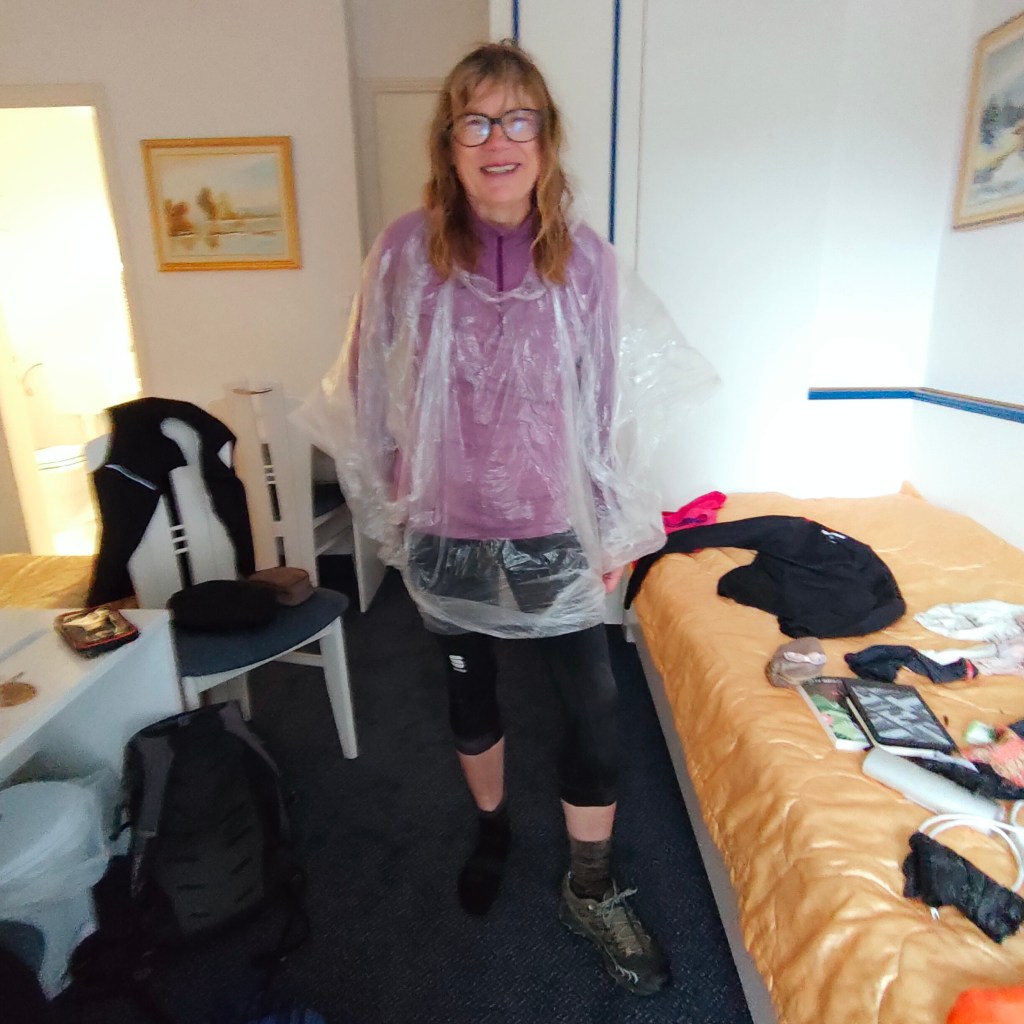
‘This will be a real test for us,’ Hannibal warned me as we packed the next day. Not difficult as I hadn’t brought much. I did make sure our cheap ponchos, all of 2.5 euros a piece, were on top. But why did hubbie have such a furrowed brow?

Crossing the Drau/Drava (flows from Sud Tirol/Alto Adige in Italy into the Danube at Osijek, Croatia)

We could see, once we reached the river, that that the landscape was changing. So much the better. We needed a challenge. We stopped to have a little sandwich in Ferlach, at which point we were already halfway to Lake Bled in Slovenia. All was well.

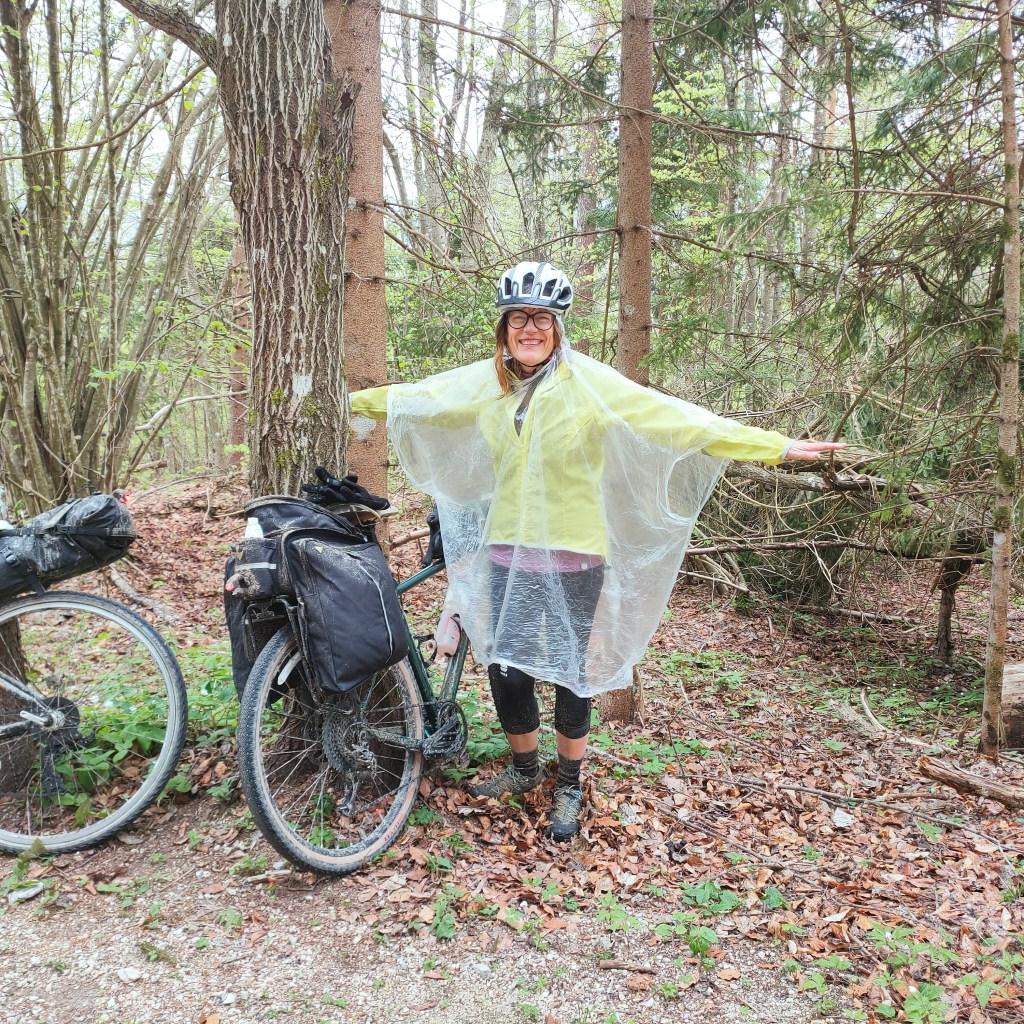
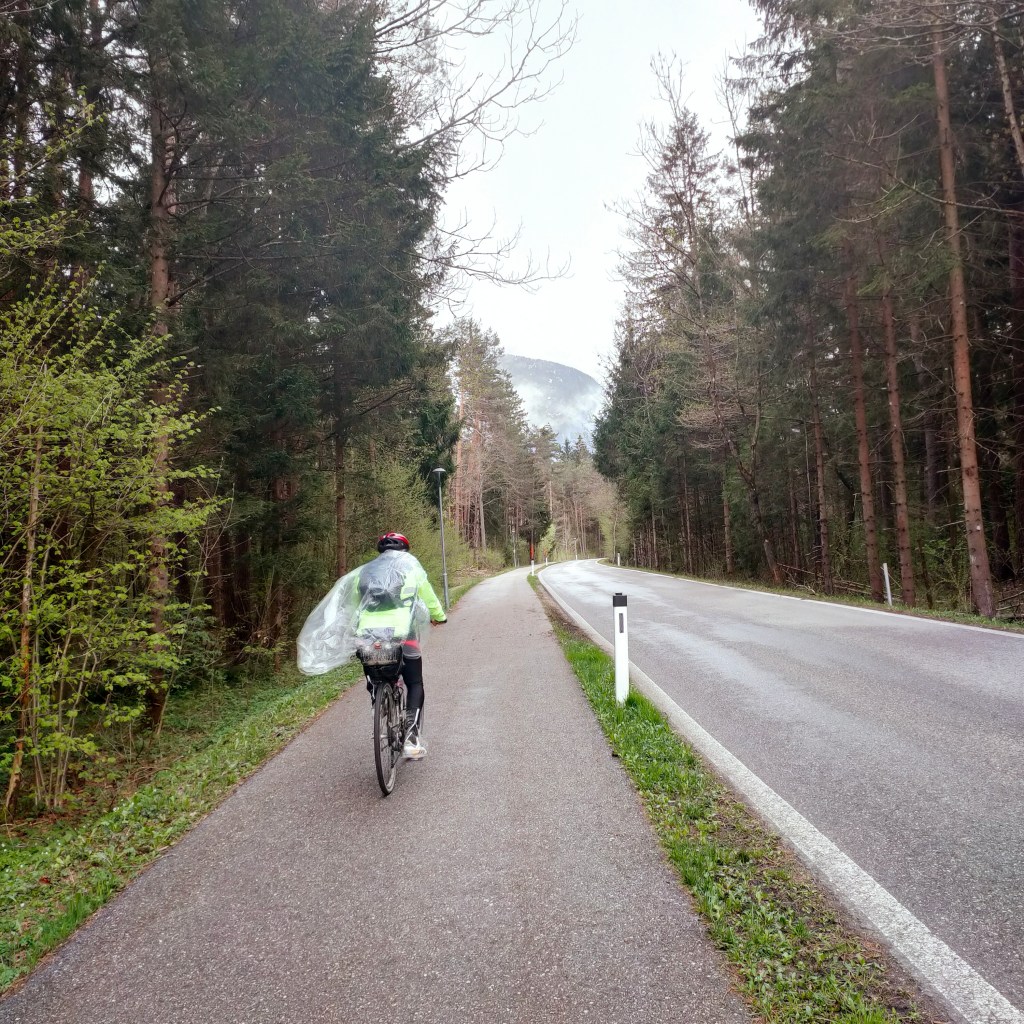
We then started on the forest road, and felt the first sprinkles of rain. The weather was starting. Time for to whip out our featherweight protective gear.

Loose fit

We came around a bend and an Austrian woman called out to my husband in German, telling him he looked like an angel! The transparent plastic we were swathed in, lifted by the breeze into wings, did give us an odd aura. The last time someone likened Hannibal to a heavenly creature was when we lived in Rome. Not a city where pedestrians are king. My husband stopped his car to let a tour guide lead her group of aging sightseers over a crosswalk near the Colosseum. The guide came up to his window to confer angelic status on him right then and there. She’d been standing on the curb for twenty minutes waiting for another driver to obey the law, or simply show some kindness. Hannibal was engaging in the latter behavior, she understood.

I was brought back to the present by a sudden realization that I was suffering. We were now on the main ascent to the Loibl-Ljubelj Pass between Austria and Slovenia. My gravel bike seemed to weigh twice as much as before. And my brand new bikepack, which slid onto a plastic rack behind my seat, felt as it were made of cement.

I couldn’t get up all of the tough bits (some at 15%). My husband’s bike having less sophisticated gears than mine meant that he had to jump off his even more often and simply push it up the bad parts. I found that getting off was just as bad as sitting on my increasingly painful seat. I also didn’t have the arm muscles to push or drag a loaded set of wheels up a hill. And the air-filled ponchos were useless. We were bedraggled angels halfway up.

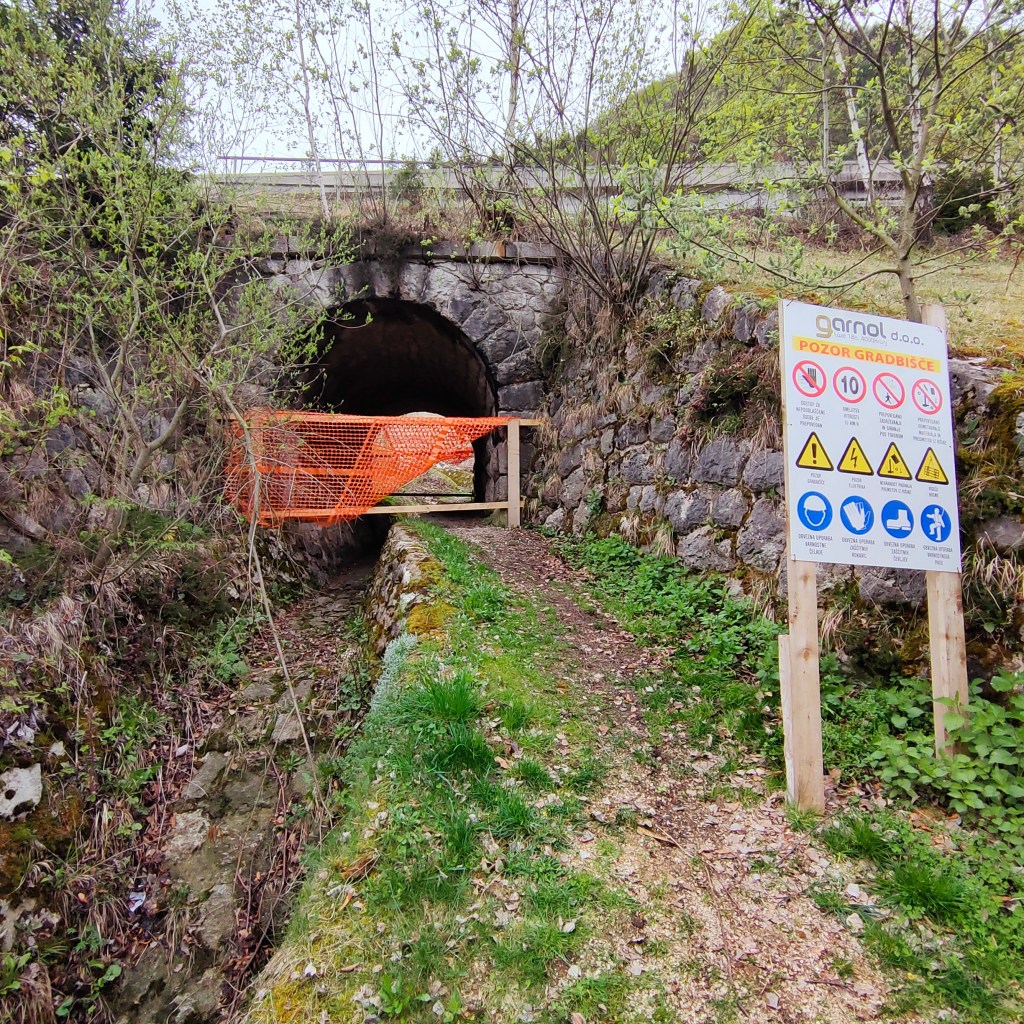
Then we passed by a sign indicating a KZ Gedankstatte Mauthausen. I stopped to think about what that meant. Mauthausen was an infamous Nazi concentration camp in another part of Austria. But there had been a branch here too, apparently. The memorial didn’t seem to be open, though, and I didn’t have a good internet connection on my phone. So we continued going up the main road, at our very slow pace, until we reached a tunnel. A long one, it turned out, over 1.5 kilometres long, and narrow. We cycled on the equally narrow raised sidewalk which consisted of vertical slabs of cement placed next to each other. I kept imagining my tire getting stuck in the slit between the slabs and me being hurtled into the lane full of traffic to my left. I wouldn’t recommend that particular route to anyone. It’s probably illegal for cyclists, as a matter of fact. Not that that had stopped us, not on Komoot.

Once I did have a good connection, later in the day, I found out that the tunnel itself was infamous. It was actually built by prisoners from the local branch of the Mauthausen camp during WWII, some of whom died while constructing it or were executed in northern Austria when they could no longer work. A few survived and walked through the tunnel to Yugoslavia at the end of the war (Slovenia became an independent country in 1992, after having been part of the southern Slav nation-federation of Yugoslavia since 1918).

Every country has its history. Some worse than others. And some events are in the more distant past but others still too recent, and shocking, and shocking also because they are recent, to ignore. Haven’t human beings evolved at all? I think of the plaques I now see in the US reminding people of massacres and lynchings that took place in pretty spots in Virginia, for example, before and long after the end of slavery. And Austria is, in fact, the birthplace of Schnitzler, Freud, and Hitler.

Here is some more information about this particular site: https://www.mauthausen-memorial.org/en/Loibl/The-Concentration-Camp-Loibl

We made it out of the harrowing tunnel, and found ourselves in Slovenia. On a saddle in the Karawanks/Karavanke (a mountain chain in the Southern Limestone Alps, which include the Dolomites). There was still a bit of snow higher up. I turned to my husband and told him that although we were utterly exhausted, we weren’t actually soaked. Only light precipitation in Karnten, after all. No sooner had the words popped out of my mouth than the heavens opened up and drenched us with an icy downpour. I took off down the busy highway without further ado. I paid no attention to the cars and trucks I was racing alongside or the floating sheets of water on the road.

In Slovenia, on the southern side of the Loibl Tunnel

I got to the bottom of the hill first. But where was my companion, usually so much faster than me? He caught up five minutes later, aghast at the risks I’d taken. ‘You could have been killed!’

I explained that I had lost my powers of reasoning. I just wanted to get to our hotel room in Lake Bled, the inauspitious-sounding Bled. A famous spa town in northern Slovenia on the shores of a lake with an steeple-topped island in the middle, surrounded by hills, that doesn’t have anything to do with bleeding. Still…

‘We somehow missed the track that Komoot suggested! It’s back up there!’ I glanced up at the top of the slope. Unthinkable. And I hadn’t seen any sign of an opening on my way down. My husband showed me, once we’d found a bus stop with a roof, and he was able to wipe the screen of his phone dry, that he was referrring to a steep rocky path with boulders that would have taken us up to another saddle, from which we have been catapulted down into the next valley. A fearsome short-cut that we might have trouble even finding in a storm. ‘We’d have to drag our bikes up that,’ Hannibal explained. ‘And drag them down, too,’ I whispered.

I explained that my crotch was on fire and that I was probably suffering from hypothermia.

So we checked our map again and decided to cut westward across the countryside to Bled to avoid the main thoroughfares. The route also looked slightly shorter.

It wasn’t raining quite so much, and the road we’d chosen was lovely. Meadows and fields and little stands of trees in their seasonal shade of light green. I would’ve taken many pictures at any other time. An ascent to each little town, and a descent before the ascent to the next one. Up hill and down hill, over and over and over. All those clusters of houses that had to protect themselves from marauders in the Middle Ages were serviced by our byway. So unbelievably charming. My leg muscles were inflamed and my head was spinning.

Rule of thumb: Always bring extra footwear

We finally reached the outskirts of Bled, at which point there was even a bit of bleeding going on. Never mind. We found our hotel and I fell off my bike. I hung on to the bannister to get up the staircase to our cold room. There I discovered that my new bike case and bags weren’t waterproof! I squeezed the water out of my shoes, warmed my hands over the tepid radiator and hobbled across the street to a gostilna where we each had a plateful of wienerschnitzel. My husband told me I was heroic. I said that I was just plain clueless. It was actually the most grueling workout I remembered ever doing in my whole life. The combination of no conditioning, bad clothing, and not knowing the route was downright foolish. I had bitten off too much, once again.

And to continue in that trend, I turned back to my book. What happened next to Handke’s mother?

She and her German husband got out of East Berlin in 1948. She used her Slovenian to talk to a Russian guard at the border crossing. The family ended up back on the farm in Karnten, where she had more children, and also performed abortions on herself. Her husband would get drunk during the winter when there was nothing to do, and beat her up. She was curious, she started reading books. I fell asleep.

We took one picture of the truly lovely lake most people come to for a relaxing sauna. But no time for dawdling. We had to get back to Italy.

View of Lake Bled, Slovenia

Our app then sent us on an adventurous route to get up to the northern valley of Kranjska Gora.

Komoot, as far as I understand, was created by a bunch of young men who weren’t too worried about things like safety, private property and so on. They just want their users to get to places as fast as possible. And Annibale delights in doing illegal things he knows he can get away with. He swears that this is his Italianness.

Our app assumed we had good tires

At a certain point, we were told to ride under a bridge on an informal sort of road, and then rumble along in the deep trough of a railway under construction. And then through a tunnel undergoing repairs under a railway that was actually functioning. Tiring, but also so much fun! Breaking rules has that effect on people, apparently.

No need to translate

Our off-track biking did get us to where we wanted to go while bypassing some busy roads. We ended up east of Kranjska Gora, a ski resort in northern Slovenia located on a side spur of the same Adriatic-Alps bike trail we’d taken from Pontebba. We knew that our troubles were over.

Riding westward towards Italy
A typical European Union border

The path to Italy was wonderfully paved, just like the entire Adriatic-Alps route. Smooth sailing, which was just as well, because I could no longer sit on my saddle. I stood on my pedals and let gravity take me back to the car.

Limestone blue in the Fusine lakes

We did stop to look at the karst Fusine area, just inside the Italian border. Karst, by the way, refers to a landscape full of underground rivers and sinkholes and caves and such caused by its limestone base. It comes from the German name given to the rocky plateau overlooking Trieste, which is also called Carso in Italian, and Kras in Slovenian.

I got home and continued to read my book as I recovered from our trip. I reached the bitter end, not sure I’d actually understood what the son thought about his mother’s decision to end her life. Was he proud of her, did I get that part right? I’d have to start over, I decided. I would be going back to Austria, and I would continue working on the challenging German language.

I also needed to be more constant about my cycling, to make my excursions less dramatic. The Loibl/Ljubelj Pass isn’t even all that difficult, compared to many others that I have done myself. https://climbfinder.com/en/climbs/loiblpass-ljubelj-ferlach

And I had to look for a book by a Slovenian author for my next trip to a small country full of mountains, rivers, caves, and bicycles. But not in Slovenian. Not yet.

Lanzarote: unforgiving, or land of opportunity?

View from Cesar Manrique’s home and museum

A woman in Naples, Italy, scratched her ‘gratta e vinci’ lottery card and turned it over to the tobacconist to cash it in. By golly, she’d hit the jackpot! But opportunity makes the thief and the man behind the counter just went plumb crazy when he saw the figure of 500,000 euros staring up at him. Grabbing the card for himself, the miscreant jumped onto his motorbike and was caught a day later trying to leave the Rome airport with a one-way ticket to Fuerteventura.

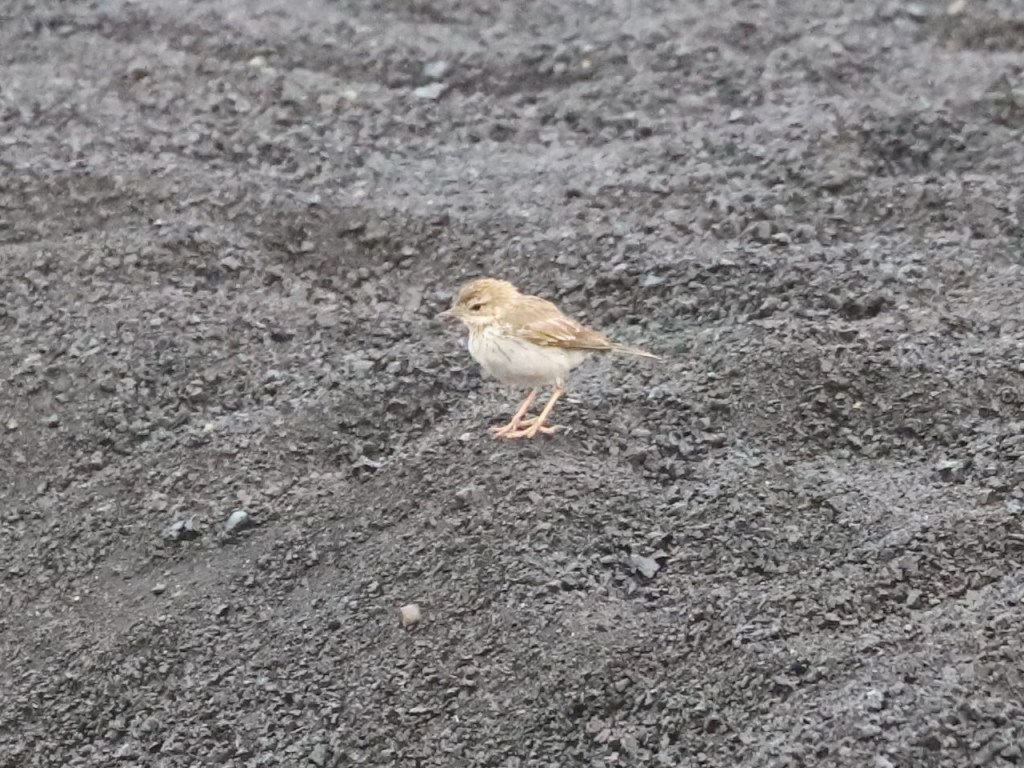
Berthelot’s pipit thriving on its stomping grounds in Lanzarote

Fuerteventura, just south of Lanzarote – a place I knew! The scofflaw must have seen a picture of an exotic landscape in the dusty window of a travel agency. Did he think that the date palm trees and sharp black rocks would make a good robber’s roost? Well, he was clearly oblivious to the fact that despite all appearances, he would still have been in Europe. Just a deserty outpost of the European Union. And that’s a fact.

Now, what are we talking about, anyway?

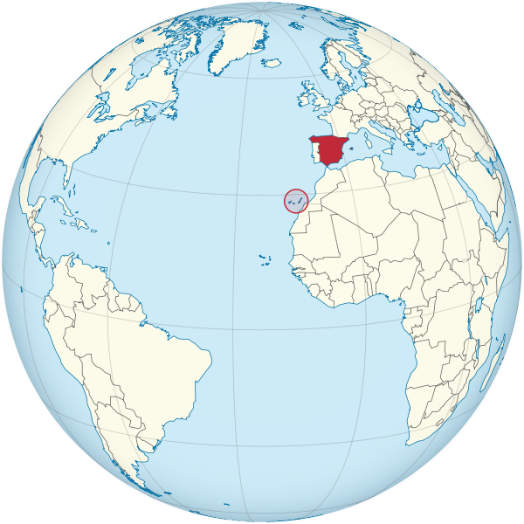
Canary Islands, in the red circle. Spain, the mother country, in red. Taken from Wikicommons

The Canary Islands, of course. There they are, nestled together, if volcanoes do such gentle things as nestle, right off the coast of Morocco. The tobacconist can be forgiven for his geographical ignorance, if nothing else. How could these bits of Macaronesia, the volcanic archipelagoes of the North Atlantic, still be part of a continent they’re not even close to? That’s a long, old story, similar to many others.

I clearly haven’t finished with my island obsession. When I started writing this, I was confined again. Laid up with Covid19 itself, finally, in the summer of 2022. So there I was in the sweltering heat of northern Italy, wondering why I had stopped wearing my mask as diligently as before, trying not to collapse over my computer, and dreaming of a water-lapped land of explosive mountains, where the trade winds always blow. Outlandish Lanzarote, or Tyterogaka, the only Canary I have laid eyes on, looks as if it should be hanging up in the sky next to another planet. But it’s of this earth, actually, and also very much under this earth, with its legs planted firmly in the sea. There it is, hiding in plain sight.

Near Playa Papagayo

Hiding, I say, because the islands were ‘forgotten’ for a long time. Probably originally settled by climate-change immigrants from North Africa, they were then colonized by the Carthaginians, then found and forgotten by the Romans – who called them The Fortunate Isles – then briefly found and forgotten by the Arabs, forgotten by all but the first pioneers, the Guanches (or Majos on Lanzarote itself), who then almost forgot their cousins on the neighboring isles. They were living there, cut off from the world for centuries, until first contact was made with the increasingly aggressive continent to their north. The year was somewhere around 1312, and the contact went by the name of Lanzarotto Malocello, from Genoa. Genoa, yes, just a small Italian maritime republic, and a producer of ambitious mariners. Life could be very short, so adventure on a small boat on the high seas wouldn’t have been such a crazy idea. Why not see something of the world, like Ulysses, or make a profit, whether by hook or by crook, trade or plunder, before succumbing to whatever plague was roaming around in your century?

Vulcan del Cuervo

We live in different times now, and adventure is synonymous with fun. Other sorts of journeys have different names attached to them.

So in that modern-day spirit of ‘adventure’, during the summer of 2021 my Italian sun-and-water loving friends exhorted us to go and stay at an eco-hotel (Mana Eco-Retreat, manaecoretreat.com), on Lanzarote set up by a young couple they knew. “Let’s help them out, hard times…just pack your vaccination certificate and a swimming suit!”

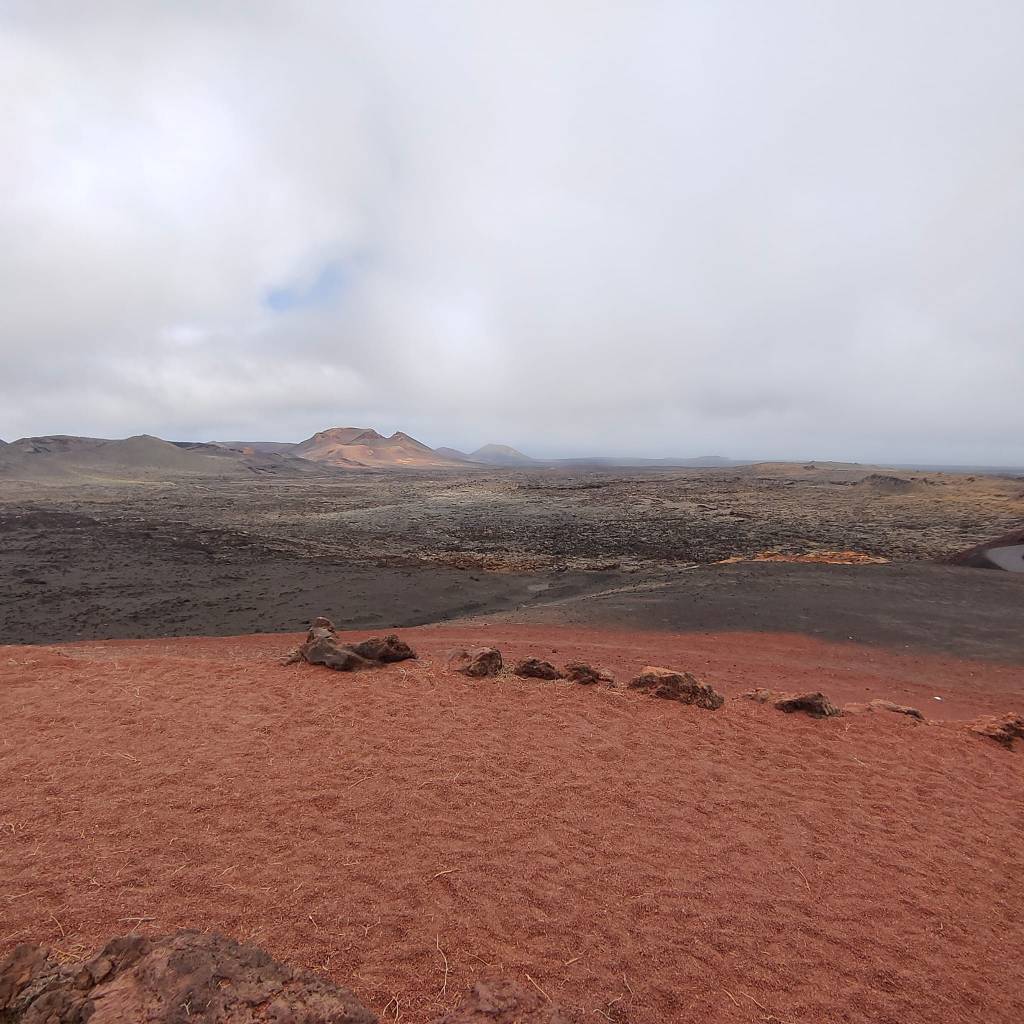
In recent years I’ve become fond of Josè Saramago, the Nobel-prize winning author. One of his publications is Notebook from Lanzarote, where he settled after censorship issues with his homeland, Portugal. I leafed through the book and stopped short at a sentence about his adopted residence. Something to the effect that although Lanzarote had a menacing sort of appearance, it also exuded a “feminine sweetness”, the kind that Lady Macbeth might have shown when she was asleep. Lady Macbeth! Why hadn’t I read that before? The terrain around Las Brenas (near Yaiza), where we were staying, down slope from the grand volcano of Timanfaya, looked so grim even while slumbering that it resembled all those paintings I’d seen of Hell. Was this really what one would call a vacation destination?

Our crew near the top of Timanfaya

After all, I’m not a beach lizard. I’m more of a woodsy, and mountain and museum-loving person. But that’s not what we had decided to do as a group. Our focus was resting and relaxing in the water or at the table.

We couldn’t not head up the closest peak, though, up through the Timanfaya National Park, to the top of the caldera, on a guided bus tour. This is the best way to access the park on its one narrow road, unless you plan to hike in and out on a single path, reserving ahead. Because you can’t actually do any walking around on your own. This is just as well, considering the very delicate ecosystem you are treading on, which could also suddenly come alive and thus become as murderous as Medea bent on revenge! That’s exactly what Timanfaya did in the 1730s, burying villages, sending out lava and ash, and emigrants away from the very ‘unfortunate’ island. Lanzarote betrayed her people once again.

Los Volcanes nautral park

But now some immigrants are coming back, as the Ladies are dormant. The local Spanish apparently sounds as if it came from the Caribbean rather than Castile. And our young hosts had given up jobs in finance in Amsterdam, with all its cold and damp, to strike out on their own in a gusty but also decidedly sunny corner of the Atlantic.

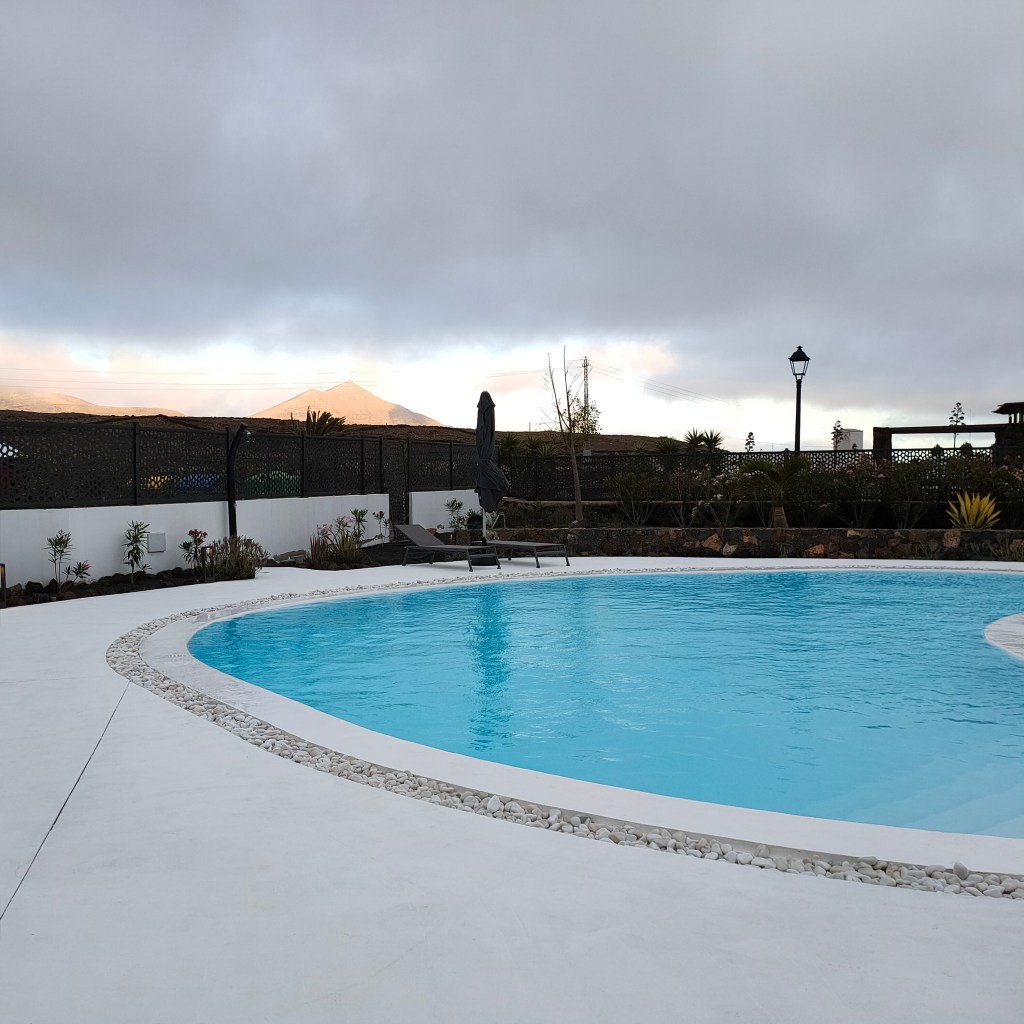
View from Mana Eco-Retreat

Is that what the first Europeans thought when they came adventuring here? Try to make a living in a location where it can be spring year round? Where you have to wear a sweater in the evenings even in July? That was true in 2021, anyway…

Lanzarotto spent a few decades hanging out on what he discovered, and built a castle. Then along came a Norman, Jean de Bethencourt, in 1402, backed by the Spanish crown and the Catholic Church. He found a population with a king and queen but no weapons to match his own. A member of his family married the royal princess, Teguise. Sound familiar?

The Guanches/Mayos were decimated. Naked, treeless Lanzarote became a trap. Her inhabitants were enslaved or killed en masse after rebelling. Their bloodlines must be there, among the descendants of the survivors, but their language is remembered above all in the local nomenclature. Teguise, for example, lives on as the name of the loveliest town on the island.

The Canary Islands came into being when the landmasses later known as Africa and the Americas broke apart. But the Canaries then became key to bringing those continents closer together in more ways than one. The conquest of these stark mountaintops sticking out of the water was a dress rehearsal and also a boon for future Spanish endeavours . Those harbors at the corner of the quandrant Europe – Africa – the Caribbean – North America – Europe – helped sea-farers get across the wide Atlantic, as a matter of fact. Columbus stopped there, and then took advantage of those famous trade winds, oh yes, to go west. Lanzarotto had bumped into a stepping stone which would lead the way to fabulous gains and cataclysmic losses.

I read these things while listening to my beach towel flapping furiously on the drying rack outside my window. We’d had a large lunch, with calamari, patatas rugas, and plenty of local white wine. Well, we were so relaxed we were becoming catatonic. But I was determined o find out more about this weird and intriguing place that had been so hard on many of its human inhabitants.

We went on a afternoon constitutional around the neighborhood to take in our bleak surroundings.

Las Brenas (Yaiza)

Then a bird flew overhead. What was it, a falcon? A Barbary falcon, which is a type of Peregrine found in North Africa? It was clear that addictive feathered creatures were going to drag us away from human history for a while.

The next day our friends took a ferry to lounge on the soft beaches of Fuerteventura (the lottery robber wasn’t totally off in his hasty thinking), while my husband and I went on an expedition with Carmen Portella. She is the director of Eco-Insider (eco-insider.com), a team of experts on the biology of Lanzarote. Carmen took the two of us on a bouncy ride to check out the local flora and fowl in an empty area northeast of Yaiza. The birds are all out there, she assured as, as we strained our eyes peering out the window of the jeep. We couldn’t help being a bit skeptical as we scanned the sand lying around us. What would the birds eat? Every living thing’s gotta eat. This island was clearly a really rough neck of the woods, metaphorically speaking.

But not all animals are picky and some even make do with spiky, spindly weeds and whatever lives on them. And many go out of their way to blend in, as they say. More power to them all.

Don’t see much? Let me help you out.

Our energetic, affable guide also explained the difficulties of living on a piece of land with barely any precipitation that is very far removed from the nation it is part of. Water (desalinized), schools, healthcare were at the top of her list. But she also helped us understand how on earth wine is produced locally and why Lanzarote doesn’t have monster hotels.

The vineyards first.

near la Geria

After ash from the volcanic eruptions in the 18th century smothered wide swaths of land on Lanzarote, it was then discovered that the new soil had its advantages. So the desert was made to bloom in a most unlikely way. Opportunity indeed. Stone ‘cups’ protect the vines from the wind and hold the dew in. What a sight to see, but not a bad drink to quaff either, I must say.

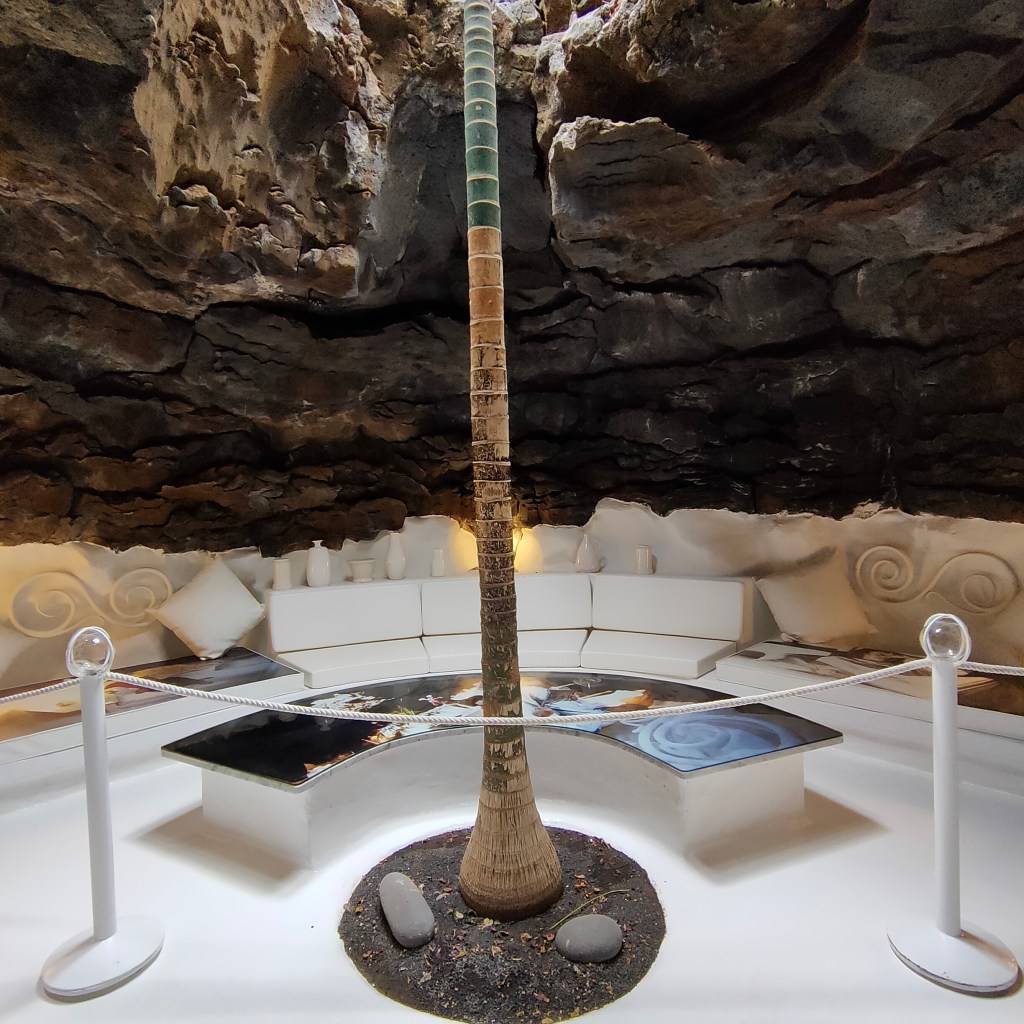
Vegetation of all sorts also fascinated native son Cesar Manrique. He had something in common with the ingenious birds and plants. Or was he inspired by a benevolent god who decided to take an interest in a forlorn isle? An artist, sculptor, architect and urban planner, Manrique was more than unfazed by the barrenness of his birthplace. As a matter of fact, after he returned to Lanzarote from a career abroad, he started to exploit those rocks and tough Canarian palms and cacti. He focused on trying to bring people and their environment together. The most fascinating places in Lanzarote, apart from the craters, and beaches, which I still haven’t mentioned, are the houses, gardens and other natural features Manrique fashioned into slightly treacherous oases. Just don’t hit your head on the wall or fall on a plant or into the water lining the corridor. Stay on your toes even while relaxing. Remember the sleeping Lady Macbeth and Medea.

House renovated for Omar Sharif, who then lost it in a high-stakes card game
Cozy living area
Author trying to keep her balance after lunch

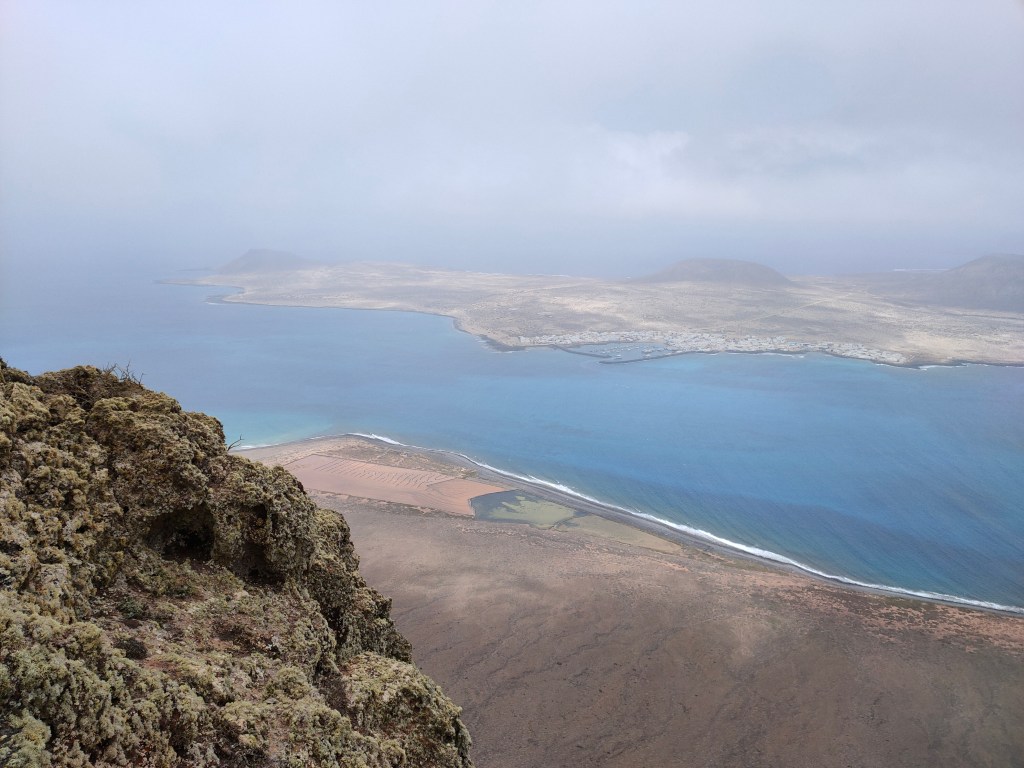
One last thing before I go. The beaches, right? Well, let me make up for completely omitting them so far by revealing the ones I liked best. I saved them for last because they’re not actually on Lanzarote! Now there is a tiny island to the north called La Graciosa. Graceful and pretty, and undeveloped. Not only are there no highrises, there aren’t even any paved roads. You take a boat from Orzola, on the northern part of Lanzarote and cross a rough channel to this modest little outcropping where you can hike, cycle or take a bone-rattling jeep ride to circumnavigate it. And then lie on a towel and take in the scenery. There is, of course, a volcano even on the little sister islet.

Right now, these islands seem to be living in their fortunate phase. Not godforsaken. It’s all relative, of course.

La Graciosa from Lanzarote

Lanzarote: unforgiving, or land of opportunity?

View from Cesar Manrique’s home and museum

A woman in Naples, Italy, scratched her ‘gratta e vinci’ lottery card and turned it over to the tobacconist to cash it in. By golly, she’d hit the jackpot! But opportunity makes the thief and the man behind the counter just went plumb crazy when he saw the figure of 500,000 euros staring up at him. Grabbing the card for himself, the miscreant jumped onto his motorbike and was caught a day later trying to leave the Rome airport with a one-way ticket to Fuerteventura.

Berthelot’s pipit thriving on its stomping grounds in Lanzarote

Fuerteventura, just south of Lanzarote – a place I knew! The scofflaw must have seen a picture of an exotic landscape in the dusty window of a travel agency. Did he think that the date palm trees and sharp black rocks would make a good robber’s roost? Well, he was clearly oblivious to the fact that despite all appearances, he would still have been in Europe. Just a deserty outpost of the European Union. And that’s a fact.

Now, what are we talking about, anyway?

Canary Islands, in the red circle. Spain, the mother country, in red. Taken from Wikicommons

The Canary Islands, of course. There they are, nestled together, if volcanoes do such gentle things as nestle, right off the coast of Morocco. The tobacconist can be forgiven for his geographical ignorance, if nothing else. How could these bits of Macaronesia, the volcanic archipelagoes of the North Atlantic, still be part of a continent they’re not even close to? That’s a long, old story, similar to many others.

I clearly haven’t finished with my island obsession. When I started writing this, I was confined again. Laid up with Covid19 itself, finally, in the summer of 2022. So there I was in the sweltering heat of northern Italy, wondering why I had stopped wearing my mask as diligently as before, trying not to collapse over my computer, and dreaming of a water-lapped land of explosive mountains, where the trade winds always blow. Outlandish Lanzarote, or Tyterogaka, the only Canary I have laid eyes on, looks as if it should be hanging up in the sky next to another planet. But it’s of this earth, actually, and also very much under this earth, with its legs planted firmly in the sea. There it is, hiding in plain sight.

Near Playa Papagayo

Hiding, I say, because the islands were ‘forgotten’ for a long time. Probably originally settled by climate-change immigrants from North Africa, they were then colonized by the Carthaginians, then found and forgotten by the Romans – who called them The Fortunate Isles – then briefly found and forgotten by the Arabs, forgotten by all but the first pioneers, the Guanches (or Majos on Lanzarote itself), who then almost forgot their cousins on the neighboring isles. They were living there, cut off from the world for centuries, until first contact was made with the increasingly aggressive continent to their north. The year was somewhere around 1312, and the contact went by the name of Lanzarotto Malocello, from Genoa. Genoa, yes, just a small Italian maritime republic, and a producer of ambitious mariners. Life could be very short, so adventure on a small boat on the high seas wouldn’t have been such a crazy idea. Why not see something of the world, like Ulysses, or make a profit, whether by hook or by crook, trade or plunder, before succumbing to whatever plague was roaming around in your century?

Vulcan del Cuervo

We live in different times now, and adventure is synonymous with fun. Other sorts of journeys have different names attached to them.

So in that modern-day spirit of ‘adventure’, during the summer of 2021 my Italian sun-and-water loving friends exhorted us to go and stay at an eco-hotel (Mana Eco-Retreat, manaecoretreat.com), on Lanzarote set up by a young couple they knew. “Let’s help them out, hard times…just pack your vaccination certificate and a swimming suit!”

In recent years I’ve become fond of Josè Saramago, the Nobel-prize winning author. One of his publications is Notebook from Lanzarote, where he settled after censorship issues with his homeland, Portugal. I leafed through the book and stopped short at a sentence about his adopted residence. Something to the effect that although Lanzarote had a menacing sort of appearance, it also exuded a “feminine sweetness”, the kind that Lady Macbeth might have shown when she was asleep. Lady Macbeth! Why hadn’t I read that before? The terrain around Las Brenas (near Yaiza), where we were staying, down slope from the grand volcano of Timanfaya, looked so grim even while slumbering that it resembled all those paintings I’d seen of Hell. Was this really what one would call a vacation destination?

Our crew near the top of Timanfaya

After all, I’m not a beach lizard. I’m more of a woodsy, and mountain and museum-loving person. But that’s not what we had decided to do as a group. Our focus was resting and relaxing in the water or at the table.

We couldn’t not head up the closest peak, though, up through the Timanfaya National Park, to the top of the caldera, on a guided bus tour. This is the best way to access the park on its one narrow road, unless you plan to hike in and out on a single path, reserving ahead. Because you can’t actually do any walking around on your own. This is just as well, considering the very delicate ecosystem you are treading on, which could also suddenly come alive and thus become as murderous as Medea bent on revenge! That’s exactly what Timanfaya did in the 1730s, burying villages, sending out lava and ash, and emigrants away from the very ‘unfortunate’ island. Lanzarote betrayed her people once again.

Los Volcanes nautral park

But now some immigrants are coming back, as the Ladies are dormant. The local Spanish apparently sounds as if it came from the Caribbean rather than Castile. And our young hosts had given up jobs in finance in Amsterdam, with all its cold and damp, to strike out on their own in a gusty but also decidedly sunny corner of the Atlantic.

View from Mana Eco-Retreat

Is that what the first Europeans thought when they came adventuring here? Try to make a living in a location where it can be spring year round? Where you have to wear a sweater in the evenings even in July? That was true in 2021, anyway…

Lanzarotto spent a few decades hanging out on what he discovered, and built a castle. Then along came a Norman, Jean de Bethencourt, in 1402, backed by the Spanish crown and the Catholic Church. He found a population with a king and queen but no weapons to match his own. A member of his family married the royal princess, Teguise. Sound familiar?

The Guanches/Mayos were decimated. Naked, treeless Lanzarote became a trap. Her inhabitants were enslaved or killed en masse after rebelling. Their bloodlines must be there, among the descendants of the survivors, but their language is remembered above all in the local nomenclature. Teguise, for example, lives on as the name of the loveliest town on the island.

The Canary Islands came into being when the landmasses later known as Africa and the Americas broke apart. But the Canaries then became key to bringing those continents closer together in more ways than one. The conquest of these stark mountaintops sticking out of the water was a dress rehearsal and also a boon for future Spanish endeavours . Those harbors at the corner of the quandrant Europe – Africa – the Caribbean – North America – Europe – helped sea-farers get across the wide Atlantic, as a matter of fact. Columbus stopped there, and then took advantage of those famous trade winds, oh yes, to go west. Lanzarotto had bumped into a stepping stone which would lead the way to fabulous gains and cataclysmic losses.

I read these things while listening to my beach towel flapping furiously on the drying rack outside my window. We’d had a large lunch, with calamari, patatas rugas, and plenty of local white wine. Well, we were so relaxed we were becoming catatonic. But I was determined o find out more about this weird and intriguing place that had been so hard on many of its human inhabitants.

We went on a afternoon constitutional around the neighborhood to take in our bleak surroundings.

Las Brenas (Yaiza)

Then a bird flew overhead. What was it, a falcon? A Barbary falcon, which is a type of Peregrine found in North Africa? It was clear that addictive feathered creatures were going to drag us away from human history for a while.

The next day our friends took a ferry to lounge on the soft beaches of Fuerteventura (the lottery robber wasn’t totally off in his hasty thinking), while my husband and I went on an expedition with Carmen Portella. She is the director of Eco-Insider (eco-insider.com), a team of experts on the biology of Lanzarote. Carmen took the two of us on a bouncy ride to check out the local flora and fowl in an empty area northeast of Yaiza. The birds are all out there, she assured as, as we strained our eyes peering out the window of the jeep. We couldn’t help being a bit skeptical as we scanned the sand lying around us. What would the birds eat? Every living thing’s gotta eat. This island was clearly a really rough neck of the woods, metaphorically speaking.

But not all animals are picky and some even make do with spiky, spindly weeds and whatever lives on them. And many go out of their way to blend in, as they say. More power to them all.

Don’t see much? Let me help you out.

Our energetic, affable guide also explained the difficulties of living on a piece of land with barely any precipitation that is very far removed from the nation it is part of. Water (desalinized), schools, healthcare were at the top of her list. But she also helped us understand how on earth wine is produced locally and why Lanzarote doesn’t have monster hotels.

The vineyards first.

near la Geria

After ash from the volcanic eruptions in the 18th century smothered wide swaths of land on Lanzarote, it was then discovered that the new soil had its advantages. So the desert was made to bloom in a most unlikely way. Opportunity indeed. Stone ‘cups’ protect the vines from the wind and hold the dew in. What a sight to see, but not a bad drink to quaff either, I must say.

Vegetation of all sorts also fascinated native son Cesar Manrique. He had something in common with the ingenious birds and plants. Or was he inspired by a benevolent god who decided to take an interest in a forlorn isle? An artist, sculptor, architect and urban planner, Manrique was more than unfazed by the barrenness of his birthplace. As a matter of fact, after he returned to Lanzarote from a career abroad, he started to exploit those rocks and tough Canarian palms and cacti. He focused on trying to bring people and their environment together. The most fascinating places in Lanzarote, apart from the craters, and beaches, which I still haven’t mentioned, are the houses, gardens and other natural features Manrique fashioned into slightly treacherous oases. Just don’t hit your head on the wall or fall on a plant or into the water lining the corridor. Stay on your toes even while relaxing. Remember the sleeping Lady Macbeth and Medea.

House renovated for Omar Sharif, who then lost it in a high-stakes card game
Cozy living area
Author trying to keep her balance after lunch

One last thing before I go. The beaches, right? Well, let me make up for completely omitting them so far by revealing the ones I liked best. I saved them for last because they’re not actually on Lanzarote! Now there is a tiny island to the north called La Graciosa. Graceful and pretty, and undeveloped. Not only are there no highrises, there aren’t even any paved roads. You take a boat from Orzola, on the northern part of Lanzarote and cross a rough channel to this modest little outcropping where you can hike, cycle or take a bone-rattling jeep ride to circumnavigate it. And then lie on a towel and take in the scenery. There is, of course, a volcano even on the little sister islet.

Right now, these islands seem to be living in their fortunate phase. Not godforsaken. It’s all relative, of course.

La Graciosa from Lanzarote

No Picnic on Capraia

Ex agricultural penal colony on Capraia

I’ve been on a small land mass kick recently. Pandemic permitting, of course. So what’s with those islands, anyway? Is it because you’re stuck there once you arrive and so just have to make the most of everything? Gawk at blythe birds while walking against powerful breezes and tripping over volcanic rocks? Is it because they are all kind of weird, in their own way?

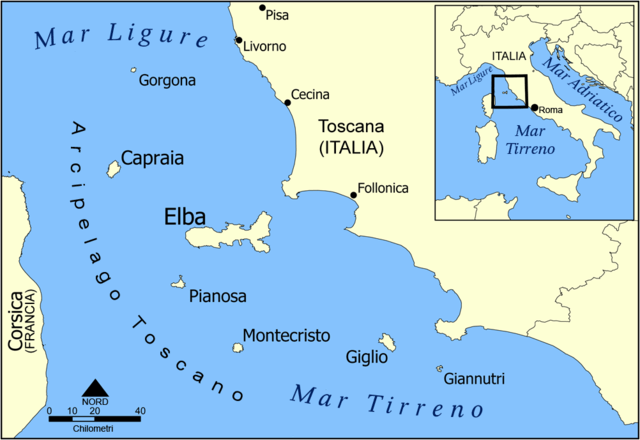
Well, here’s another one for you. Capraia, off the west coast of Italy, once home to pirates, monks, and convicts. And goats, of course. In fact, we could easily dub Capraia ‘Goat Island’ (capra means goat in Italian). A humble name for a backwater that Alexandre Dumas, the famous French writer, snubbed when choosing the location for his book about a haunted man hunting for treasure in the Tuscan archipelago, between Italy and France. Of course, the Count of Montecristo sounds much more beguiling than the Count of Goatland.

The monastery is an ivy-encrusted ruin, the corsairs’ run is over, and the prison was closed decades ago. There are no springs, and no beaches. No beaches in the Mediterranean?? Come on. So why would anyone waste their time on a place that takes two and a half hours to reach from the mainland? Well, the sea is protected around most of the island, part of a marine preserve. The water is clean. Birds also abound. And there are some pretty determined bird stalkers, as well as walkers and boaters, where the sea is open.

And that’s how my birdwatching husband and I found ourselves climbing up a lumpy track on Capraia on a brilliant spring day in 2019. It was migration season, in those halcyon days when humans could flit about like birds.

Loaded down with binoculars and cameras, we had decent footwear, but were definitely not as nimble as the wild shaggy creatures that used to wander around this stoic land mass eight kilometers long and four across.

Modern-day domesticated goats thrive here

In the Inferno, Dante, ever imaginative, calls on Capraia and the neighboring island of Gorgona to move and hedge in the river Arno. He wanted them to drown all the citizens of Pisa. What had the inhabitants done to deserve such a fantastical death,? Killed by roving islands? Well, the true part of the story is that a nobleman, Count Ugolino, and his sons got locked up in a tower in the middle of the Tuscan city, and starved to death. It is a reminder that Italy was not always just a holiday destination, and times were tough in the Middle Ages.

Upper reaches of abandoned colony. Notice the monumental arched entrance on road below the wall

Now Dante knew his geography, he did. Capraia and tiny Gorgona are pretty much just across the water from Pisa. And strangely enough, both have hosted agricultural penal colonies (Gorgona still has one). So although they don’t go floating around at any poet’s bidding, the two stony islands are actually used to dealing with crime and punishment.    

By Afnecors – Image:Tuscan archipelago blank map.png, CC BY-SA 3.0, https://commons.wikimedia.org/w/index.php?curid=4025811
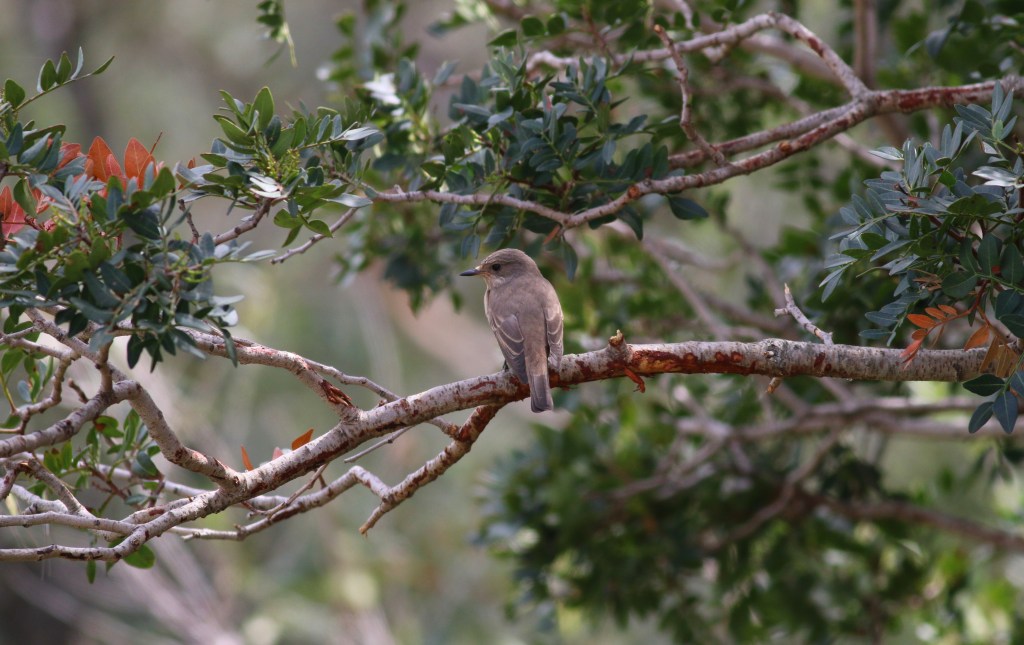
Spotted Flycatcher (muscicapa striata) sitting on the branch of a lentisco (pistacia lentiscus) shrub

 We were there for Liberation Day, April 25th, a holiday to remember the Italian Resistance’s victory over what was left of the Nazi-Fascists in northern Italy in 1945, at the end of WWII. Some people would appear to like to forget what happened during Mussolini’s dictatorship (often simply referred to as the ventennio, literally, two decades, the years from 1922 to 1943-5) and his diabolical alliance with Hitler.  But everyone, no matter what sort of nostalgia affects them, takes advantage of a day off, or even better, a long weekend. We celebrated by going to investigate yet another far-flung corner of this patchwork peninsula.

First we drove to Livorno or Leghorn, on the Tyrrhenian coast. There we managed to find a restaurant at ten o’clock at night that still had some of the local spicy fish soup, cacciucco, sitting in the pot. Then we stumbled into bed and got up early to catch the morning ferry.  

We passed Elba as we drank coffee on the deck and stared at the sky and the sea.


View from the southwestern tip of Capraia of her bigger sisters: Elba on the left, and Corsica on the right

Although the biggest island in the archipelago is pretty and forested, the conqueror who changed the face of Europe was restless in his tiny princedom. Napolean couldn’t end his days governing a bunch of Tuscan hicks from his smallish mansion. No. Waterloo just had to become more than a little town in Belgium. Not only was Elba too confining for the Corsican, it was also just too close to home.

In fact, Corsica loomed up ahead. Our barren destination came first, though, 25 kilometres from the French coast. No, not barren! Not in April. Even downright green in some places. But shadeless, practically treeless. Except for a few planted umbrella pines. The live oaks, the ilex, that idled here back in prehistoric days are gone. Capraia didn’t have much else to offer demanding, relentless folks such as the Romans. No fresh water to feed luxury palaces, no metals to make a profit. The only tangible asset was wood, yes. And so the ilex all got cut down and carted off. 


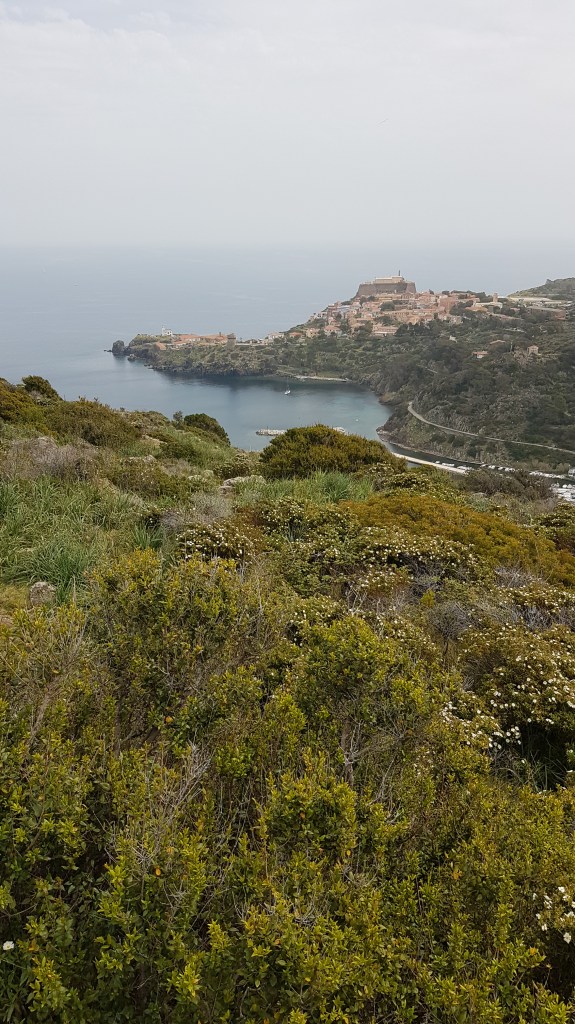
Port, and town of Capraia, connected by the one paved road on the island

We walked off the boat. The tiny port is below the town with its impressive fortress-luxury rental property on top. These two places are where people actually live and work and rent rooms. Apart from a few farms, that just about does it for human habitation on Goat Island. The rest is for the birds. Hopefully, the elusive Corsican finch, for one. Napoleon may have turned his back on his birthplace, but it has other claims to fame. This finch is a must, apparently.

Now I had chosen a ‘farm-stay’ on a promontory above the port. I had chosen isolation even in spring, when it’s too cold to swim and there is no crowd to speak of. I also didn’t realize that getting to and from our accommodation meant walking up and down, every morning and every night, through the abandoned penal colony with its striking and also stricken umbrella pine trees lining the road. Night on a pebbly road with no lights except our phone flashlights. Strangely enough, we were the only guests at our bed and breakfast which vaunted sustainable practices such as no use of plastic, organic jams for breakfast, no air conditioning and other good things like that.  It became clear to me pretty soon that not everyone was into strenous exercise, especially after dinner.

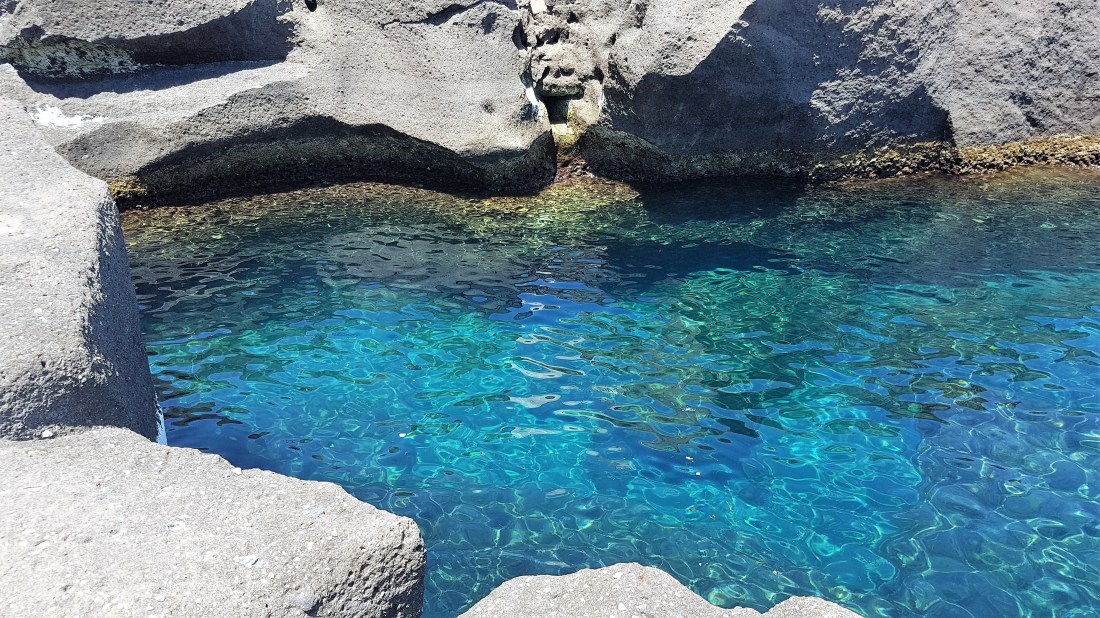
Pockmarked volcanic rock viewed from the sea

But we were. After taking a a thrilling boat tour of the islands cliffs to see birds, and gasp at bizarre geological formations caused by volcanic eruptions, we just had to do some real hiking. I studied the brochure in our room.  It said it would take nine hours to circumnavigate the island on foot. Ridiculous. We’d do it in less. So my husband bought cheese and salami and bread in the town, and made huge sandwiches the night before. Then at breakfast we told our host about our plan.

Cala Rossa (part of an ancient volcano)

‘Oh, that’s a long walk. A good nine hours, I’d say,’ said the sturdy man gravely. Surprised, but not dissuaded, we wolfed down as many pieces of dried toast and jam as we could manage without choking. He then asked us how much water we had.

‘Well, not much, just this bicycle bottle here that we filled in the bathroom.’

‘No!’ Our host’s sense of humanity was suddenly activated. No longer eco entrepreneur, he ducked into the kitchen and came back with a liter and half of ice- cold fizzy mineral water encased in plastic. ‘Take it, please! There are no fountains and no houses on your itinerary, do you understand? Only wilderness!’
It sounded wonderful. But we did accept the bottle, despite its being another piece of reckless, planet-damaging waste.    

Backpacks filled with birdbooks, nourishment, and liquid, we set out.  

First of all, a word about the penal colony. Now I’d never been in favor of them, starting from when I had to read Kafka in high school. Of course, his tale of a diabolical machine that scratched the names of prisoners’ crimes onto their bare backs was bound to freak out any 17-year-old. And connect bizarre execution methods with islands and detention centers. Well, there is something to that. But this was an agricultural penal colony, self-sustaining, and more like a modern-day Norwegian prison than Devil’s Island.    

I mentioned pirates earlier. Well, the first ones got ousted by the Romans. Then came the monks. But the return of other pirates, especially Dragut, a famous corsair from the Barbary Coast, made life very difficult. In the end the Genoese took over, built a fort, and held onto the island for centuries before Italy unified in 1861. What then to do with little Capraia? In 1873 the government built a special open-air penal colony for prisoners about to end their sentences, and make the prisoners herd domesticated goats, produce cheese and honey. The prisoners’ families settled in the town, and modified the local dialect, which was very close to what is spoken in Corsica. The colony closed in 1986. But the buildings and trees remain, and the place has a gloomy allure to it. Reminds me of another German-speaking writer, W.G. Sebald. How can one not be fascinated by decay and oblivion?

Well, we passed the upper part of what was left of the complex, including the sheep pen, and then started on our jumbled trail. It is what you call ‘unimproved’. The type you can twist your ankle on, that sort of thing. So we placed our feet carefully between the jagged rocks as we climbed and climbed under a shining blue sky.

Gariga on the hills

After almost four hours of huffing and puffing through shrubs, and a bit of traversing of the aromatic gariga, the low-lying drought tolerant plants, the lavender, thyme, cistus and elicriso, that are ubiquitous in the Mediterranean, we reached a little pond. The only one, which disappears in the summer. There were a few people, too many for us, of course, and so we walked a bit further. Then we sat on some boulders, absolutely famished. “Ok, where’s the sandwich with the pecorino and finocchiona?” I said. My husband stared at me. ‘You always bring the food! I mean, don’t you?’ We started cursing. A short discussion ensued.

Who said I was the steward of the victuals? And what about the obvious rule that sandwich makers should also be sandwich packers? But we stopped because it was heartbreaking. Resignation and silence then, prevailed, something I’m sure the ancient monks knew all about.  

I also thought, as I looked over towards Corsica, that the brochure might be right. it looked like we had many hours to go to reach home that night.

Corsica across the channel

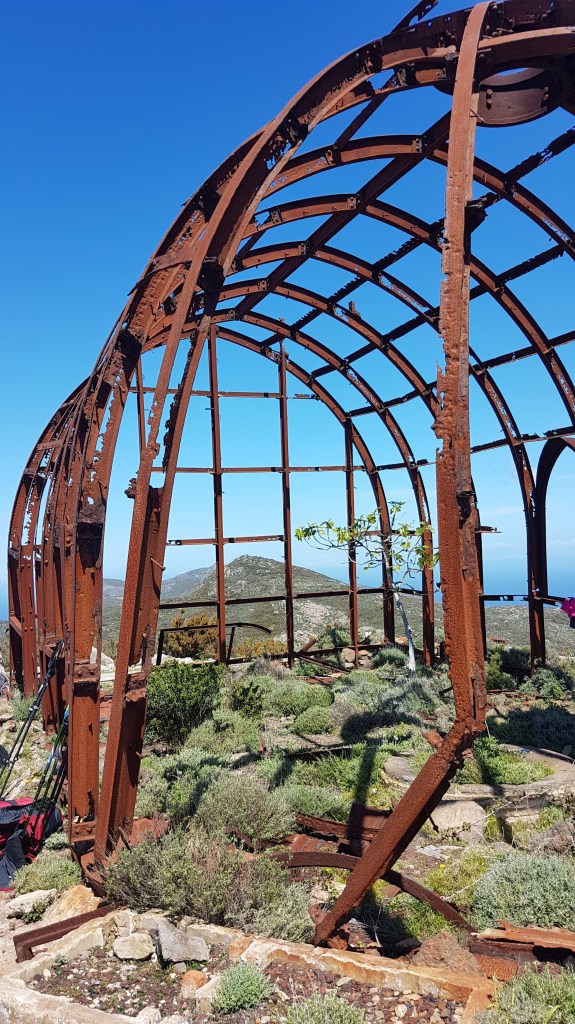
We kept going. Soon we were scrambling up a hill to an old radio tower, called the Semaforo, used for communication and spying by the Italian Navy till 1943. A group of hikers from the city of Modena were spread out around the metal structure, munching on all sorts of goodies. I was salivating. My husband got sidetracked in some bushes, looking for the finch, of course, and I sat down to rest on the springy thyme covering the ground. A man sat next to me, introduced himself, and told me that all his hiking companions, from the Italian Alpine Club were trying out different sorts of cheeses they’d brought with them from their region, Emilia Romagna. ‘It’s a veritable cheese sampling here!’ he exclaimed. I had to control myself. If I told him my sad story, he would feel obliged to offer me some of his lunch. His friends too. Then my husband would pop out of the shrubbery, and he would have to be fed as well. The Modenesi would be generous. They’d ply us with what they had. Emilia Romagna. Home of warm-hearted gastronomes. Where parmesan, Parma prosciutto, Bolognese meat sauce, come from, for god’s sake. I bit my tongue.

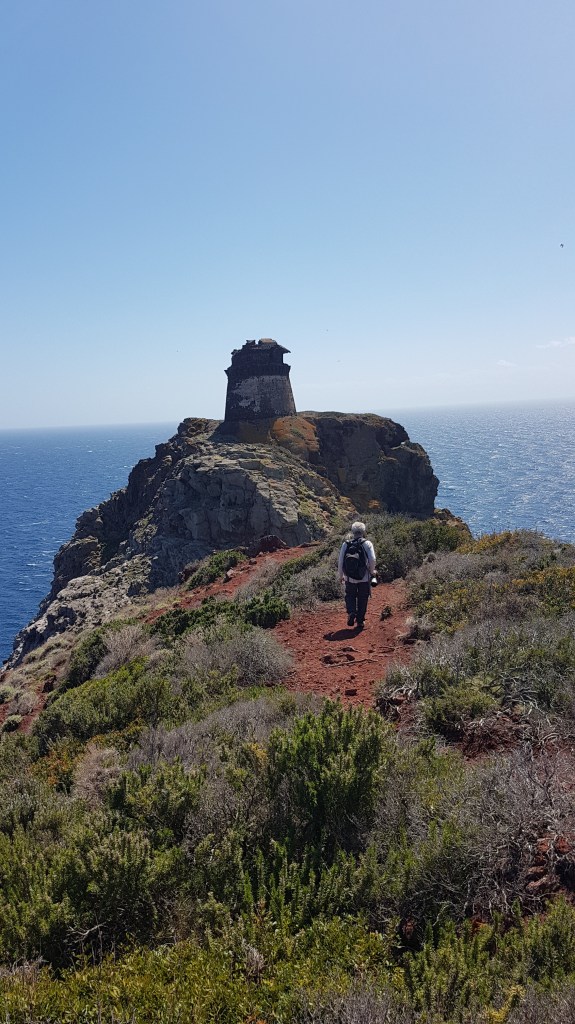
The Semaforo

We trudged on. The path continued to be unimproved. Uphill and downhill. We finished our water. Then we reached the southernmost point of the island. My husband walked out to a tower, la torre dello Zenobito (cenobite, a monk who lives in a community, as opposed to a hermit)  while I sat in the prickly, grayish gariga, one step up from desertification. The macchia (called maquis in French) includes bigger shrubs and small trees, and is greener.

I decided to draw a picture of one of these tough flowers making up the gariga. I fished around for a pencil in my husband’s backpack. And then, voilà, I found a packet of candied ginger and another one of pistacchios! I’d stumbled onto his birdwatching emergency stash! The type of stash you always forget you have! I fell on this treasure and gobbled up my half before my husband had made it back with his zoom-equipped camera swinging from his side. Now refreshed, we were able to trudge on for another three and a half hours.

Racing toward the Torre dello Cenobito on an empty stomach

We crept around the remains of the old monastery of Santo Stefano. What attractive, tough vegetation. Glossy honeysuckle, myrtle, lentisco, all plants that withstand frying-pan-like heat in the summer and wind all year round. I was impressed by the feistiness of the corbezzolo, small trees that produce a strawberry-colored fruit.  Why had it died twice on my terrace?? The guantlet had been thrown at my feet, and I would have to take up the challenge again. If something could grow here, it could grow just about anywhere, without too much coddling.

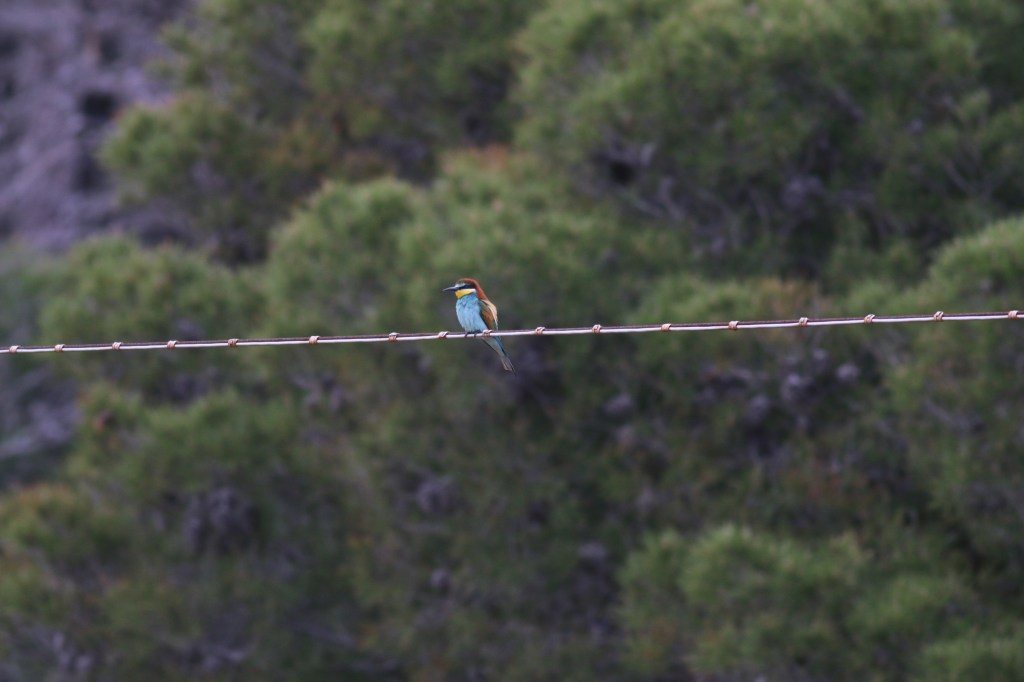
IWe crossed a lush marshy area. We heard some funny rhythmic sounds. “Bee-eaters!” said my husband excitedly. And there they were, yes, straight from Africa, making a fine spectacle.

Showy European Bee-eater (merops apiaster)

We were getting close to the end. The track was paved in places. We crossed paths with a few other birdwatchers. And then, we saw it! The inconspicuous but resilient thing that we had come for. Napoleon would have been proud of his little namesake. The Corsican, at last.

Corsican Finch (carduelis corsicana)

We dashed into a bar in town and bought some fizzy sugary junk drink that was going to keep us going until dinner. We needed to drag ourselves up through the penal colony and come back. I said goodbye to the asphodels on our way up the corrugated gravel road. How many hours out? Nine. We had been humbled by humble little Capraia. We didn’t have four legs and cloven hooves. We were just run-of-the-mill walkers and stalkers.

Asphodels

While eating our pasta later on, I asked my husband about his bird list. ‘How many lifers, apart from the Corsican?’

Useful website: http://www.isoladicapraia.it/index.html (also available in English)

Little Island In The Mediterreanean: Confining or Inspiring?

Villa Giulia, northern tip of Ventotene

It’s January 3nd, 2021 and Italy is red hot. No, it’s not the temperature, and the sun is barely lighting up the sky under those clouds that have been hovering over us for days up here in Veneto. It’s just Covid, the crimson monster, that’s leaked its color all over us. So we’re not supposed to wander around unless we desperately need food, exercise, drugs or a doctor. As far as the last two are concerned, I’m following all the rules and keeping my fingers crossed!

But it’s also why I spend most of my time inside, reading and doing a few jumping jacks when the urge comes over me. Then I try to remember a few of the good things that happened during that year of 2020 that turned everything upside down. Mannaggia 2020!   

For example, during those halcyon summer months which seemed deceptively virus-free, my husband and I and our Roman friends crept out of our respective nests to disembark on an island south of Rome. Yes, we traveled for hours by train and boat with our N95 masks, to find freedom on Ventotene’s rocky slabs of beaches!

Rock beach near the old Roman fish pools, with the island and prison of Santo Stefano

And it’s even more ironic considering that tiny little springless Pantadaria, as the ancient Romans called it, is most famous for being a place of confinement. Yes, people were sent into lonely exile there, to cut them off from all ties with society. Islands, of course, are by definition isolated. So a great place to keep enemies of the state, if that’s what you have in mind.

As we came into the port, we looked across a little bay to a miniscule islet with a yellowish 18th century building embedded with windows that look like gigantic unblinking eyes. Now abandoned, Santo Stefano’s high security prison is where Gaetano Bresci, the anarchist who made his way back to Italy from Paterson, New Jersey to assassinate King Umberto I of Italy, was given a life sentence. That life didn’t last long, as he was himself killed soon after by his jailers. I learned about Bresci from one of the most poetic and inspiring films I watched during last spring’s stringent lockdown – Paterson by Jim Jarmusch. Yes, I spend a lot of time catching up on movies as well. Movies talk to you and jostle your brain.

Villa Giulia

Anyway, to return to our destination island, diligent Augustus built a luxurious vacation home on Pandataria. But he then realized he was too busy consolidating his empire to waste time on frivolous pastimes and so he stuck his only child, Julia, there in 2 BCE, to wither away. She was leading a scandalous life in Rome. Was she also plotting against him with one of her lovers? Certainly, she would never have been censored for her flings or needed to conspire to get power had she been born a boy, his heir! But that’s how things worked and you can think about her as you stand on the ruins of what’s now called the Villa Giulia. It’s at the northern tip of the island, on a nicely windswept outcropping, surrounded by the blue blue sea. Julia, the first prisoner of Ventotene, could have looked landward to Circeo, the peninsula where the sorceress Circe hung out with her humanoid animals or to Vesuvius or north or south to other volcanic islands studding the waters. None of that would have helped her feel less lonely because she couldn’t have visitors or books. No human or intellectual comfort whatsoever while she ate her hard bread and gruel. At least she didn’t actually starve to death there.

To find out more about the unlucky Julia, you could go to a wonderful bookstore on the main square of the only town on Ventotene. At L’Ultima Spiaggia (literally, ‘the last beach’ which also means ‘the last resort’) I found John William’s great historical novel ‘Augustus’ (winner of the National Book Award).  I had already read it in English, so I purchased an Italian book, ‘La Macchina del Tempo (The Time Machine) by by Wu Ming 1 (one of the mysterious writers in the Wu Ming collective authors’ group). La Macchina del Tempo is about the dissidents confined to Ventotene during the Fascist era. What a group they were!

Main Square, with our favorite cafè and the ‘Last Resort’ bookstore (L’Ultima Spiaggia)

I dived into my new find in between walks on the few roads crisscrossing the island, visits to the hard rock slabs with my towel and new slimming swimming suit, and meals consumed on a regular basis with our friends. We ate fishy things such as octopus and mussels, and lentils too. All very tasty, as the people who live on Ventotene now descend from Neapolitans invited here in the 18th century. The Bourbon monarch of the Kingdom of the Two Sicilies had decided to repopulate an abandoned archipelago. The pioneers cleared some of the indigenous maquis vegetation to create a patchwork of fields for lentils and grapevines in the moister hollows.

Flowering caper

So I found out, as I rested on my narrow bed in our little hotel room after a taxing day of sunbathing and feasting in company, so strange and wonderful!, that Mussolini followed in the Bourbons’ and Augustus’ footsteps by putting any perceived danger to his regime in outlandish places where they too would languish in silence.  

However, the modern-day dictator wasn’t as efficient, for example, as the Roman he venerated. The communists, socialists and rebellious people from subjugated lands such as Albania and Yugoslavia, had some things Julia didn’t. Books, and each other. There were so many of them, and the island so small, that despite the rules of confinement, they managed to get together surreptitiously, talk, and amke audacious plans for a better future. One of them, Altiero Spinelli, is considered a father of the European Union, as one of the authors of the Ventotene Manifesto. Another, Sandro Pertini, became a partisan and later politician and finally president of Italy in 1978.  

      Even though we weren’t sleeping in the same lodgings, gravity pulled us down to the main square every morning from the steep hillsides we were perched on. There we had coffee and pastries at the same cafè every morning and discussed the day’s plans. A little beach, a little history, a little exercise, before more fish down by the Roman port for our noonday and evening sustenance.  

Port and lighthouse

The Romans were builders. No doubt about the fact that the Romans were master builders. Having taken a tour of the intricate system of cisterns and conduits they slaved away at (no doubt with slave labor) to collect and distribute rainwater on Ventotene, we tried to get into the archeological museum as well.

Stairs into Roman cistern

But the museum was shut because of the virus, so we decided to rent a boat instead. A friend who felt pretty familiar with the sea was at the helm as we skirted the island. It didn’t take long, so we also threw ourselves into the clear, clear water from time to time, trying, but not always succeeding in avoiding the rare jellyfish lurking there. We joked about various things. We’ve almost all known each other for some 40 years, so no qualms about showing off our post-lockdown bodies.

Our friend Massimo (left) manning the ship

       I finished off my Italian book after our communal activites were over. So I learned that after Mussolini’s fall from power, in 1943, Italy was still under the grip of his nefarious allies, the Germans. The latter didn’t leave Ventotene until a small group of US soldiers, helped by one of the few remaining political exiles, freed it through guile and luck. The story is told by John Steinbeck, a war correspondent, in his collection of articles, Once There Was A War. Well, he was a skillful writer and it’s worth reading. You can find this volume at archive.org and borrow it for a few hours.

It was time to go back home. We felt both soothed and galvanized by our conversations with our interesting old friends. Close quarters can be a good thing if done with the right tools! As we pulled out of the harbor, masked up, we could see some seagulls flying overhead. Ventotene signifies freedom from want and a respite for migratory birds heading north on their learned paths from Africa in the spring. Crazy birdwatchers descend on Pandataria in April to bathe in the sight of thousands of winged creatures finding refuge on this dry, greenish crag in the Mediterranean. But that’s another story.

Southern tip of Ventotene, closest to Africa

Monte Grappa


20180513_155631
Looking northward from crumbling remains of WWI trench at Monte Tomba, eastern edge of the Grappa Massif

There is a broad mountain in northeastern Italy, south of the Alps and north of the Venetian plain, that is famous for cycling and war.

The name itself, Monte Grappa, actually brings to mind a drink. Grappa is a type of aquavite, or water of life, which was originally supposed to have medicinal properties. It’s not very clear what those are now, exactly, other than killing the effects of the overly strong stimulant in your cup of coffee if you decide to wash it down with a shot of one of the many alcoholic beverages that Italians call ammazzacaffè (literally, kill coffee).

Grape, Grappa. They must have a common root. They do, or at least the fruit and the drink do, as they appear to derive from the Germanic Krappa (hook or bunch of fruit that looks like a hook – the Italian grappolo comes from the same word and refers to a bunch of grapes). But there are no vineyards on this massive massif in the Veneto.

20180630_150813_LI
Eastern Alps, with the Monte Grappa massif circled in orange; Lake Garda is in the southwestern corner, the Venetian lagoon in the southeastern corner.


In the upper meadows of Grappa, elevation 1,745 metres (5725 feet), you find: sheep, cows, a few chamois, some birds, and a lot of rocks. So the geographical name might actually come from the pre-Latin (i.e. primitive) Krapp, which has to do with those rocks. Now the blunt primeval word could work if you are English speaking and frustrated.  Mount Krap might be what you say when you are scaling it in the rain or fog and haven’t trained enough. Translated, however, it loses flavor. Mount Rocky is just subpar. So we’ll stick with the word that rolls off our tongues more easily.

20180623_140306-e1538384601830.jpg
The monument to the fallen soldiers of WWI at the summit


Cycling and war. Well, war comes first. Monte Grappa has a grim side, there is simply no escaping it. To begin with, what the name says to many Italians, actually, is ‘World War I’, or ‘defending your country’. The military song ‘Monte Grappa, you are my homeland…’ pops up in my head every now and then all by itself. The Italian Alpini (the Mountain Corps of the Army) still sing it in their famous choirs. They are also, by the way, stalwart drinkers. Well, the Alpini must have consumed a fair amount of fiery tonic when they were trying to hold the ice-glazed ridges of the mountain against the Austrians during the last year of the Great War. What I am saying is that it is quite possible that a lot of grappa was drunk around treacherous Monte Grappa in 1918, with good reason.

WWI, yes. Well, back then Italy had territorial ambitions as well as historic conflicts with its Austro-Hungarian neighbor to the north and the east. The young country had only managed to wrangle the Italian-speaking regions of Lombardy and Veneto away from the Hapsburg empire in the second half of the 19th century.  So in 1915, the kingdom of Italy entered the conflagration that was already underway in hopes of getting more lands, Italian-speaking or not, to add to its size and prestige. It attacked Austria-Hungary (and later declared war on Austria’s allies), thereby opening a front that some historians call the ‘White War’. What was white about it was the snow that soldiers found in the eastern Italian Alps, chiefly the Dolomites, and all the lesser peaks of the foothills where they lived and fought.

20180708_132530

Well, the Italians made a little headway into what is now western Slovenia in the first year. But then things stalled until the Austrians and Germans  launched a surprise attack, a Blitzkrieg, on their enemy at the village of Caporetto (Kobarid in Slovenian) in 1917. The massive, chaotic retreat of traumatized Italian troops and civilians, as described by Hemingway in his novel, A Farewell to Arms, didn’t stop until west of the Piave River. Just to give you an idea of how far that could be in some spots, the distance between the Piave below Monte Grappa and Caporetto is a whopping 190 km.

The Piave, now officially denominated the ‘sacred’ river of the homeland, comes down from the Dolomites, plowing valleys out of the limestone as it wends its way to the sea. One of those valleys forms the eastern edge of the Grappa massif. Thus the entire mountain, inevitably, whether it wanted to or not, was bound to become a fortress on the new front. From November 1917 to November 1918, soldiers turned a natural rampart of rocks and trees into a fortified one of tunnels and guns.

The mighty polyglot Austro-Hungarian juggernaut eventually surrendered and collapsed. Italy prevailed. But the dead were already dead and it is fitting that the remains of over 20,000 troops from both sides, victors and the vanquished, all soldiers obeying orders, lie in the huge ossuary on the summit of Monte Grappa.

20180708_131422
Monumental ossuary

The ossuary is omething you must visit if you happen upon Monte Grappa, even though its monumental aspect is reminiscent of Fascist architecture you see in other parts of the country. It was, in fact, built in the 1930s, during the Fascist ventennio (twenty-year period), and its purpose was not only to commemorate the fallen but also to glorify the homeland. It’s good to remember that Fascism as a movement started in Italy during WWI itself, and manipulated patriotism as well as other postwar issues to create a dictatorship in the 1920s.

20180708_131501
Each rectangle bears the name of a famous battle site

But it’s possible to separate the political rhetoric from the pathos you feel when you are up against the testimony of so many lives cut short. I, for example, am always reminded of the fact that my husband’s grandfathers were both conscripted from their villages in southern Italy to go to war in the north when they were barely 18. They had probably never left their respective valleys in Molise, let alone the south, in their entire lives before being shipped off to the northeastern border. They would only have known their local dialect, and must certainly have felt the contrast between the rhythms of an agrarian life spent with family and neighbors in the fields or tending to livestock, and the harsh discipline of the army.

One grandfather only made it out alive by the skin of his teeth, as a matter of fact. Accused of insubordination, he was tied to a fence where enemy snipers could have used him as target practice if they had felt like it. They took pity on him, for some reason, he survived the trial by fire, and went home to start a family when it was all over. He was lucky not to have been one of those brought down by the enemy, disease, or the elements, whether it was to enlarge or defend their country, whose deaths are honored by the monument.

Unfortunately, that’s not the end of the sombre side of the mountain. There was more violence on Monte Grappa at the end of WWII. In the fall of 1944, the Germans still controlled northern Italy along with the collaborationist Fascist regime of the Repubblica di Salo’ (a town on the western edge of Lake Garda). The Allies were making their way up the peninsula to dislodge the Nazis. The new government in Rome by then had made peace with the Anglo-American forces, but Italians who lived in areas occupied by the Germans risked being conscripted by the Fascists or having to flee. The number of anti-fascist partisans was thus on the rise and the Germans and their Italian cohorts decided to crack down on those hiding out in the folds of Monte Grappa.

20180623_124437
Memorial to partisans captured near Campo Croce

Some partisans were killed right then and there, whereas others were taken to nearby Bassano (called Bassano del Grappa after WWI, in homage to the mountain), executed and hanged in public along the main street. It’s hard to imagine such a horror taking place in this pretty town, the gateway to the far north, with its famous geranium-bedecked Palladian bridge stretching over the river Brenta, where tourists taste grappa and buy Alpini souvenirs. But that’s WWII for you.

Monte Grappa is a visible symbol of Italian resistance during wartime. But like all enthralling places, it is also multi-faceted. Nowadays, the truth be told, many people visit the area above all to do some hiking, fill themselves on inexpensive mountain food, throw themselves off a hillside in a hang-glider, or huff and puff their way up one of its ten road ascents on a bicycle.

The secret to Grappa’s popularity among cyclists is probably that incredible number of ascents. The massif is so spread out, has so many ridges and so many routes crisscrossing it that you can go at it from the four cardinal points. Montony is not an issue. Grappa is one of the most versatile mountains I have ever had the chance to become acquainted with. So when last May my husband and I decided that we needed to get into shape as quickly as possible after a winter of hibernating, we knew there was no better way than to go up and down our closest not-so-very-mountain as many times as we could.

20181001_111641 map of Monte Grappa road bike routes
Map taken from Brevetto del Grappa showing all ten routes

The classic route is up the ‘strada Cadorna’ starting in the village of Romano d’Ezzelino, in the valley to the south. Cadorna was a WWI general who built this military access road before the Caporetto disaster, after which he lost his job. The surface is good, it is wide and well engineered, with about 28 switchbacks, and the grade never goes beyond 11%. You find the steepness at the beginning, which is a little discouraging, and some at the end, when you are getting tuckered out. Campo Solagna at 13 k is the last place to buy drinks so make sure you bring water with you. It is, in fact, a longish slog.

20180630_144747
Road from Semonzo to the summit


Another possibility is the route from Semonzo, a bit to the east of Romano. This road is narrower, but has less traffic and is a breeze for the first 12 k. After Campo Croce, however, the slope changes. It was around then that I started thinking about having babies. I mean, the pain of a actually giving birth to a baby. I know that’s a real stretch, comparing the process of bringing a new life into the world with a grueling, frivolous activity that serves no purpose whatsoever  But that is, in fact, what my mind did. I started considering the route from Semonzo, only 19 k to the top (max gradient 14%), and the one from Romano (27 k) and thinking that the shorter ascent was akin to going through labor on a hormone drip as opposed to doing without. Yes, that drip that increases the frequency of the contractions, making the whole experience faster but more excruciating. Romano-Cadorna, instead, was more like totally natural childbirth – long and slow and ultimately, more exhausting. Having completed Semonzo a few times now, I can vote for it. It is direct, has some beautiful forested stretches, a few tunnels, and gets you to where you are going fairly quickly. If your heart can put up with it, you will feel refreshed when it’s all over and still want to go to a mountain diary, a malga, and eat fried cheese and drink wine. There, I’m for the drip.

As far as the Caupo option is concerned, all I can say is that it is long yet delightful (28 k, max. gradient 12%). Shadier and narrower than the Romano road, with a view of truly tall mountains to the north, it only has short steep sections, interspersed with some downhill stretches. We did it right ahead of the Giro d’Italia in 2017 and so had a crowd of spectators lining the route, offering us beer and encouragement and comments about who was faster, my husband or me. People seem to be intensely interested in whether a woman can overtake a man around here. There is a whole story there, for another time. Anyway, that was a wonderful experience, especially when I was cheered like a champion because I happened to cross the finish line of the climb by myself, just before the professionals arrived. My husband had got ahead of me right about then and I was all alone and somehow, in my tipsy, disheveled state, a star.

20180630_131516
Top of 20% climb from Seren del Grappa

Seren del Grappa, (25 K, max. gradient 20%) however, which also starts from the north, is a different kettle of fish. The advantage is that there is very little traffic indeed, it having barely more than one lane in some spots. It has too few switchbacks, and some awful ramps that go straight up and are too narrow to allow you to ‘paperboy’ them from one side to the other. The scree on the road made my bicycle slide and I was worried about getting a puncture in my tire or my leg. A man I crossed paths with who looked as if he’d participated in Ironman multiple times told me when we met again on top at the capacious Rifugio Bassano (good food and basic lodging, part of the Alpine hut network) that Seren was the second-most difficult route of them all. Hmm, I said. Well, it’s the last time I’m ever doing that. Until next year, right? was his answer.  I guess that’s the spirit. I’ve only completed four out of the ten climbs so far, but what’s to stop me from trying the others? Nothing. It can’t be any worse than childbirth, after all.

So I think I can hum ‘Monte Grappa, sei la mia patria’ to myself as I crawl up one of its byways and give my own meaning to its words. I’m just hooked on the place, as you can see.

20180617_143529


Further information:

Romano d’Ezzelino is 88 k from the city of Venice and 88 k from Trento.

Rifugio Bassano: Via Madonna Del Covolo, 161, 31017 Crespano del Grappa (located just below the summit of Monte Grappa)

Brevetto del Grappa: You can buy this informative ‘license’ attesting to your endurance and prowess at bars and restaurants located at the start of each climb. You get a stamp at the bottom and one at the top and are expected to complete all ten in one year…

20181001_111507-cover-of-monte-grappa-license.jpg
Brevetto (‘license’) attesting to your endurance and prowess. You have to ask for a stamp at the designated venue at the bottom and top of each route.

Getting religious in southern Utah

Boulder

20171230_161937
Birds hanging out in downtown Boulder at sunset

Last December, my brother Will and I took my father, who now has serious trouble walking and resides in an assisted living facility in Austin, Texas, to Utah. The aim was to meet up with some of his longtime friends, mostly members of the Sierra Club, who are infatuated with the Colorado Plateau. These pals and comrades-in-arms have been gathering in a tiny hamlet to ring in the New Year for decades.

20171230_163728
My father checking out bygone prices

Boulder, Utah. Where the heck is that, you might say? Well, you’d be forgiven for your ignorance and yet you would probably want to know more, because it’s a pretty far-out place in many ways. For one thing, it’s in the middle of the southern part of the state of Utah. The big, weird rocks and utter loneliness of the whole area have such an effect on people that I understand my brother when he calls it ‘the church of southern Utah.’ Being there is, in fact, like going to church, in the best sense of the term. You feel reverant and somehow purged of all bad feelings by its mystery, minus the mumbo-jumbo.

20171229_171553
Waterpocket Fold

Now Boulder is supposedly the last town in the lower 48 states to receive mail by mule. The poor mules walked along a scenic trail which some of them apparently fell off from time to time.

20171230_141014
Boulder Mail Trail

Their service to the community ended in the 1930s, when the federal Civilian Conservation Corps finished a gravel road connecting the two metropolises of Boulder, population 266, and Escalante, pop. 878, further to the south. This circuitous link, which goes up and around and down, is called Hell’s Backbone and is kind of a wild ride, too, as the name implies. Most drivers these days would prefer Highway 12 from Escalante or Torrey, to the north. But another possibility is the semi-paved Burr Trail that comes in from the east, and that’s what my brother decided to take to get our father to Boulder for New Year’s Eve.


20171229_164507
Looking eastward from Burr Trail

When I was a teenager in Salt Lake City, I did some backpacking in the canyons of the Escalante (the last river to receive an official name in the lower 48) and its tributaries, including a lovely place called Death Hollow. It may have gotten its name from the long-suffering mules falling into it. It is truly lovely, though. And those trips changed my attitude towards a state I was new to and not getting along with very well. That church of southern Utah experience came over me, and I realized there was something sort of magical down there in those fissures and streambeds and rocks.

I then moved away from the West, and didn’t go back to that part of the state until after Clinton created the Grand Staircase/Escalante National Monument. That seemed like a wondrous thing. Extraordinary land protected forever. Until the end of time. That was the reasoning behind the designation of the first national monument, Devil’s Tower in Wyoming, in 1906. It was supposed to go on like that, forever!


20171230_132417
Grand Staircase/Escalante

But as my father loves to say, after Chaucer, “all good things must come to an end.” I guess that is true, but don’t know it should be so. In any case, the US has had its ups and downs as a country. For example, the bit about the end of time, wasn’t that what the government said to Native Americans over and over? In the 1868 treaty with the Sioux, the Indians were promised the Black Hills of South Dakota forever and ever, until the end of the world. I remember reading that somewhere, maybe in a museum. But the agreement, signed and sealed, only lasted until the next gold rush.

20171230_131636
My brother Will enjoying winter landscape (Grand Staircase/Escalante)


We know, in fact, that the US has not seen the end of the gilded eras of robber barons, blatant and tolerated corruption and total lack of respect for treaties and people’s rights,etc.  Our current president, who doesn’t like exercise and knows nothing about natural beauty, has declared that the monument lands of Grand Staircase/Escalante and Bear’s Ears, created by Obama at the request of five local Native American tribes, have now been reduced by half and 85% respectively. This is to open up these places to oil and coal development and save them from being overprotected for the general public. The general public, ordinary people who like walking, in goobledygook language, have been referred to as ‘special interests.’


20171229_144532
Bear’s Ears from highway 95

Well, when we, my brother, sister-in-law and father, came into southeastern Utah on December 30th (from New Mexico via a tiny piece of Colorado) we drove past the southern end of Bears Ears on state highway 95, a road that doesn’t get much traffic in the winter. We crossed paths with one car on the 90 some miles to the Hite Bridge over the Colorado river. We had a schedule to stick to but I couldn’t help gawking. Bears Ears is sacred to the Navajo, Hopi, Zuni and Ute peoples and is chock full of well-preserved artefacts from ancient dwellings going back over 10,000 years. Not to mention an incredible trove of Triassic fossils.

20171229_145512
Westward-ho along highway 95

But most of that has to go, to allow coal mining or oil drilling to boost the local economy, say local politicians, Secretary of the Interior Zinke and Trump. They think nothing of tearing up places that are akin to Mayan temples or the Vatican. I shook my head. Surely there had to be a way to save all of this fantastic land from fly-by-night activities.

20171229_152246
Looking southward near Hite

We reached the Colorado, crossed the striking white bridge at Hite and then went over the Dirty Devil river soon afterwards. This is the northernmost point of Lake Powell, the reservoir created by the Glen Canyon Dam on the Colorado. The lake is receding and what we saw below us was unnavigable. We stopped to take pictures and I let my old dad out of the car to stretch his numb legs

20171229_2238302-e1520180209796.jpg
Standing tall at Hite Viewpoint

Then we piled back in to continue our drive over to highway 276, which we turned off of just before Lake Powell’s Bullfrog Marina to get onto the Burr Trail. I had never traveled on this particular route before and was wondering why that was so. How could I have missed it? But here we were, at last, on a perfect day in the dead of winter. It’s 67 miles to Boulder and the only sign of humans or development that we encountered, apart from what we were rumbling on, were two gung-ho cyclists and some cows grazing in the southern end of Capitol Reef National Park. No towns, no farms, no houses, no telephone poles, electrical lines, no nothing except for mountains, plateaus, escarpments and canyons. All of that overwhelms you, and also makes you feel thirsty for water, even when it’s cold. No country for unprepared people, that’s for sure.


20171229_161920
Who wants highways? Shortcut to Boulder on Burr Trail

The Henry Mountains (last peaks to be named in the lower 48) appeared off to the east, and the Waterpocket Fold to the west. Capitol Reef was due north.

20171229_223626
My brother and sister-in-law Mia feeling reverent along Burr Trail

At a certain point, we went up over the Fold, which looked as if some gods were messing around and started hurtling slabs of rock into a line of clay. The pieces then got stuck every whichway. That seemed about as plausible an explanation as anything else. What the heck. We all did a lot of gaping and picture snapping and sighing. If we’d lingered a little bit longer, with some alcohol, we might have started speaking in tongues or something.


20171229_225448
Henry Mountains from top of Waterpocket Fold

Our party reached Boulder just after sundown and joined my parents’ old friends at one of their homes. I found a calendar there with pictures of reunions from bygone years, including one with my mother in it. I touched her face. She was gone, but her spirit was here with these people. She had fought the good fight for air quality and preservation of public lands. She also liked Boulder. I remember when she was thinking of selling her house in Salt Lake and buying property here, where the nearest supermarket is over 30 miles away and state liquor store many miles more. “That’s crazy,” I told her. “You like malls, boutiques, theaters….and wine, for god’s sake!” My mother reconsidered, and she and my father, still on more or less amicable terms after their divorce, contented themselves with visiting their community of friends on a yearly basis.

20171230_130036
Easy hiking in Grand Staircase/Escalante

Our hostess this evening thanked me for bringing my father. “Like old times,” she said. Her husband, Gibbs Smith, had passed away very suddenly a few months beforehand and the get-together in 2017 was a tribute to this man, a publisher and man of ideas, who had sort of started the whole Boulder adventure to begin with. After the northern part of highway 12 was finally paved in 1985, the village became easier to get to from the capital. The good road basically put it on the map for nature-loving city slickers.
Gibbs printed some beautiful volumes about the Escalante area itself, one of which I look at fondly now and then. Some of the people I met at our New Year’s Eve gathering, where we quaffed wine that had been brought from all over, included the developer who designed and built the attractive Boulder Mountain Lodge, where we stayed, and a photographer and alpinist who lives near Boulder but travels the world. He said that after going to Ladakh in the winter, he most looks forward to exploring the unknown, unnamed canyons of southeastern Utah in the spring.


20171230_151525
View from terrace of Boulder Mountain Lodge

We briefly discussed the fate of Grand Staircase/Escalante and Bears’ Ears. I was struck by the fact that these seasoned activists didn’t seem to be terribly worried about sudden rampant destruction. They pointed out that many things, such as coal mining on the nearly impenetrable Kaiparowits Plateau, to the west of where we were, had been tried in the ‘70s, and come to nothing. Mining and energy companies want things to be cost effective. Hauling ore that might not be as desirable as in the past from places that have few roads and no people makes even less sense than before. An encouraging sign was that a power plant, the Navajo Generating Station, just south of the Glen Canyon Dam, was slated to be closed. It is the sole customer of a local coal mine. So much for more of that.


20171230_115535
Grand Staircase/Escalante

Utah, as we all know, is a red state, which means that ‘development’ is considered synonymous with ripping up the earth. It is unfortunate that one of the most interesting and intact landscapes on our planet is under the stewardship of people who couldn’t care less about it. But that’s how the cookie crumbles, sometimes, and why you have to be constantly on your toes if you disagree with lax stewards.


20171230_120136

20171230_120225
American History in a cave

We spent the next few days with our friends who knew every little cave and slot canyon in the neighborhood. I cajoled my father into trying to do part of an easy trail strewn with pieces of petrified rock. I held his hand to get him over slightly steep spots, and waited for him to creep along the flat ones. I knew it might be the last time he had the opportunity to actually hike in the church of southern Utah.


20171231_233329
Old pilgrim

…..
Recommended reading:

Wallace Stegner’s Beyond the Hundredth Meridian, about John Wesley Powell and his explorations and legacy, is a must. Powell, by the way, was the man who named Glen Canyon, the Escalante river (after Father Escalante, the 18th century Spanish explorer), the Dirty Devil river, the Henry Mountains, etc. After getting through the first half of the book, which describes Powell’s trips down the Green and Colorado, you’ll want to throw on a pack and run out into the wilderness yourself.

Trail Guide to Grand Staircase-Escalante National Monument by David Urmann, publisher Gibbs Smith

Desert Solitaire by Edward Abbey

The Monkeywrench Gang by Edward Abbey

Red by Terry Tempest Williams

Archeological significance of Bears’ Ears:
https://www.nature.com/articles/d41586-017-07794-5

Information about Boulder: http://boulder.utah.gov/;

Boulder Mountain Lodge: https://utah.com/boulder-mountain-lodge

Burr Trail: https://www.nps.gov/glca/planyourvisit/driving-the-burr-trail.htm


Somewhat bird crazy

bird and me
Coal tit and me

Origins

My Italian husband was already crazy about birds when I first met him. At that time he still had stories about duck hunting in his ancestral village in the southern Appennines.  He would take up a gun and go tramping around with his cousins in the sparsely wooded mountains of Molise. There wasn’t a lot to do there back then, apart from going to the local bar and playing card games. So going after the little game left in those arid hills that had been inhabited for millenia was a pretty good pastime, for men, at least.

100_4408 (2)
Foci, hamlet just up the valley from my husband’s birthplace

The idea of enjoying natural areas and observing wild creatures for their own sake might not come easily to people, male or female, who make a living off a hardscrabble land. We once stopped to ask a weather-beaten shepherdess who could’ve been anywhere from 60 to 90 which way to turn when we were driving up to the top of the mountain that looms over my husband’s birthplace. We were on a dirt road, crossing a grassy plateau graced by boulders and a few small oak trees. Small sheep were milling around us. Rocky pinnacles ringed our meadow. A few crows cawed in the distance. The herder asked us why we there and I said that it was beautiful. Beautiful? Her mouth twisted.  “Chess’e’ r’diav’r!” she answered in her dialect. “This is the devil!” I only half understood the last word but I got the drift as she gestured with her crook towards all that infernal nature that had enslaved her. She had a point. She really had a point.

road to mountain pasture
Road to mountain pasture, r’diav’r


By the time I met Annibale (Hannibal in English), however, he had been living in a large city, Rome, for over a decade, and he hadn’t fired a shot in a few years. He, instead, was always going on about song birds. He had taken care of a wounded green finch for a week or so when he was a child. So my first Christmas present to him was a pair of prolific canaries. They lived in a cage, where the male trilled, and the couple mated often. The female, subsequently, spent a lot of time brooding her offspring. We finally decided to cook up a few unborn ones to reduce the growing avian population in our little Roman apartment. One of the weirder sights I’ve seen in my life is a canary egg cooked sunnyside up and eaten on a tiny morsel of bread.

20180112_190111 (2)
Our canaries, Liebchen and Mario Merola (a famous Neapolitan singer)

Back then, caged birds were all the rage. Every Roman neighborhood had an uccelleria, a bird store. They were almost all run by men, who would hang out there with their buddies, shooting the breeze. You’d walk into these narrow, dank shops full of stacked up cages, and twitterings and flutterings and guys smoking and gossiping. The smoke helped cover the smell of the bird excrement, pretty much.

The Italian word for bird, ‘uccello’, is also a colloquial term for penis, by the way. I had a certain knack for picking up street talk. That’s not to say that I wasn’t trying to learn more highbrow terms too. Anyway, when a gregarious American co-worker of mine told me she wanted to look for a lovebird, I told her I was 100 percent sure that the translation probably wasn’t an “uccello d’amore”. She scoffed at me for being so nitpicky and sashayed out the door of the office we worked in to head for the nearest bird store.

The next day my colleague sidled up to me, looking a little sheepish. “Hey, what was that other meaning you were talking about…? I mean, I kinda have a feeling I was asking for a love-dick! Ha, ha. One guy said, ‘I have one for you right here, honey’, and pointed to below his potbelly!”

Now this might explain why in this country ‘birdwatching’ is just called, well, ‘birdwatching’. If you ask a casual Italian acquaintance whether they are interested in looking at ‘uccelli’, they could easily take you for a voyeur of the male anatomy rather than someone who wants to enlarge the community of aficionados of fowl.

The English word is also appropriate because they, the English, invented the whole thing: the idea of observing birds in the wild instead of only shooting, and eating them.

OLYMPUS DIGITAL CAMERA
Birdwatching in Pian dele Femene, in the foothills of the Dolomites

In northern Italy a few people still like catching and munching on little songbirds, roasted on a spit. It’s illegal but some will tell tell you they have tried this specialty. One of my students said he loved it, but his girlfriend “didn’t like getting all those little bones stuck in her teeth.”

100_0764
Nets to capture live migratory birds (from Bird Fair in Comacchio)


cages for live bait birds
Cages to hold live ‘bait’ birds, which sing and lure wild birds into nets and traps (from Bird Fair in Comacchio)

We now live just south of the Alps and not far from the sea. There is definitely more fauna here. It’s easy to see hawks sitting erect on telephone lines running parallel to the tollroad from Venice to Slovenia, for example. The predators, mostly buzzards or kestrels, stunned us at first. How could they be perched there with all those cars and trucks whizzing by? But now we look out for these fascinating scourges of field mice.

So my husband has put aside the attitudes he used to have towards feathered, flying creatures. Hannibal no longer shoots them and tries not to eat them. Now he’s more interested in spying and stalking, another English word incorporated into Italian. Once we moved to Veneto, the region of which Venice is the capital, he started following online birding sites.  Then the Venetian Birding Group was formed and we started participating in their outings.

20171202_105854
Experts

I go along to be a good sport because I don’t know very much about the creatures we look at. I admire the big ones flying around like little airplanes. How do they do it? How do they get themselves up there? But, ultimately, who cares if it’s a tundra or whistling swan? Or a sparrowhawk or a merlin? I do admire the people that can do all that identifying, though, and I am in awe of their competence and dedication.

20171202_194853
Area east of Caorle called ‘la Brussa’

Birding on a cold day

In December, I agreed to go along on an outing in the Venetian plain that was reclaimed from the sea in the 20th century. The lonely low-lying area between the seaside towns of Caorle and Bibbione, east of Venice, used to be marshy and malaria-ridden. Then drainage projects were carried out and farmhouses were built. Ambitious plans were made for development. Some have been abandoned, but others still thrive. Now there are emerald green fields, even in the winter, and the flatlands are  dotted with small lakes which attract all sorts of water birds. They fish in the ponds and then go over to the fields to look for grain. This is at the northern edge of the Adriatic Sea, a quiet stopping point for migrating species.

20171202_131955 pond la brussa
Waterfowl in coastal pond with wind

It was freezing cold that day and I dragged a ugly down coat out of the mothballs . What with global warming and changing fashions, I hadn’t used that garment for a good while. But it put up with the buffetting wind pretty well. I felt as cozy as the teals and the shovelers and the wigeons in the water, which were totally undeterred by the blasts of icy currents coming down off the Carnian Dolomites to the north.

Greater white-fronted geese flying south of the Carnian Dolomites
Greater white-fronted geese and Carnian Dolomites (south of Austrian border)


One advantage of the low temperatures was that we never stayed very long in one place. Our leader set up a spotting scope, explained what everything was, made sure we all got a look, and then had us we move on. Now that is my kind of birdwatching.

Bewick's swans
Bewick’s swans

Greater white-fronted geese and Bewick’s swans and common cranes flew over us. A common kestrel, like an extra-large hummingbird, hovered over some muddy furrows, checking for mice. A greater spotted eagle, like a flying dinosaur, circled higher up, scaring the hell out of everything under it.  Great egrets stood stock still by the water’s edge, always graceful and elegant. Always eye candy, every time.

Our little group, less than 20 that day, occasionally heard some ominous sounds. There are hunting reserves along the coast, called “valli”, which are privately run and sometimes very exclusive. Thick shrubbery hide them to the point that you would never even know that a whole little world of lodges and wealthy hunters and a whole staff of helpers gravitating around lagoons full of waterfowl and migratory birds exist there until you hear the sharp cracks of gunshots.  In some ‘valli’ hunters still fire from inside barrels, what Hemingway did back in the day and described in his melancholy book ‘Across the River and Into the Trees’. His alter-ego, instead of killing birds, and getting soused on Valpolicella while waiting for death to take him, might have been happier had he spent his time with binoculars and a camera.

20171202_233428
No hunting


I Love Rambling

Montello – my favorite little cycling hill

What better thing to do on a clear fall day in northeastern Italy than hop on a road bike and head for the nearest hill? Leave the tedious flood plain surrounding my city of Treviso and go for the closest personal and geolographical relief?

In my case, it’s an elongated mound attached to the northern horizon like a limpet. This greenish limpet is called the Montello, which means “little hill”. “Little” is an understatement, considering the pretty big hills rising up behind it. When the air is free from pesky particulates, you can see the Dolomites standing tall beyond yet another range of foothills.  I always look for those mountains in the paintings of Venetian masters. They were paid to bring Christ and the Madonna and an incredible multitude of saints to life, but couldn’t help adding those fantastical mirage-like backdrops to their work.

20171110_160836
The Montello, preceded by vineyards, topped by a WWI ossuary and half-ruined abbey, and set off by the foothills of the Dolomites.

Pinarello

I pass the flagship store of the Pinarello bicycle makers on my way out of town. I have one of their creations and used to feel proud I was helping the local economy. Now it turns out world-famous Pinarello has been sold to a private equity firm.  But I will always feel loyal to the brand because I’ve had so much fun tooling around on my low-end racing model.

I also liked the old man, the founder and ex-racer Giovanni Pinarello, who would hang out in his store and share his thoughts with customers in a strong local accent, using bicycle jargon when possible. He once poked my brother in the stomach with his cane and told him that he needed to put on the brakes when he got home. My brother used to be as thin as a rail but had expanded in his midriff after moving to Texas, and didn’t take kindly to this kind of comment about his eating habits. Mr. Pinarello was a trim octogenerian himself and a bit of a ladies’ man. When I bought my bike eight years ago, he told me that I’d have men coming after me. My exceptional new speed, of course, would allow me to stay ahead of any male who wanted to compete. Another time he told my husband that I had a good ‘frame’, as if I were a window or a loom, although I was swathed at that moment in a shapeless floor-length winter coat. Yet I didn’t mind being compared to a pair of glasses. I was just happy that anyone was taking my desire to ride a decent bike seriously.

Well, it was a strain for me to understand Mr Pinarello’s lingo. I’ve lived in Veneto for over ten years but have been lazy about picking up the accent or dialect. I thought standard Italian would be enough but I am sometimes stumped when dealing with older people and the populace in general after they’ve had a few glasses of wine. And now that a referendum on some sort of autonomy for this region won by a landslide a few weeks ago, maybe the time has come to take an accelerated course in Trevigiano. The best place to start would be a bar.

Venetian Timber Reserve

But let’s go back to my great day riding to my little hill, which was one of the Venetian Republic’s timber reserves for at least three centuries. The Serenissima guarded their trees with vigor. Although that fine example of forestry vanished when the Republic disintegrated after Napoleon’s arrival in the late 18th century, the Montello still has something special about it.

20171110_163044
Presa 16 from the south

Getting to the Montello from Treviso

I take the Via Montello, which starts right outside the ringroad circling the historic center of Treviso. There can be a lot of traffic on this route for the first ten kilometres, depending on the time of day. Some stretches have cycling lanes which then end abruptly. I mostly stay on the road and make sure cars have to pass me rather than force me into the ditch. I could break a leg and become a cripple for life, whereas they might lose ten seconds of their time.

It’s amazing how all these close encounters with cars in the last few years have made me more daring. It’s just a question of habit!

After crossing the Via Postumia, a major thoroughfare, traffic gets sparser and the whole experience actually starts becoming pleasant.  I pedal on and guzzle water, trying to stay focused as I get closer to Giavera, a town at the base of the Montello, to see the British War Cemetery.

Montello and WWI

Oct. 24th, 2017, was the 100th anniversary of the battle of Caporetto (Kobarid), in Slovenia, during WWI. The Italians suffered a horrific defeat there at the hands of the Austrians and Germans. ‘Caporetto’ was such a bloody massacre that it is a kind of old-fashioned Italian synonym for disaster. Hemingway, always looking for action, happened to be there. In between bouts of drinking, he wrote about the Austro-German Blitzkrieg and the chaotic Italian retreat in ‘A Farewell to Arms.’ The retreat ended hundreds of kilometres to the west, just across the Piave River.

The Montello on a map looks less like a mollusk than a kidney nestled in a sharp bend of the Piave. So the little hill was crisscrossed with trenches and became a crucial part of the Italian front, where British and French troops also fought in the last year of the war, from December 1917 to November 1918.

20171024_141848-e1510328909673.jpg

British War Cemetery

I cycled up the steep ramp to the cemetery. A man in a saffron-colored caftan was standing by his car and speaking on his phone in what sounded like Arabic in the empty parking lot across the street. This humble hill, just a lump of soil tucked away here between the sea and the Prosecco hills and the mountains, sees a number of foreigners these days. There are tourists from Germany and Great Britain and immigrants from all over who live in the many small villages in the province of Treviso.

The tidy walled graveyard, maintained by the Commonwealth War Graves Commission, is an uncommonly peaceful resting place. The men who are buried on this grassy hillside, some of whom died in the very last days before the armistice (November 4th in Italy), will always be remembered because they get a fair number of visitors, including me. I think about lives cut short and the horror of war and that sort of thing as I walk past the symmetrical rows of white stones embedded in green, green grass and spruced up with flowering plants. I study some of the stones and see that the men were mostly non-commissioned officers or privates. There were a few lieutenants. Some were decidedly Christian, some less so. Some were Jewish. All died for King and country. I always think that in a perfect world, politicians should be shut up alone in a war cemetery for a few hours to contemplate exactly why those markers are there.

But, as I said, the aesthetics of this particular spot mitigate the sadness of what happened. Someone also takes care good care of the olive and magnolia trees leading up to the entrance of this Anglo-Italian hanging garden.

20171028_130451
Giavera British Cemetery

The ‘prese’, good enough for a world championship

Well, it is now time to get some real exercise so I make my way down to the flat canal road that runs along the bottom of the rise, the Montello Riviera. That’s a pretty loaded name, but it really is a relaxing ride. Gazing at rushing water while racing along makes everything better. I weave in between mothers out with their strollers and couples with their dogs until the I reach the start of ‘presa’ number 10. ‘Presa’ comes from the verb ‘prendere’, i.e. ‘take’. The Venetians must have traced the original prese to get to their forest gold. The tracks were then modified when the Montello was privatized by the unified Italian state in the late 19th century.

There are 21 of these ‘prese’, which get steeper from east to west. So presa 1 is a piece of cake, whereas presa 16 has a nasty spot. They all go up to the central ridge and then curve down again towards another canal and the Piave river to the north. In some cases, the northern ascent is harder than the southern, or vice versa. So the number and variety of these prese, some of which are paved and others still gravel or dirt, are a boon to all sorts of cyclists looking for a series of short winding challenges. It’s encouraging to remember that the UCI Road World Championships took place here in 1985, with Tour de France champions Joop Zoetemelk and Greg Lemond coming in first and second respectively in the men’s road race. Maria Canins took silver in the women’s road race.

20171101_122822
The Montello ‘Riviera’

Food

Although privatization was supposed to lead to extensive farming, it didn’t work everywhere. So many trees grew back, even after the ravages of the war.  There aren’t that many houses on the hill itself, just a few restaurants. Going to fill up on food on the Montello is a thing to do on a weekend. The prices and portions are competitive. The best time to go up a presa is at 12.30 on a Sunday. Everyone will have parked their cars by then and be seated at a table, drinking an aperitivo and about to dig into a plate of polenta and meat on a spit. That’s the sort of food that sticks to your ribs.

20171028_134423.jpg
Appetizer with pickled broccoli, onions and cold cuts. The wine is Phigaia, produced by Serafini Vidotto.

Presa 10 and Santa Maria della Vittoria

I don’t get any of that, because I have to finish my tour. Now no. 10  has become my favorite training ascent. It starts out steepish (going up to 15% in the first two kilometres) but then becomes more forgiving. There are some slippery chestnut burrs on the road, and people in the forest, poking the leaves with sticks, looking for mushrooms. I’ve also seen hawks and brightly colored jays here from time to time. The Venetians helped to keep this place relatively wild because of their voracious appetite for wood to build ships in their ‘arsenale’. Ironically enough, the Montello ultimately benefited from all the planning for conquest in the Adriatic that went on during the mother city’s heyday.


I huff and puff my way along, then turn left when I reach the central ridge road and go up to the hamlet of Santa Maria Della Vittoria, the highest point at 371 metres above sea level. This proves that you don’t need high elevation to find a good climb. The Victory in the name of the cluster of houses refers, of course, to a battle in WWI. You also feel victorious because you’ve made it to the top and can have a snack, fill up your bottle at the fountain, and even use a bathroom put there specifically for cyclists, who are mostly men. It’s so clear that mostly men use the toilet that I would go in the bushes if there weren’t a monumental church right next door.

20170622_112952
Sturdy patriotic public toilet next to Santa Maria della Vittoria, highest point on the Montello.


Winezal,ò.u

The fun part is the fast descent down the western edge of the hill, past more woods and fields and vineyards, towards Biadene. There is also some good wine produced here, which I’ve often drunk in local restaurants. Loredan Gasparini in Venegazzu’ (as well as Serafini Vidotto and Giusti, in Nervesa della Battaglia, on the eastern side of the Montello) make some tasty stuff. I do believe that if you’re going to kill brain cells, you might as well do it in style and not waste your time on some worthless vintage.

I make it home, bored to tears on the flats just before Treviso, but ultimately galvanized by all the endorphins I have activated. I have also breathed in a lot of car exhaust, which might shorten my life. But then, not cycling would shorten it too. And there is the evergreen allure of euphoria. It never hurts, ‘non guasta mai,’ as they say in Italian. Is there a local version of that saying? Guess I’ll have to do some research the next time I go out for an ‘ombra’ (glass of wine).

20171101_132511
Part of the Loredan Gasparini winery which once housed the Venetian Republic’s Montello forestry headquarters.