IN THE LAND OF UNSHEEPISH SHEEPLOVERS

“So he wants sheep,” said the man to himself. He shook his head…” (Independent People, p 210)

Don’t you sometimes feel like going to a place where volcanoes might blow up at any time? Well, my husband and I actually had no hankering for that kind of thing on our way to Iceland. A., in fact, was stuck on wildfowl and I on livestock. Because I was busy rereading ‘Independent People’, by Halldor Laxness. Never heard of it? Well, you’re missing out on a brutal and beguiling 20th century saga, worthy of the medieval ones that came out of the island lying atop two continental plates, the North American and the Eurasian, just below the Arctic Circle. All kinds of thermal activity there. Geyser is, in fact, an Icelandic word.  Saga too: long stories about people in a wondrous place almost unfit for human habitation.

I first picked up ‘People’ years ago only because of the stubborn-looking creatures on the cover. Then I rushed through page after page. I read about a man fiendishly obsessed with the animals that were going to make him free, on a bit of remote turf spurned by everyone else. Just like his Viking ancestors did, away from their kings and bishops.

Bjartur of Summerhouses only had one life to live and had no time to worry about the welfare of wives or children. Subsiding on meal after meal of porridge, or trash fish, all drowned in endless cups of coffee. Coffee! Hardly a drop of liquor! I finished the grim tale, and said, ‘Never again!’

But then I began leafing through the dusty volume once more just before my journey. The second time round there was sly humor, and poetry. And even love, tucked away here and there among the rocks, so to speak.   

Phalaropes, and green shanks wandered across the pages too.
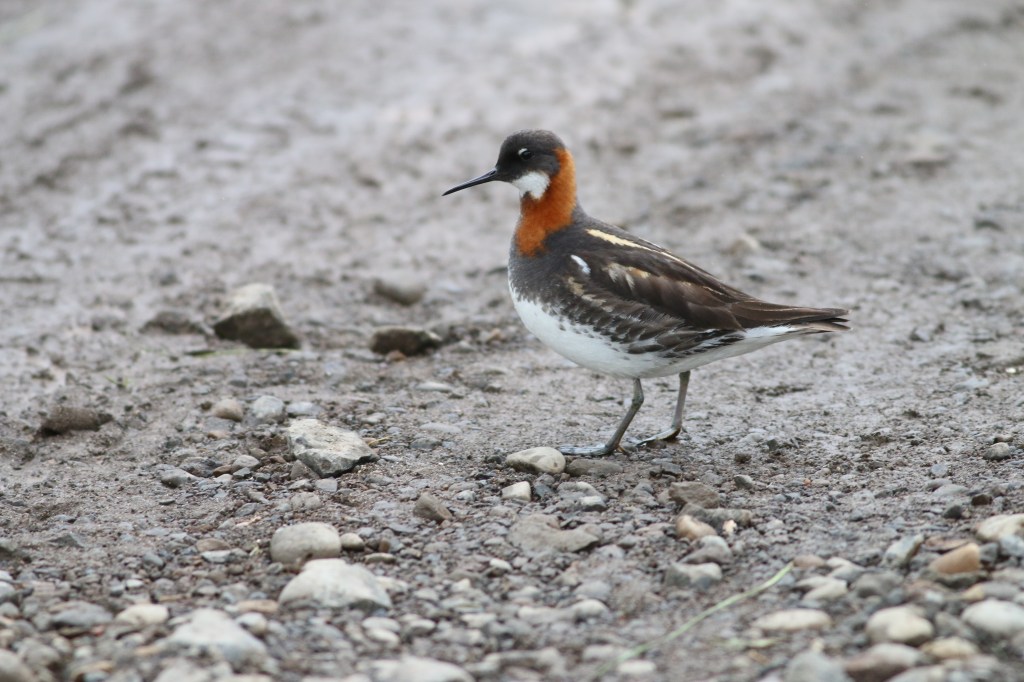
Red-necked Phalarope

I threw the paperback into my suitcase, along with a few summery things, on the 22nd of June, 2019.

An impatient teenager showed up at the Reykavik airport at 1 am to take us to his off-site car rental agency. Our eyes were half-closed, but he threw our bags into his jeep with energy and dashed off on a gravel road to a hill of granite overlooking the great ocean. The sun was just taking a cat nap below the horizon and its light was still hovering around. The solstice wasn’t over yet, by golly! We left our young dealer to celebrate this joyful event with his friends and the unopened cans of beer lining the floor of his little prefab office. Ah, that was a bit more like it.    

The, undeterred by the piece of paper on the dashboard of our basic car warning us about STRONG WINDS and reminding us to NEVER TAKE THIS TYPE OF VEHICLE ON ANY F-ROADS!, we made our way to the capital.  

F-roads, f-roads, I mused, as I dozed in the passenger seat. My oh my. What a rough land this must be.

The next morning, like someone worried about delirium tremens, I felt the need to stock up on books. I managed to find one on local history and another couple of novels by Laxness, not only a great but also prolific writer! This one was about an Icelander becoming a Mormon and moving briefly to Utah in the 1860s. Astonishing! The Latter-Day Saints were already evangelizing in such far-flung parts of the world in their early, unrepentant days? Now it’s true that the scenery in both places can be, let’s say, unexpected. The immigrant wouldn’t have felt like such a fish out of water. And maybe that’s where certain non-drinking habits were picked up, by some people, at least.   

Drowsy after driving for an hour in a northerly direction, we stopped in the town of Bogarnes to get some stimulants. We found some in The Settlement Center, a museum that was well worth whatever fee we paid. You really shouldn’t be too thrifty when sightseeing, not even in pricey climes. You can always save on food. Not every part of the world has a cuisine to write home about, in fact.

Well, we found out that the island looked rather different when the Norsemen showed up, in the late ninth century of our times. The new human arrivals found trees, by gosh. Some tall ones and many svelte birches, and grasslands, and winged creatures, and a few Irish monks, who then disappeared. The birds still flock to Iceland from far and wide, but the forests, alas, went the way of the monks. And the cows, the horses, and, last but not least, the sheep, were all brought over by the Norwegians along with the Celts they enslaved or married in Ireland and those other British Isles.  
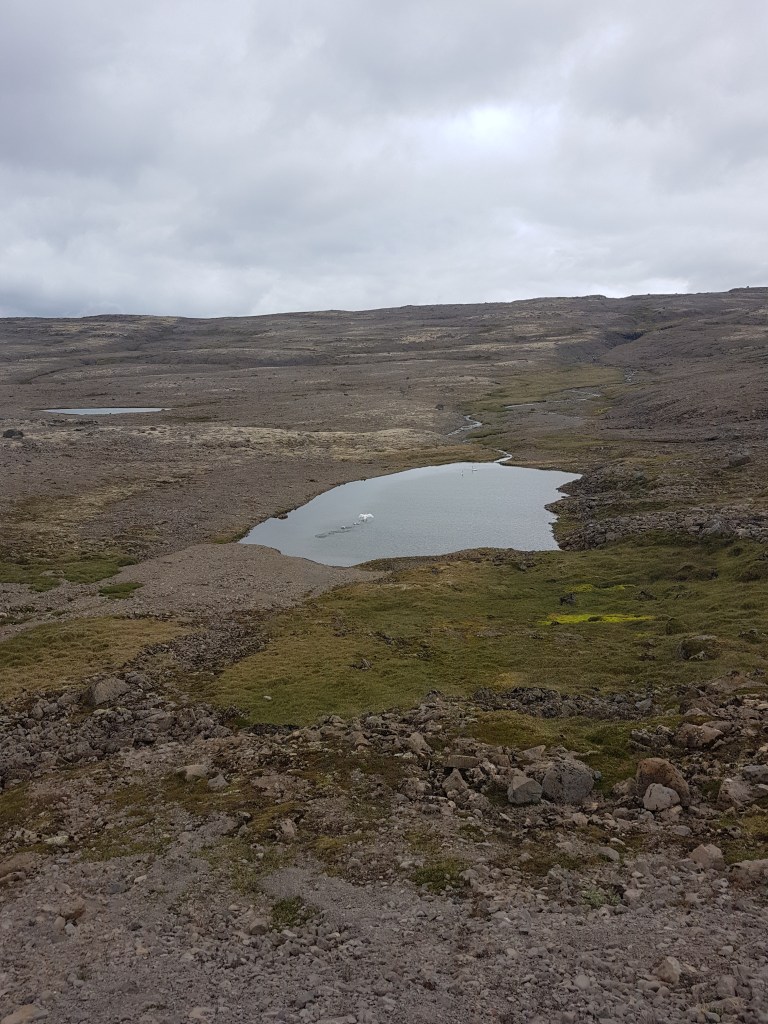
  

The newcomers were called, appropriately enough, the ‘landtakers’. There was no heirarchy, no monarch, no government. Then the settlers founded their parliament, the Althingi, which sounds suspiciously like ‘all things’, and created an island community now referred to as Free State Iceland. This golden age of taking land and free statedom lasted from about 874 to 1264 CE.

The immigrants recorded the names of the first farms in a register called the Landnamabok. They recorded the names of their representatives at the Althingi. Icelanders are keen on documentation. A young man working at the museum told us that he knew for a fact that he was descended from one of the first pioneers. He had it all in his family tree. Ah, family trees. Another odd connection there. An image of my father working away in the basement of the Mormon archives in Salt Lake City flashed by in my mind.

The Thingi took place in the Thingvellir, meaning ‘parliament plain’. But it is also a continental rift! The Mid-Atlantic Ridge.

Laxness’ narrative was becoming less arcane. Its sometimes inscrutable, and many times callous hero, Bjartar, lived in the early part of the 20th century. An Icelandic everyman who was steeped in the history of his land, he was up against the elements, large landowners, and modern-day merchants. He couldn’t be encumbered by ‘feelings’. But he wrote verses. And though he didn’t send his children to school and barely fed them, he made them memorize the ancient tales of feuds and valor and romance.

We continued on our route, which included a ferry ride from the towns of Stykkisholmur to Brjanslaekur in order to skip a bay and a peninsula. You just can’t see every one, although I would never say, ‘seen one, seen them all’!  No, no, no. Every fjord has its distinct personality and deserves to be photographed, at the very least. But we were in a rush to get to the westernmost point of the fjords in the westernmost part of the country, the Vestfirdir. The least visited by people, the most visited by the avian population. And the most reminiscent of the kind of place where Bjartar staked his claim on an abandoned and possibly bewitched patch of soil.  

There is one main highway in Iceland, called route 1. It has two lanes, scarcely any shoulders and goes in a slow circle. The roads leading off of the ring road 1 are slower yet, and some are also denominated F. As noted earlier. Well, I could only imagine what it was like in Laxness’ youth, when Iceland was neither a tourist mecca nor independent.

We disembarked and drove like mad to the western edge of the western fjords, the cliffs of Latrabjarg. Maybe not what everyone would endeavor to see, but honestly how can you not feel elated when you are on top of one of the highest birdwatching spots in Europe? Really?

So much to fit in before the endless day ended! The air was downright chilly and the wind was strong. My imagination had failed me in terms of garments. I was shivering and the hood of my thin jacket kept blowing off my head as we wandered along the edge of a grassy field that suddenly turned into an eroding ledge. I could see waves breaking below, where the Denmark Strait meets the Atlantic Ocean. Greenland was the next stop over to the New World.

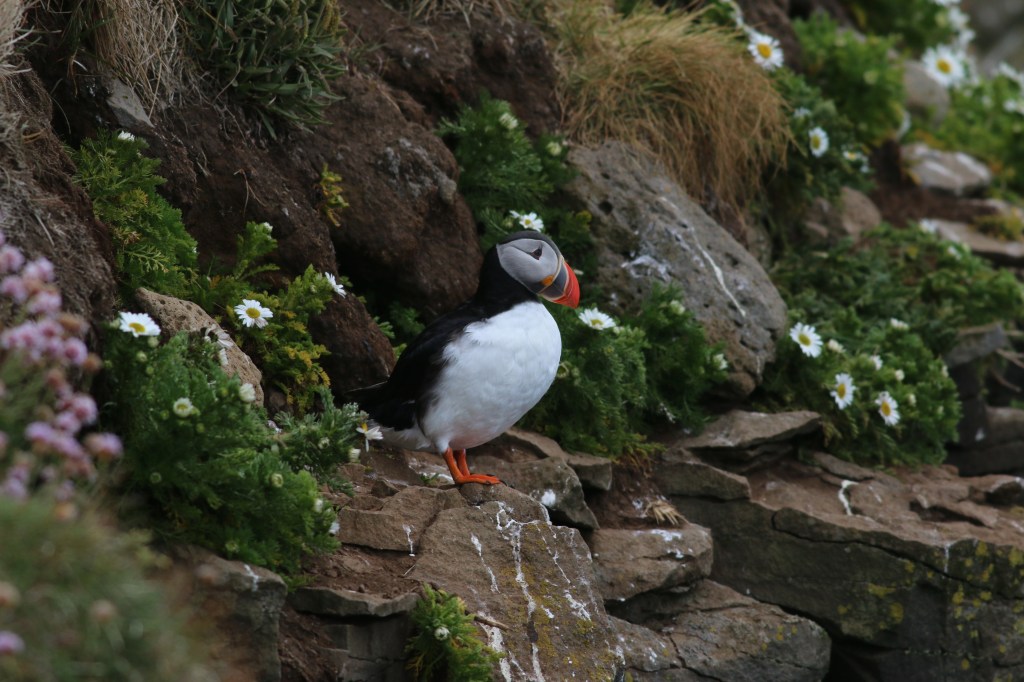
Puffins, guillemots, gannets and eagles were darting and soaring and feeding their young in a free state. At liberty to come and go.
We then hurried to the one hotel, very practically named the Labratarg, with a room available in the entire area. When we arrived at the lodge, only open in the summer months, the elderly owner told us that there was some food left for us. Good thing, he added, solemnly. It was 9 pm and the next eatery was hours away.  

Our international dinner was served to us by staff from Latin America. The owner explained that Iceland has such a small population that it has to look elsewhere for employees during the tourist season, especially in the more remote areas. We drank a little beer, without overdoing it, and then my husband and I went out for a walk along the main road. It was gravel and it was deserted. Except for some weird sounds. A ghostly thing was ricocheting from one side of the road to the other in the twilight. There was also talk of the supernatural in old Icelandic tales. Necromancers and elves and such. Then we finally managed to catch a flitting spectre in our binoculars.  A brave little snipe! The lesser snipe, to be exact, beating its wings back and forth so fast we’d have never been able to bring it down with, say, a gun.  

The Vesfirdir on a map resemble a sort of eight-fingered left hand with a small wrist and a huge thumb. A recipe for a meandering trek in a vehicle. Our next drive took us up and over one of the digits, from the Patreksfordur to the Sudurfirdir. The wind did buffet our vehicle, and as I gingerly cracked open the passenger door at the top of one climb, it almost got torn off its hinges. That warning was correct.

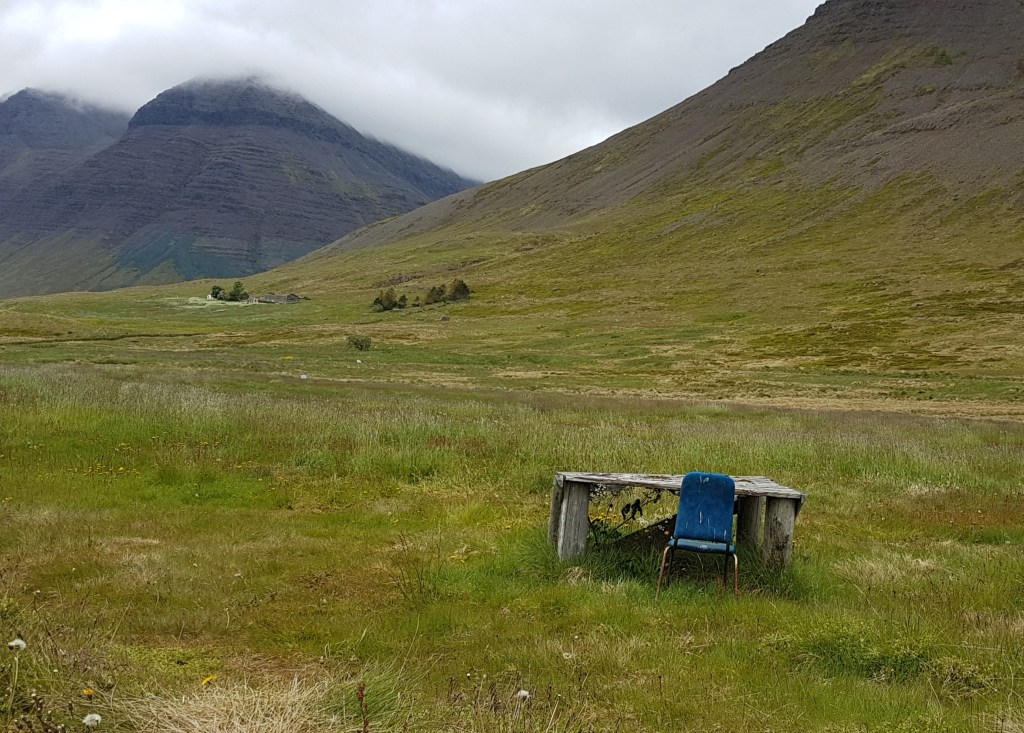
Long views of water, and barren mountains. The trees were cut down for fuel and to build small boats. The sheep could roam about and find food. Their wool was wonderful. But the sheep also ate all the edible highland plants, which didn’t grow back easily. There were volcanic eruptions as well. Only 1% of the forests still exist and nearly half of the grasslands are gone. No wonder not everyone was enthusiastic about the grazers.

We stopped to read a sign about a famous saga. Not a dwelling in sight in these denuded uplands, but some deeds were done here back in the heroic Middle Ages that Bjartur studied with fervor.

More driving on gravel roads, with wind and rain. Not many trails to detect. Markers but no actual paths. Some sturdy hikers with ponchos and long staffs were going up steep inclines willy-nilly, in the stark landscape.

Starkness, starkness. There was grass in the lush valleys at the head of the fjords, but not much greenery on any slopes closer to the sea. In fact, quite a bit of scree, with just patches of blue to give them some color. What extraordinary flowers, I thought, those purplish-blue things. Then I read that these Nootka lupine were introduced from Alaska after WWII. A pushy plant which creates controversy. It holds the land, and adds fertility. But it is not native and no one can stop its proliferation. An invader or a godsend?  

After Norway took over the country in the 13th century, Denmark then dominated Iceland from 1383 until 1944. By then the more powerful country was occupied by the Nazis. Iceland had invited the US to set up a base on their soil and the new nation was born with the blessing of the country then considered the leader and defender of the free world. 

So independence came once again for the Icelanders. Independence, after those early, heady days, so reminiscent of the ancient Greek polis, what philosophers enthused about. Some historians say that democracy took shape where it did in the Mediterrenean because of the mild climate. People could walk about, and socialize and exchange ideas at all times of the year. But maybe an inclement climate with little to offer the greedy could have the same result.

We started wandering around humpy green hillocks. There were sheep too, contented sheep. Like the ones belonging to Bjartur after things started going better.  When his family was no longer starving, during WWI. As the character says, slaughter on the continent, good business for the Icelanders. Bjartur the everyman was never worried about being genteel.

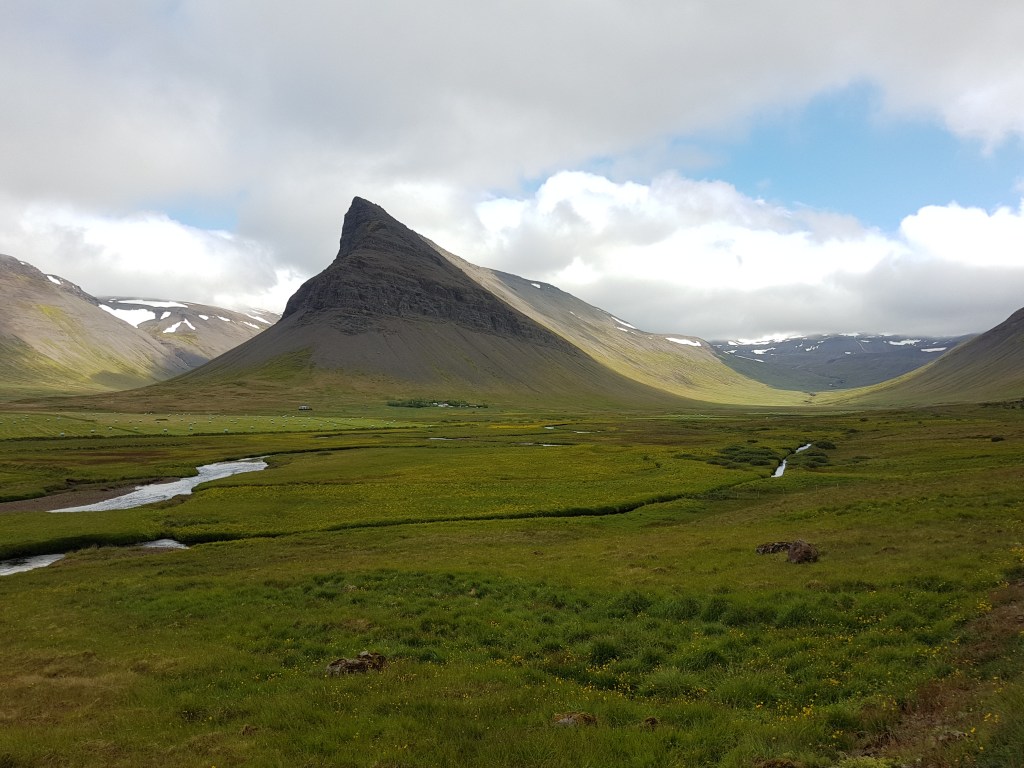
After a few nights in Sandfell, in an expensive hotel with school cafeteria-style food and tiny bathrooms and hard beds, we started on the long gracious slog from Isajordur over to Holmavik. A billboard for a campground advertising a natural hot pot caught our attention. A charming steamy basin in the ground. We paid a small sum of money to use the changing rooms to put on our swimsuits under our clothes and then walked across a field and over a stream to a windwhipped hillside with a hot spring filling a pool not much bigger than a bathtub in a luxury hotel.  I tested the water with one toe and then dropped in, to defend myself from the fresh air of summer in Iceland.

We then decided to have, yes, that black live-giving beverage, coffee, in the campground cafeteria. It was a large room where they also sold maps, souvenirs, and, finally, at last, thick homemade sweaters. Where had they been hiding the last few days? The unique seamless pieces were hanging on a rack near the cash register. I tried on all five and decided that only one would fit me or my daughters. 180 euros, under the table. ‘You see,’ the cashier explained, ‘they are just handknitted by local women in their spare time…’ There was, fortunately, a handy ATM in the facillity, where we could get the dough to purchase this truly national treasure.  

Feeling more at home, clad in the waterproof fabric of the commonwealth, I was now ready to explore other places. We spotted more greenshanks and redshanks and terns in the torquoise or agate colored water we passed as we munched on dried fish jerky I’d bought at a convenience store. The stringy, salty fish with its leathery skin still intact might have been something even Bjartor would have disdained. Or not. Land of tough people.

We were now leaving the western hand of the country. We had to go to other parts and check out some thundering waterfalls, and see other bird species. Suddenly, our dirt road became paved as we were coming down a steepish hill. The car jolted, unused to smoothness. We had come out of the wonderful wilds. Sigh.

There were big tour buses and many cars on the road east, following the undulating northern coast. We went to a bakery in a little port town and bought another sweater, cash down. This time there were four of them hanging on a rod next to the bread and cakes. The ATM was just across the road.

I saw a government-managed liquor store in the same shopping area. It looked identical to what you find in Utah. This was also astonishing. No advertising, a barely visible sign on a plain building. But yet, plenty of people were coming in and out, carrying large bags. That evening we went to a restaurant in the countryside to eat some lamb. My husband and I ordered beer, and then he ordered another one. The teenaged waitress glared at us. She was part of the Christian Women’s Temperance Union crowd, clearly. Bjartur might have agreed, although he wasn’t sure he was a Christian. Still had that heathen in him, able to survive among the hot pots and lava.

The responsible young woman certainly had a point. Who would want to navigate route 1 when tipsy? Or venture onto a diabolical road by mistake? There were plenty of brands of artisanal brews on the menu, though, and everyone seemed to be enjoying their amber drinks.  It was clear that Iceland was as divided about alcohol as it was about the purplish-blue flowers!

Our last night out on the road we stopped in the birthplace of the famous writer Snorri Sturluson, the man who wrote down all the Norse myths about Odin and Freya and so on, saving the fireside tales on parchment for eternity. We would, in fact, not know about Thor’s hammer if it hadn’t been for this energetic man of letters living on an island with geysers in the 13th century.

 I went up to the door of the neaby bed and breakfast place I’d booked. A woman came out to greet me enthusiastically in her local tongue. ‘I’m so sorry!’ I said apologetically, ’but I don’t speak your language…’ Our host was floored. ‘But your name looks Icelandic!’ she said in perfect English. ‘No, no, it’s actually Irish…’ ‘Oh, I’m also terribly sorry,‘  the good woman replied. ‘I don’t speak any Irish…’ ‘Me neither…,’ I replied. I smiled and shrugged to show there were no hard feelings. How could one explain to an Icelander, of all people, that not all idioms or cultures make it out of the great maelstrom of time?  

 I thought that was that, until the next morning, when she served us breakfast.

‘I’ve had a think,’ the dark-haired lady said. ‘You know, the Vikings brought Celts with them long ago. So we are related, after all.’ She patted my hand.

She was right, of course. We are all related and connected in some way, not just through Irish thralls dragged to Iceland over a thousand years ago. I thought about this as I wore my new sweater during the next, dread, winter of 2020, in Italy. I discovered during that first pandemic lockdown that I didn’t need to turn up the heat at home with all that thick yarn on me. It was a grand thing.

 I was also able to save money on fuel during the next winters, with prices going up every month. Invasions and that kind of thing. So my investment paid off and I also helped the rural economy of that not-so-faraway land. Laxness’ land.

I would go back someday, to the fantastical island. European, but not only. To see more birds, so cosmopolitan, and volcanoes, and trundle along mysterious thoroughfares. To frolic in the crisp summer wind, like a sheep. The grass-devouring, erosion-promoting animal so beloved by the free Icelanders.  

F for forbidding??

Recommended reads:

Independent People by Halldor Laxness

Viking Age Iceland by Jesse Byock
Biting off more than I can chew, in three countries, on a bike

Riding towards a pass we knew nothing about

One day at the end of April, my husband Annibale (Hannibal in English) and I decided to try out cycle touring. Good for our bodies, and everyone else. There would only be some sweat oozing out of us, but no other noxious emissions.   

The problem was, of course, where to go on our bikes: forests or towns with art galore? Climb slopes or stay on the flats? Ah, an embarrassment of riches where I am plunked down, in a flat town in Veneto between the mountains and the sea.

Why not simply put it all in the hands of an app? What could go wrong? So that’s what my significant other did last spring while I was away to comfort my old dad and say hello to our newborn granddaughter. The morning after I returned, via London, where I got drunk on beer at Heathrow for lack of anything better to do during my 7-hour layover, the alarm went off and I was dragged out of bed. ‘We have to get to Austria before dark!’

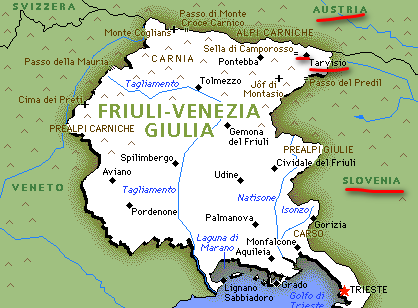
I dozed on the road to Friuli-Venezia Giulia, the region east of Veneto. Venezia Giulia is the southeastern coastal spur which includes the city of Trieste, and Friuli is the rest. By the way, if you haven’t heard a thing about the latter, don’t worry. It is one of the least known parts of Italy. The same goes for Molise, the ‘region that doesn’t exist’ that my husband happens to come from (next post).

We drove in our diesel-fueled automobile to a spot which would get us closer to our destination. It wasn’t right, it was going against the whole ethos of doing things off the grid (apart from all that airplane travel…), but Komoot, our trusty digital guide, had come up with an ambitious ride for the amount of time at our disposal. We couldn’t let it down, according to the human next to me who’d actually empowered the app.

But I was game. As game as a wreck suffering from jet lag who hadn’t been on any sort of bike in months could be.

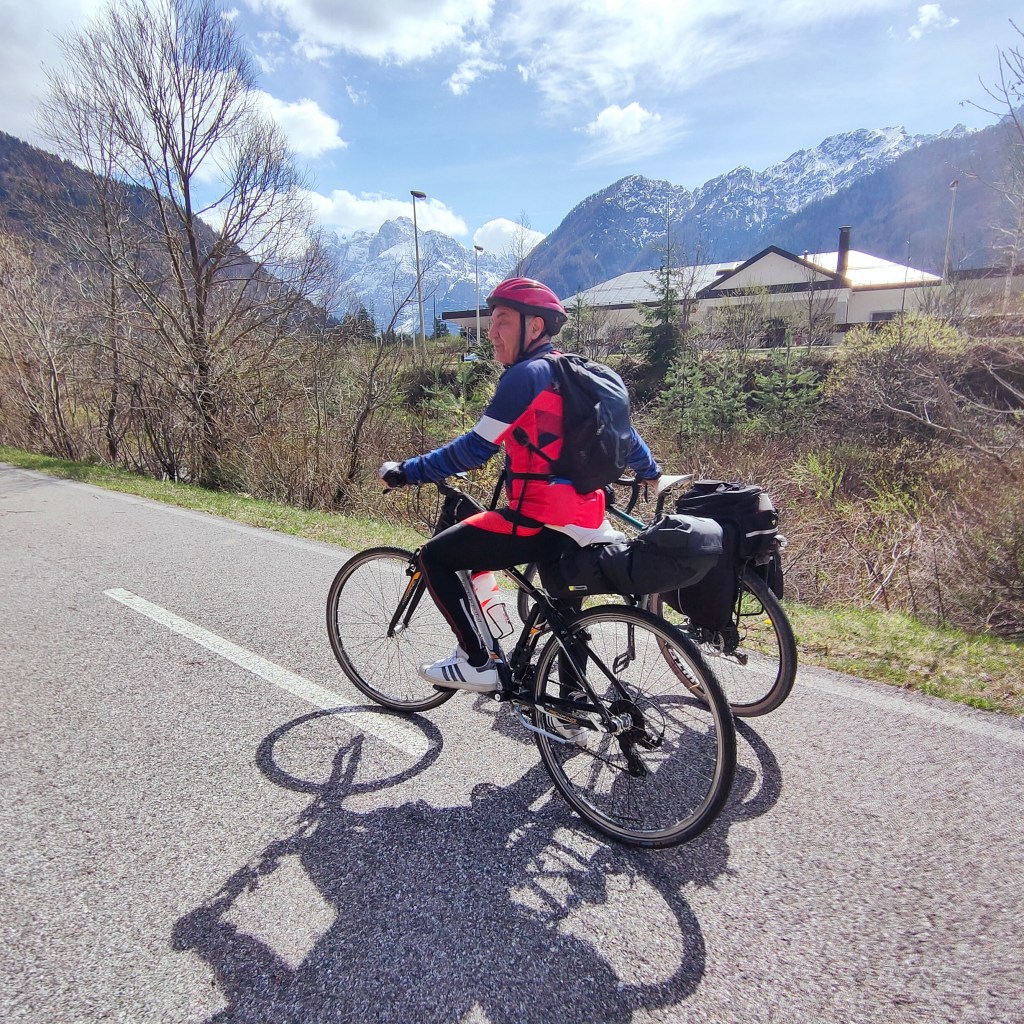
We parked in front of the Pontebba train station and headed north on a path that even my father could have handled with his walker.


Now, we were in a territory nestled between Austria and Slovenia, with some communities that still speak German and Slovenian. For this and other reasons, Friuli has a special autonomous status. That means that its local idiom, Friulano, more similar to Italian, has special status as well, and is called a language, as opposed to a lowly dialect.

Friuli produces wine, has mountains, and water flowing from the mountains, and a
vast plain, and beautiful towns which are not very large. Sparsely populated, one could say. A frontier land that is also prone to earthquakes, alas. It also saw quite a bit of fighting in WWI between the Kingdom of Italy, and the Austro-Hungarian Empire, and its German ally.

Hemingway’s A Farewell to Arms describes the chaotic Italian retreat of 1917 from Caporetto in present-day Slovenia. My husband’s grandfathers, young men who had
hardly ever left their little hamlets in the Appennines of southern Italy, were both
swooped up and conscripted to fight in the Alps of northeastern Italy during the Great
War. Despite having been wounded in Friuli, one grandpa always talked about going back
to visit that place in the wild blue yonder where he came of age, and didn’t die.

The ascent to Austria on the bike trail was so gentle that even my flabby legs didn’t feel it. And what a fine surface, set apart from the main road, with views of the river Fella below and the peaks of Carnia (northeastern Italy) and Carinthia (Karnten in southern Austria) and Carniola (Primorska and Gorenjska in northwestern Slovenia) standing in all their April splendor. You couldn’t ask for more, really.  

ascent on the forgiving Alps to Adriatic cycling path

We reached Tarvisio in no time. It lies in a land of three countries, a Dreilandereck, one of those handy German words that describe a whole situation in five or ten seconds. You can consult Mark Twain’s highly-esteemed essay The Awful German Language (https://faculty.georgetown.edu/jod/texts/twain.german.html) for more on that.

Tarvisio is famous for being in that little corner. And for having been wrested from Austro-Hungarian control during the devastating territorial war mentioned previously. Notice that the gracious sign below is written in four ways: Italian, Friuliano, German (the latter two identical here) and Slovenian.

Welcome to a border town

So far, so good. We ended up in a woody area near the extinct border between Italy and Austria, where we were following a scruffy-looking man in his late 60s with hefty panniers on both sides of his bike. He looked as if he hadn’t had the chance to take a shower lately. At a certain point a car shot out of a side road that had access to our path, forcing our cohort to make a sudden stop. ‘Asshole’, I heard the poor guy bellow. I sped up to talk to him, thinking he might be from my homeland. But no, he was a German from Bremen. Wow, I thought. Has ‘asshole’ entered the German tongue, the same way Americans say kindergarten and scheister lawyer?  Would have to ask my Teutonic colleagues about that. Full disclosure: I’ve been trying to improve my basic knowledge of the formidable German language on Duolingo as I think it’s good for my brain. No matter what Twain says. Anyway, the Bremener had cycled all the way from the North Sea to Venice and was now pedaling back. He deserved to tell the brutish automobilist off.

We were all heading for Villach, a small city in Karnten with a Slovenian name. Makes sense. The country we associate with The Blue Danube and Sissi and Sacher Torte was once part of a sprawling political entity with a whole slew of peoples and tongues. Many ethnic groups were eventually able to create their own nation-states, which didn’t necessarily include all the areas historically inhabited by them. Languages leave traces.

We crossed into Austria, where the bike path became less idyllic. We were inhaling car exhaust as we pedaled next to traffic-ridden thoroughfares in Villach, until we turned off the main route to go to an outlying village we’d chosen for a cheaper overnight stay. There we found the sort of Sound-of-Music type countryside we’d been expecting. Tidy green fields, and an understated church. And once we arrived at our modest hotel, I discovered that studying German can actually be useful, rather than simply entertaining or a way of staving off dementia. Just because English is the modern-day lingua franca doesn’t mean, of course, that everyone speaks it. Not everyone is into that kind of thing, in fact.

Back road in Austria

So I managed to understand the most crucial things, such as where the only restaurant in the entire area lay. Just a twenty-minute walk. What a relief, as our loaded gravel bikes needed a rest for the day.

I was also lucky enough to have studied, on my app, all about the love of German-speaking people for white asparagus. A goodly vegetable, full of nutrients. But what makes it so extraordinary? I reminisced about a corn-on-the-cob festival in Wisconsin I went to as child. There was a feature where you could pay five bucks for as many cobs as you could knaw on in 15 minutes. I’m sure swallowing small slices of pale slender stalks cooked in different ways is much more elegant. And therefore makes people go wild with delight, somehow.

White asparagus non-vegetarian specialty

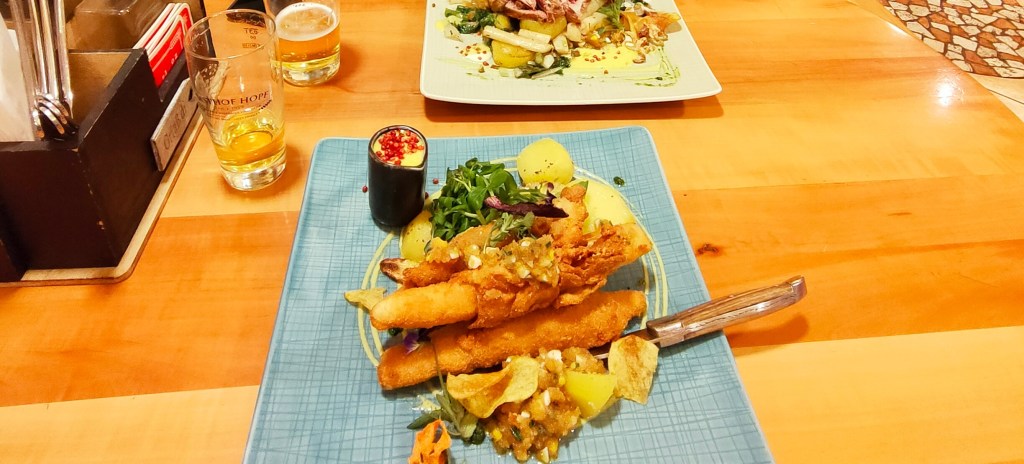
In any case, all the lessons about the famous Spargel turned out to have a purpose. They gave me a heads-up on why the local gasthof had an entire menu dedicated to this wondrous vegetable. Deep-fried asparagus wrapped in bacon may not be particularly healthy, but it did go down the hatch quite easily (along with some more beer).

Back in our room under my eiderdown, still suffering from jet-lag, I pulled out the reading material that I’d stuffed into my case. A slim paperback in lieu of an extra pair of socks. Wunschloses Ungluck, by the Nobel Prize winner Peter Handke. Difficult to swim through, but not because of its style or unbearable title (translated as A Sorrow beyond Dreams, although I would label it Dreamless Misery. But my German is execrable, so what do I know?). I was simply biting off more than I could chew. It’s a bad habit of mine which I still haven’t rid myself of. Now, I knew the ending was bad – the author’s mother was going to kill herself – but it was something a friend had once given me, it had been sitting on a shelf, neglected for twenty-some years, and it took place in Karnten. I opened it to the first page.

It turned out that Handke’s maternal grandfather was of Slovenian descent and was the first of his line to actually own property and thus be rich enough to marry. His forebears were farm laborers who procreated without the luxury of becoming husbands. I thought of my own great-great-grandfather in Sweden, who did marry, it’s true, but was also landless and so poor he had to live ‘on the parish’ – 19th century Scandinavian welfare. Some of his nine children, including my great-grandmother Nina, emigrated to America to escape that fate. I then nodded off before I could get much further than understanding that women living in rural Carinthia in the early 20th century weren’t supposed to expect much out of life. Their lot was to have a few laughs before the grim reality of marriage, children, cooking, and death.

We cycled eastward the next day. An easy ride along the Worthersee, a long lake surrounded by hills. Ah, I was in better condition than I thought. This was a bed of roses.

Calm, restful Worthersee

We passed through Klagenfurt, the busy capital of the region, had coffee, and turned north, just to put in a few more kilometres. All quite leisurely. And it turns out this is known as the sunniest part of Austria! Handke might disagree with that appellation, however. One of his sentences I actually understood without a dictionary focused on endless days of rain and fog.

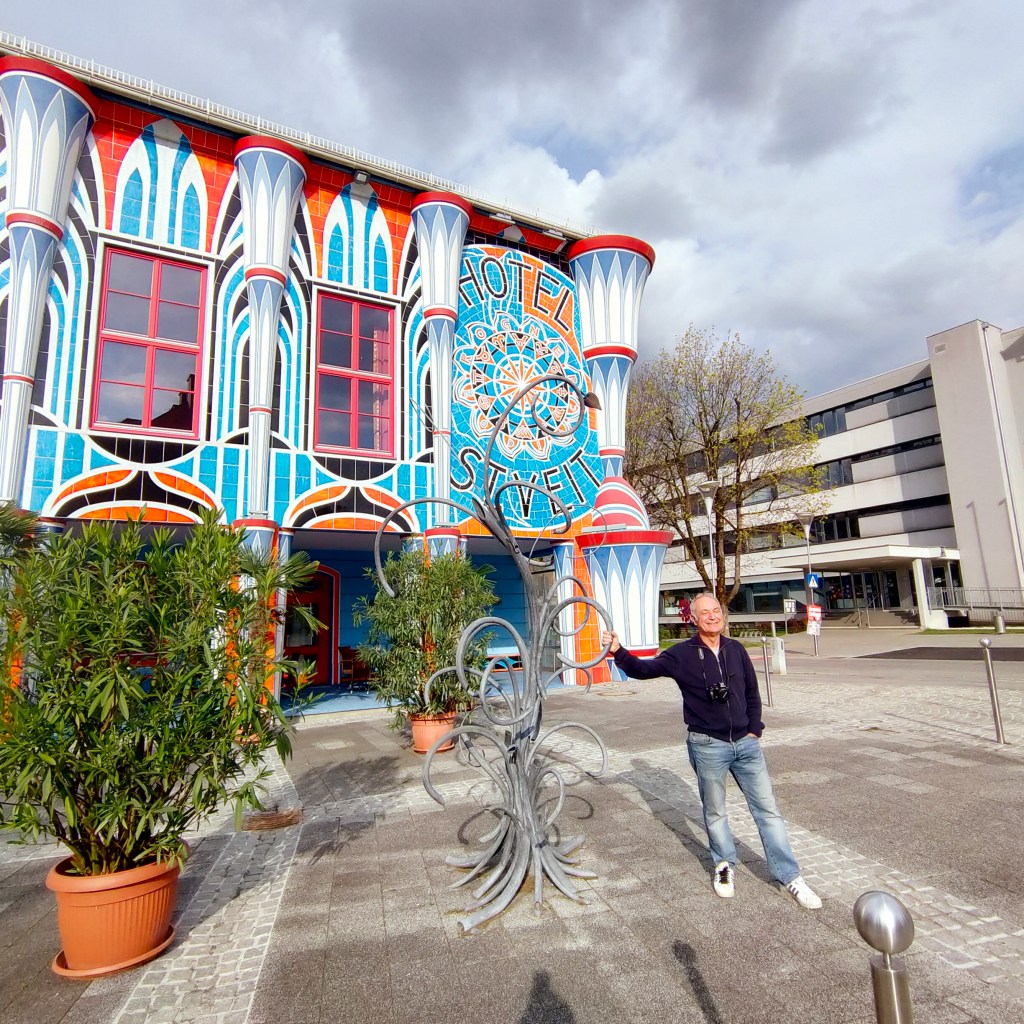
Only a little bit of grayness for us, though. We made our way up to Sankt Veit an der Glan and stayed in a fantastically decorated hotel. Austria is also known for art and design. Think of Schiele, Klimt and Hundertwasser.

Exuberant facade
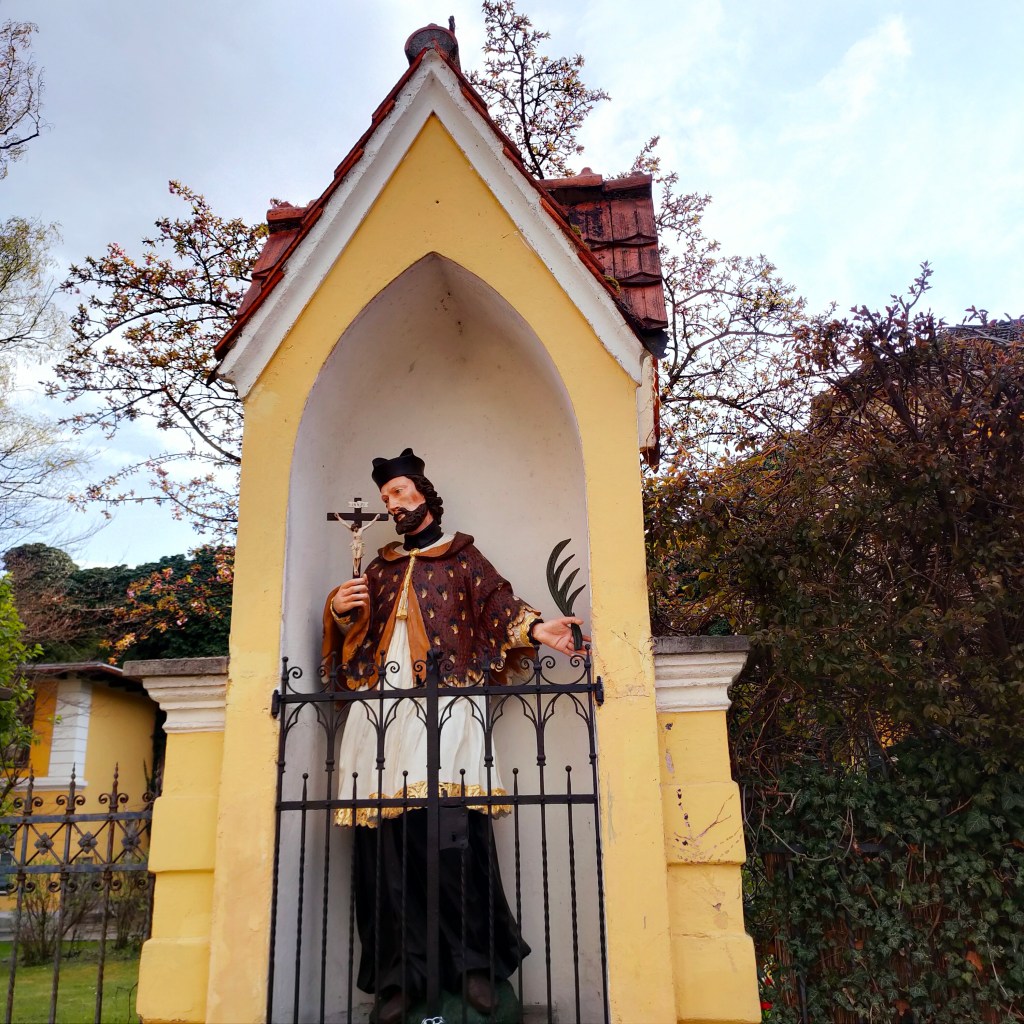
Sankt Veit himself, with his own exuberance

That night at dinner, over beer, my husband mumbled something about the road ahead. He was a little worried about the third day’s route, which would take us south over the Karawanks mountain chain into Slovenia. ‘It might be a bit steep,’ he said sheepishly, as he ate some more Spargel. Grilled this time, with sausage on the side. ‘Steep’? I was having trouble understanding him with all the noise from the other ecstatic spargel diners around us. ‘Yes, and it might rain too…it turns out…’. ‘Do we have any alternative?’ I shouted above the din.

I continued with Wunschloses Ungluck in our trendy little room. I would go through entire paragraphs where I might make out two words. So much for English and German both being germanic languages. The Normans did English such a big favor by coming over the channel and forcing their more worldly French on the provincial Anglo-Saxons. Just think what we’d be left with if they hadn’t.

Handke’s mother had gotten away from her family farm and started working in a hotel, just before the Anschluss (the German annexation of Austria in 1938). Then the war started and she got pregnant, by a German she loved, but who was already married. Then she in turn married a man she didn’t love, just to give her son a father. The misery was starting, although she didn’t realize it right away. They went to Berlin.

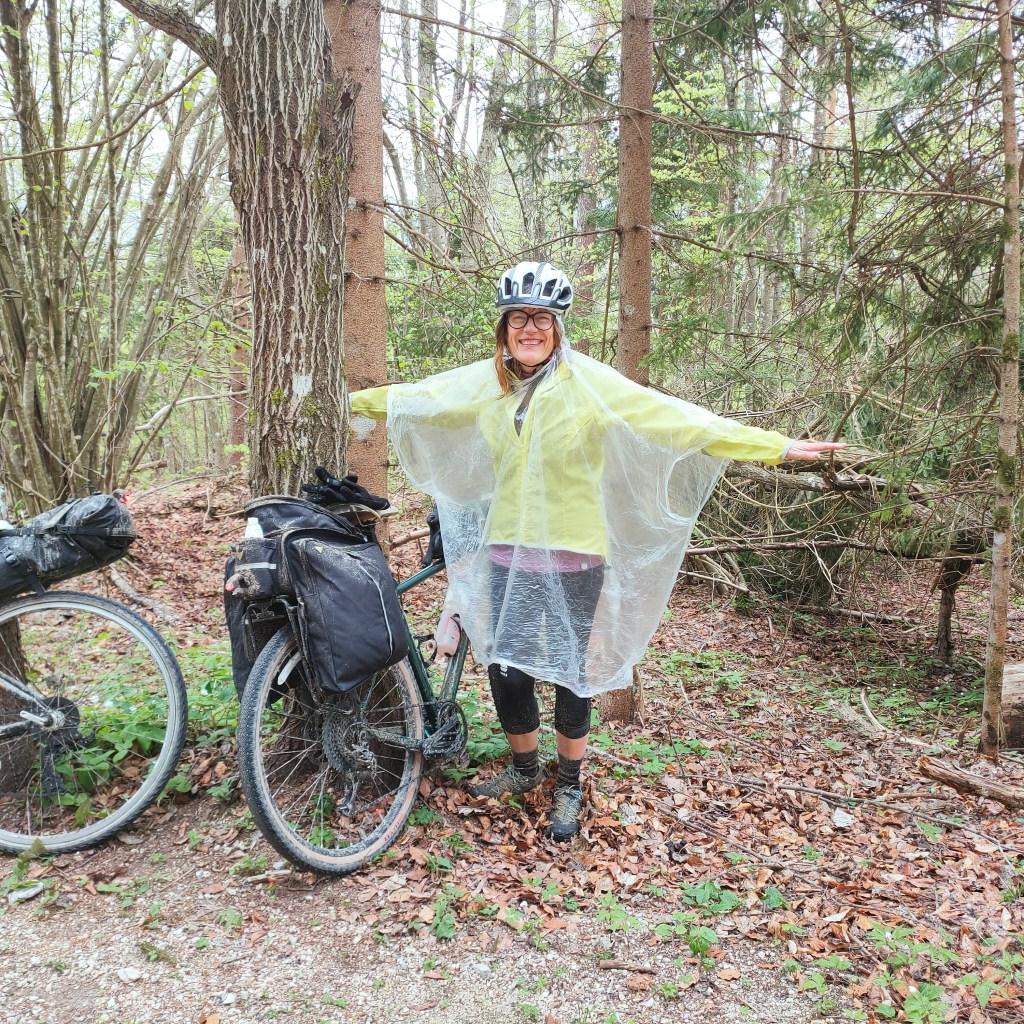
‘This will be a real test for us,’ Hannibal warned me as we packed the next day. Not difficult as I hadn’t brought much. I did make sure our cheap ponchos, all of 2.5 euros a piece, were on top. But why did hubbie have such a furrowed brow?

Crossing the Drau/Drava (flows from Sud Tirol/Alto Adige in Italy into the Danube at Osijek, Croatia)

We could see, once we reached the river, that that the landscape was changing. So much the better. We needed a challenge. We stopped to have a little sandwich in Ferlach, at which point we were already halfway to Lake Bled in Slovenia. All was well.

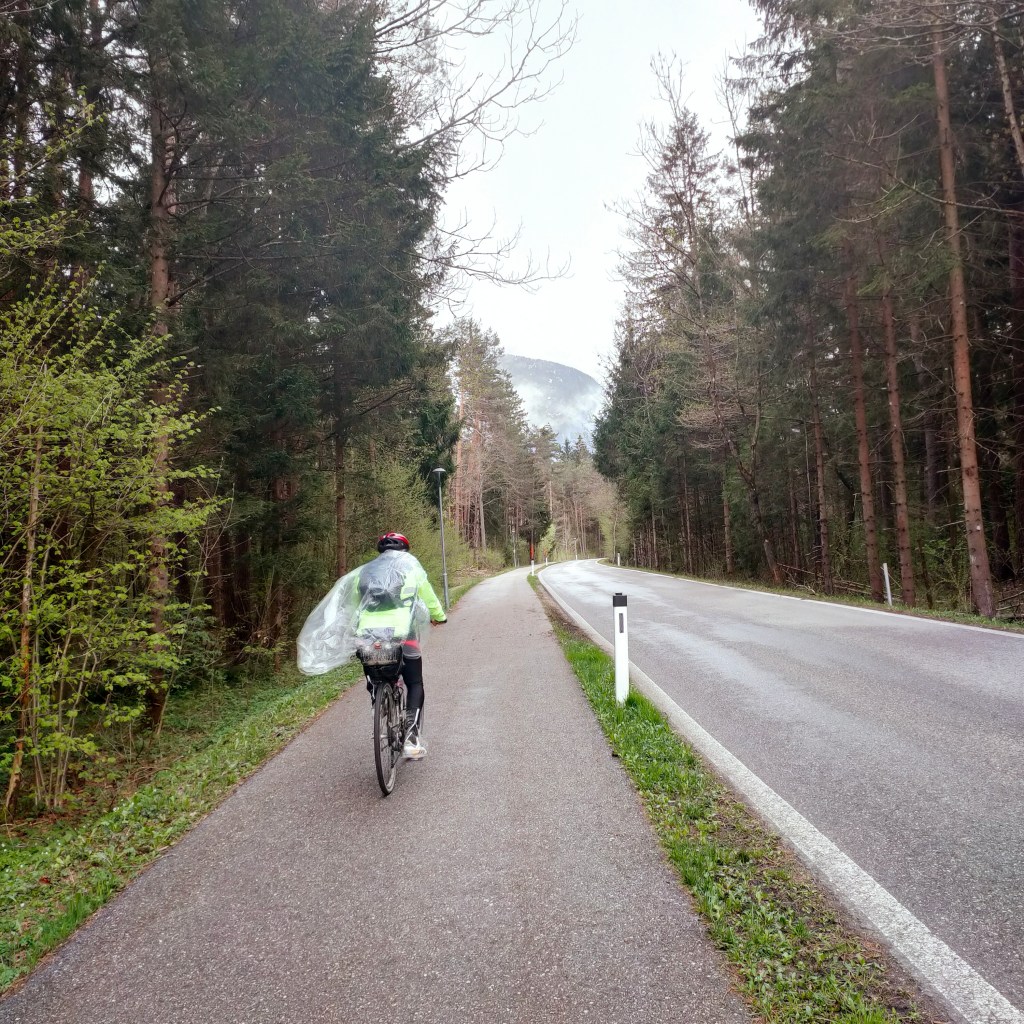
We then started on the forest road, and felt the first sprinkles of rain. The weather was starting. Time for to whip out our featherweight protective gear.

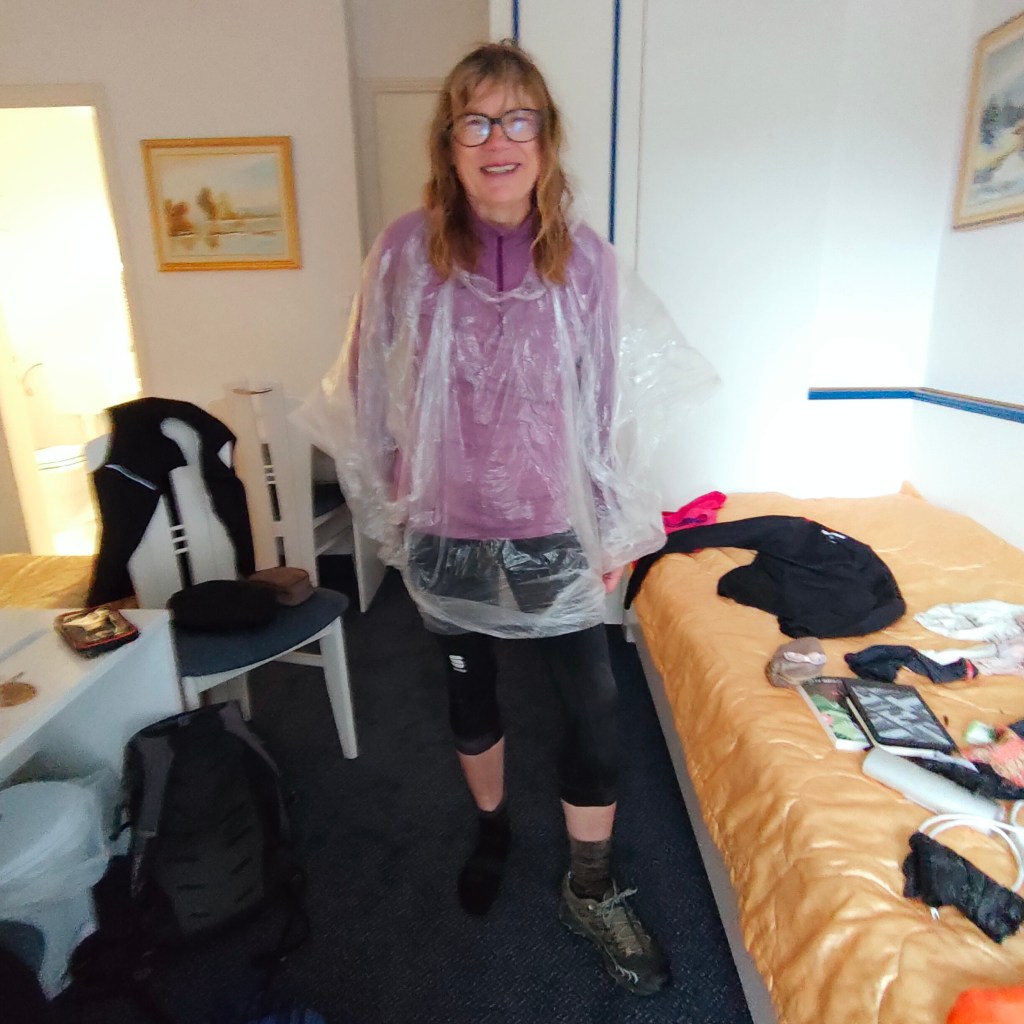
Loose fit

We came around a bend and an Austrian woman called out to my husband in German, telling him he looked like an angel! The transparent plastic we were swathed in, lifted by the breeze into wings, did give us an odd aura. The last time someone likened Hannibal to a heavenly creature was when we lived in Rome. Not a city where pedestrians are king. My husband stopped his car to let a tour guide lead her group of aging sightseers over a crosswalk near the Colosseum. The guide came up to his window to confer angelic status on him right then and there. She’d been standing on the curb for twenty minutes waiting for another driver to obey the law, or simply show some kindness. Hannibal was engaging in the latter behavior, she understood.

I was brought back to the present by a sudden realization that I was suffering. We were now on the main ascent to the Loibl-Ljubelj Pass between Austria and Slovenia. My gravel bike seemed to weigh twice as much as before. And my brand new bikepack, which slid onto a plastic rack behind my seat, felt as it were made of cement.

I couldn’t get up all of the tough bits (some at 15%). My husband’s bike having less sophisticated gears than mine meant that he had to jump off his even more often and simply push it up the bad parts. I found that getting off was just as bad as sitting on my increasingly painful seat. I also didn’t have the arm muscles to push or drag a loaded set of wheels up a hill. And the air-filled ponchos were useless. We were bedraggled angels halfway up.

Then we passed by a sign indicating a KZ Gedankstatte Mauthausen. I stopped to think about what that meant. Mauthausen was an infamous Nazi concentration camp in another part of Austria. But there had been a branch here too, apparently. The memorial didn’t seem to be open, though, and I didn’t have a good internet connection on my phone. So we continued going up the main road, at our very slow pace, until we reached a tunnel. A long one, it turned out, over 1.5 kilometres long, and narrow. We cycled on the equally narrow raised sidewalk which consisted of vertical slabs of cement placed next to each other. I kept imagining my tire getting stuck in the slit between the slabs and me being hurtled into the lane full of traffic to my left. I wouldn’t recommend that particular route to anyone. It’s probably illegal for cyclists, as a matter of fact. Not that that had stopped us, not on Komoot.

Once I did have a good connection, later in the day, I found out that the tunnel itself was infamous. It was actually built by prisoners from the local branch of the Mauthausen camp during WWII, some of whom died while constructing it or were executed in northern Austria when they could no longer work. A few survived and walked through the tunnel to Yugoslavia at the end of the war (Slovenia became an independent country in 1992, after having been part of the southern Slav nation-federation of Yugoslavia since 1918).

Every country has its history. Some worse than others. And some events are in the more distant past but others still too recent, and shocking, and shocking also because they are recent, to ignore. Haven’t human beings evolved at all? I think of the plaques I now see in the US reminding people of massacres and lynchings that took place in pretty spots in Virginia, for example, before and long after the end of slavery. And Austria is, in fact, the birthplace of Schnitzler, Freud, and Hitler.

Here is some more information about this particular site: https://www.mauthausen-memorial.org/en/Loibl/The-Concentration-Camp-Loibl

We made it out of the harrowing tunnel, and found ourselves in Slovenia. On a saddle in the Karawanks/Karavanke (a mountain chain in the Southern Limestone Alps, which include the Dolomites). There was still a bit of snow higher up. I turned to my husband and told him that although we were utterly exhausted, we weren’t actually soaked. Only light precipitation in Karnten, after all. No sooner had the words popped out of my mouth than the heavens opened up and drenched us with an icy downpour. I took off down the busy highway without further ado. I paid no attention to the cars and trucks I was racing alongside or the floating sheets of water on the road.

In Slovenia, on the southern side of the Loibl Tunnel

I got to the bottom of the hill first. But where was my companion, usually so much faster than me? He caught up five minutes later, aghast at the risks I’d taken. ‘You could have been killed!’

I explained that I had lost my powers of reasoning. I just wanted to get to our hotel room in Lake Bled, the inauspitious-sounding Bled. A famous spa town in northern Slovenia on the shores of a lake with an steeple-topped island in the middle, surrounded by hills, that doesn’t have anything to do with bleeding. Still…

‘We somehow missed the track that Komoot suggested! It’s back up there!’ I glanced up at the top of the slope. Unthinkable. And I hadn’t seen any sign of an opening on my way down. My husband showed me, once we’d found a bus stop with a roof, and he was able to wipe the screen of his phone dry, that he was referrring to a steep rocky path with boulders that would have taken us up to another saddle, from which we have been catapulted down into the next valley. A fearsome short-cut that we might have trouble even finding in a storm. ‘We’d have to drag our bikes up that,’ Hannibal explained. ‘And drag them down, too,’ I whispered.

I explained that my crotch was on fire and that I was probably suffering from hypothermia.

So we checked our map again and decided to cut westward across the countryside to Bled to avoid the main thoroughfares. The route also looked slightly shorter.

It wasn’t raining quite so much, and the road we’d chosen was lovely. Meadows and fields and little stands of trees in their seasonal shade of light green. I would’ve taken many pictures at any other time. An ascent to each little town, and a descent before the ascent to the next one. Up hill and down hill, over and over and over. All those clusters of houses that had to protect themselves from marauders in the Middle Ages were serviced by our byway. So unbelievably charming. My leg muscles were inflamed and my head was spinning.

Rule of thumb: Always bring extra footwear

We finally reached the outskirts of Bled, at which point there was even a bit of bleeding going on. Never mind. We found our hotel and I fell off my bike. I hung on to the bannister to get up the staircase to our cold room. There I discovered that my new bike case and bags weren’t waterproof! I squeezed the water out of my shoes, warmed my hands over the tepid radiator and hobbled across the street to a gostilna where we each had a plateful of wienerschnitzel. My husband told me I was heroic. I said that I was just plain clueless. It was actually the most grueling workout I remembered ever doing in my whole life. The combination of no conditioning, bad clothing, and not knowing the route was downright foolish. I had bitten off too much, once again.

And to continue in that trend, I turned back to my book. What happened next to Handke’s mother?

She and her German husband got out of East Berlin in 1948. She used her Slovenian to talk to a Russian guard at the border crossing. The family ended up back on the farm in Karnten, where she had more children, and also performed abortions on herself. Her husband would get drunk during the winter when there was nothing to do, and beat her up. She was curious, she started reading books. I fell asleep.

We took one picture of the truly lovely lake most people come to for a relaxing sauna. But no time for dawdling. We had to get back to Italy.

View of Lake Bled, Slovenia

Our app then sent us on an adventurous route to get up to the northern valley of Kranjska Gora.

Komoot, as far as I understand, was created by a bunch of young men who weren’t too worried about things like safety, private property and so on. They just want their users to get to places as fast as possible. And Annibale delights in doing illegal things he knows he can get away with. He swears that this is his Italianness.

Our app assumed we had good tires

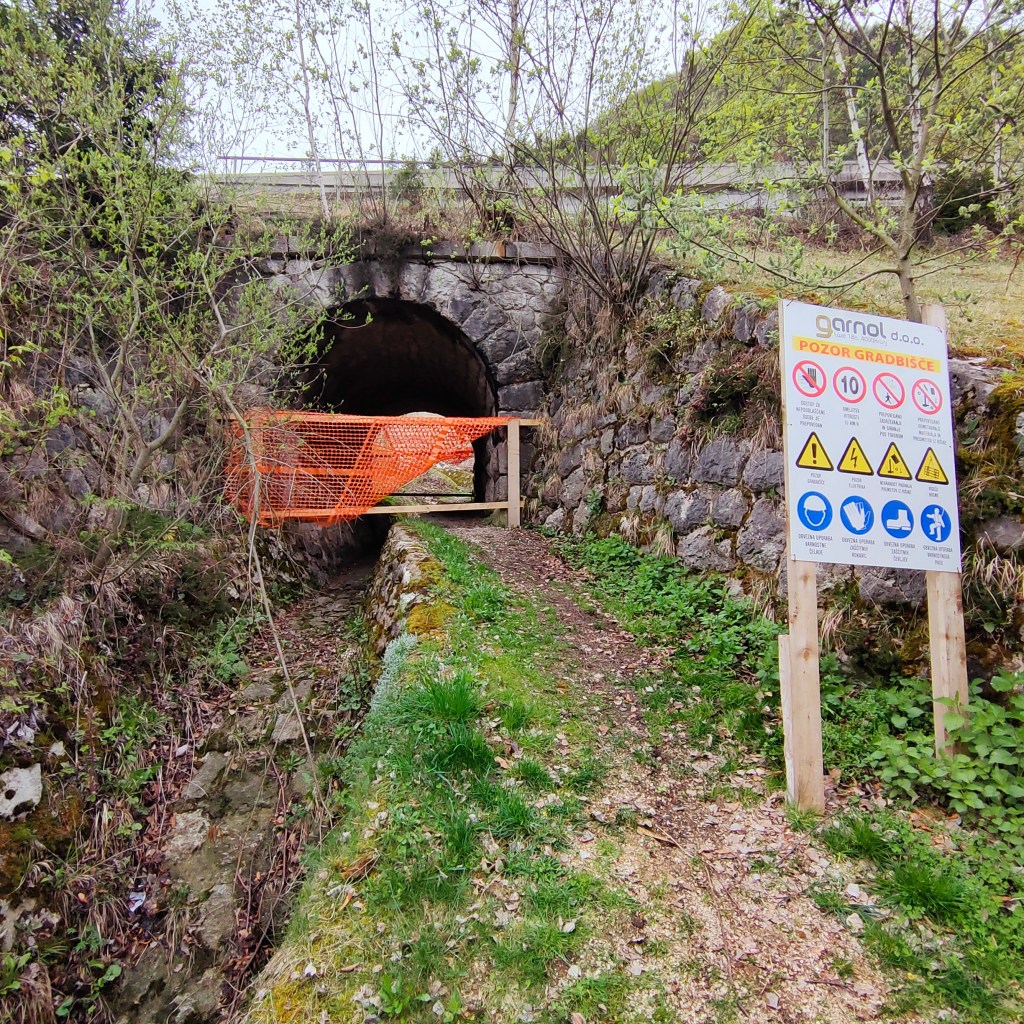
At a certain point, we were told to ride under a bridge on an informal sort of road, and then rumble along in the deep trough of a railway under construction. And then through a tunnel undergoing repairs under a railway that was actually functioning. Tiring, but also so much fun! Breaking rules has that effect on people, apparently.

No need to translate

Our off-track biking did get us to where we wanted to go while bypassing some busy roads. We ended up east of Kranjska Gora, a ski resort in northern Slovenia located on a side spur of the same Adriatic-Alps bike trail we’d taken from Pontebba. We knew that our troubles were over.

Riding westward towards Italy
A typical European Union border

The path to Italy was wonderfully paved, just like the entire Adriatic-Alps route. Smooth sailing, which was just as well, because I could no longer sit on my saddle. I stood on my pedals and let gravity take me back to the car.

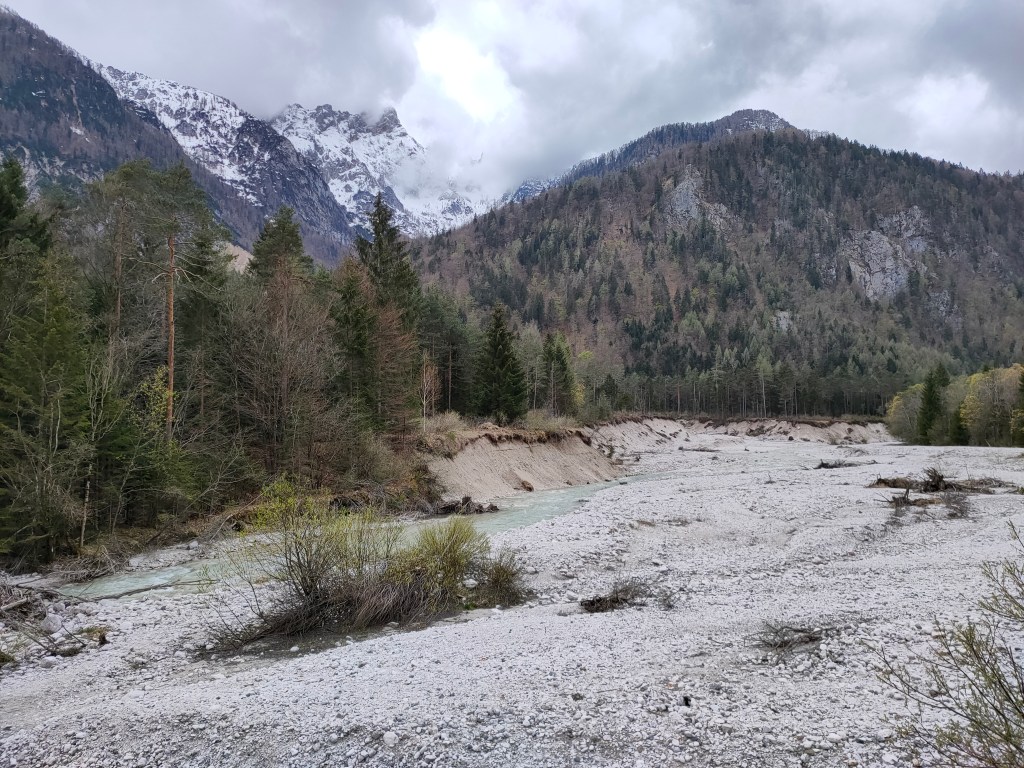
Limestone blue in the Fusine lakes

We did stop to look at the karst Fusine area, just inside the Italian border. Karst, by the way, refers to a landscape full of underground rivers and sinkholes and caves and such caused by its limestone base. It comes from the German name given to the rocky plateau overlooking Trieste, which is also called Carso in Italian, and Kras in Slovenian.

I got home and continued to read my book as I recovered from our trip. I reached the bitter end, not sure I’d actually understood what the son thought about his mother’s decision to end her life. Was he proud of her, did I get that part right? I’d have to start over, I decided. I would be going back to Austria, and I would continue working on the challenging German language.

I also needed to be more constant about my cycling, to make my excursions less dramatic. The Loibl/Ljubelj Pass isn’t even all that difficult, compared to many others that I have done myself. https://climbfinder.com/en/climbs/loiblpass-ljubelj-ferlach

And I had to look for a book by a Slovenian author for my next trip to a small country full of mountains, rivers, caves, and bicycles. But not in Slovenian. Not yet.